Meta Description

Samsung Galaxy F70 Pro 5G review covering its 120Hz Super AMOLED display, Snapdragon 6 Gen 3 performance, 50MP OIS camera, 6000mAh battery, 45W charging, One UI, AI features, software support and current value.

Introduction

The Samsung Galaxy F70 Pro 5G is an unusually focused smartphone. Rather than chasing the highest benchmark numbers or the most elaborate camera system in its class, Samsung has built the F70 Pro around four fundamentals: a large 6.7-inch 120Hz Super AMOLED display, a 6,000mAh battery, a 50MP OIS-equipped main camera and long-term software support.

That combination makes the F70 Pro interesting at its ₹25,999 starting price. But the current market is already showing considerable price variation, with the 6GB/128GB model around ₹26,499 in current listings and higher configurations moving considerably beyond ₹30,000. That changes the buying calculation.

The phone uses Qualcomm’s Snapdragon 6 Gen 3, offers 6GB or 8GB of RAM and up to 256GB of storage, supports microSD expansion, and includes 5G, NFC and a 45W charging system. Samsung also promises six generations of OS upgrades and six years of security updates, with security support listed through July 2032.

The result is a phone that looks less interested in winning a specification war than in being dependable for several years.


Best For

  • Users prioritising display quality and battery life
  • Samsung users wanting a long software-support cycle
  • Everyday users who want a large AMOLED screen
  • Buyers who value OIS and 4K video without moving into a flagship
  • Users who want NFC, 5G and microSD expansion


Not For

  • Heavy gamers looking for class-leading sustained performance
  • Buyers primarily interested in advanced zoom photography
  • Users wanting stereo speakers
  • Buyers expecting flagship-level charging speeds
  • Anyone paying substantially above ₹30,000 for the 6GB/128GB configuration


Our Preferred Configuration

8GB RAM + 256GB storage is the strongest long-term configuration, provided its price remains reasonably close to the 8GB/128GB model.

For the lowest-cost purchase, the 6GB/128GB version makes sense around its launch territory, but 8GB is the better choice for several years of multitasking and increasingly demanding software.


Best Buying Territory

Around ₹26,000–₹28,000: strong proposition.

₹28,000–₹30,000: still reasonable if the display, battery and Samsung software ecosystem are priorities.

Above ₹30,000: value becomes much more difficult to defend because competing phones offer stronger performance or faster charging.

This is particularly important because current listings show significant variation: the 6GB/128GB model is listed around ₹26,499, while the 8GB variants can move toward ₹30,000–₹35,500 depending on configuration and seller.


Mini Specification

SpecificationGalaxy F70 Pro 5G
Launch3 August 2026
Starting price₹25,999
Display6.7-inch FHD+ Super AMOLED
Refresh rateUp to 120Hz
ProcessorQualcomm Snapdragon 6 Gen 3
RAM6GB / 8GB
Storage128GB / 256GB
microSDUp to 2TB
Rear cameras50MP + 5MP + 2MP
Main camera50MP, f/1.8, OIS
Front camera12MP
Rear videoUp to 4K 30fps
Battery6,000mAh
Charging45W
OSAndroid 16 / One UI
5GYes
NFCYes
ProtectionGorilla Glass Victus; IP64 reported in independent specifications
Weight206g
Thickness8.1mm
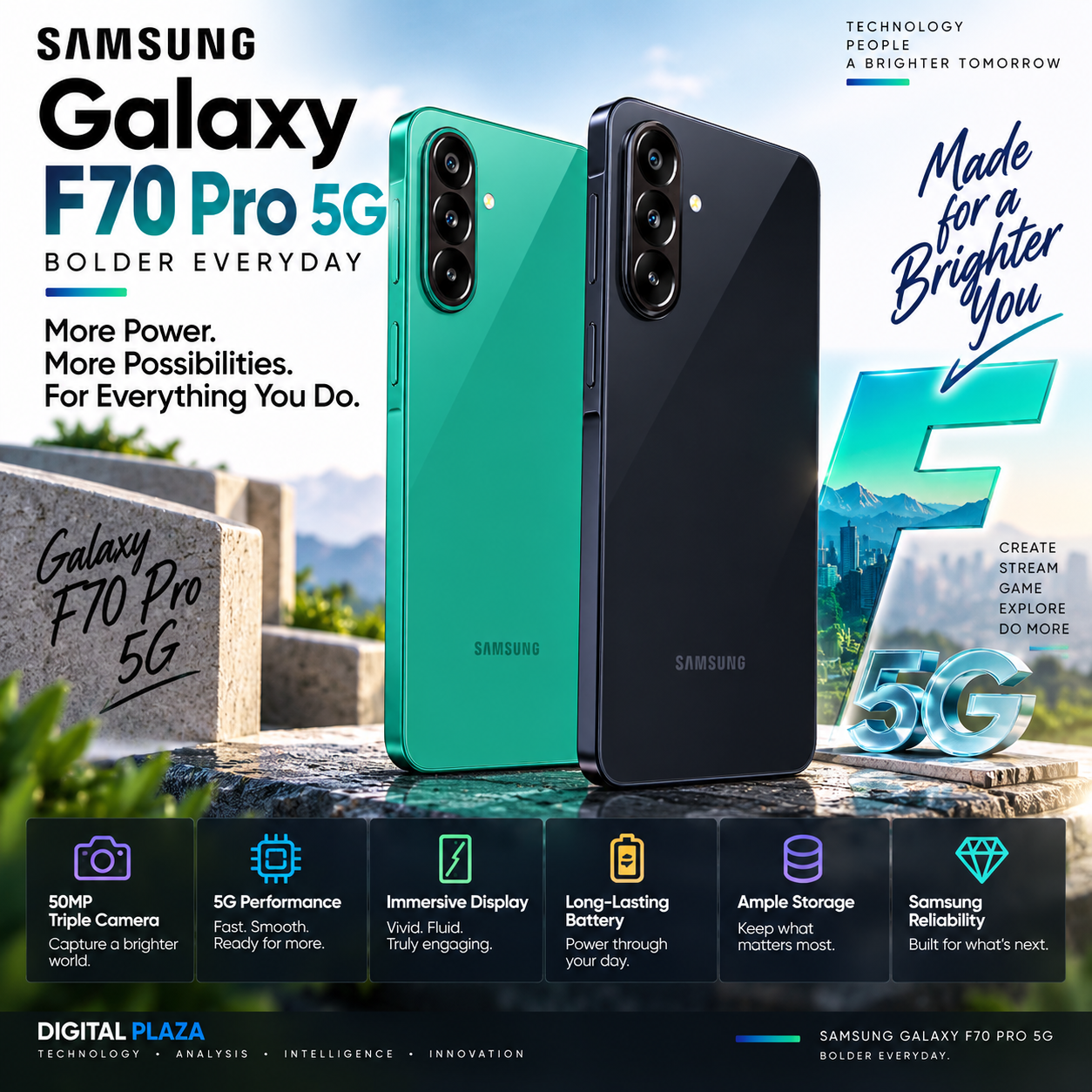
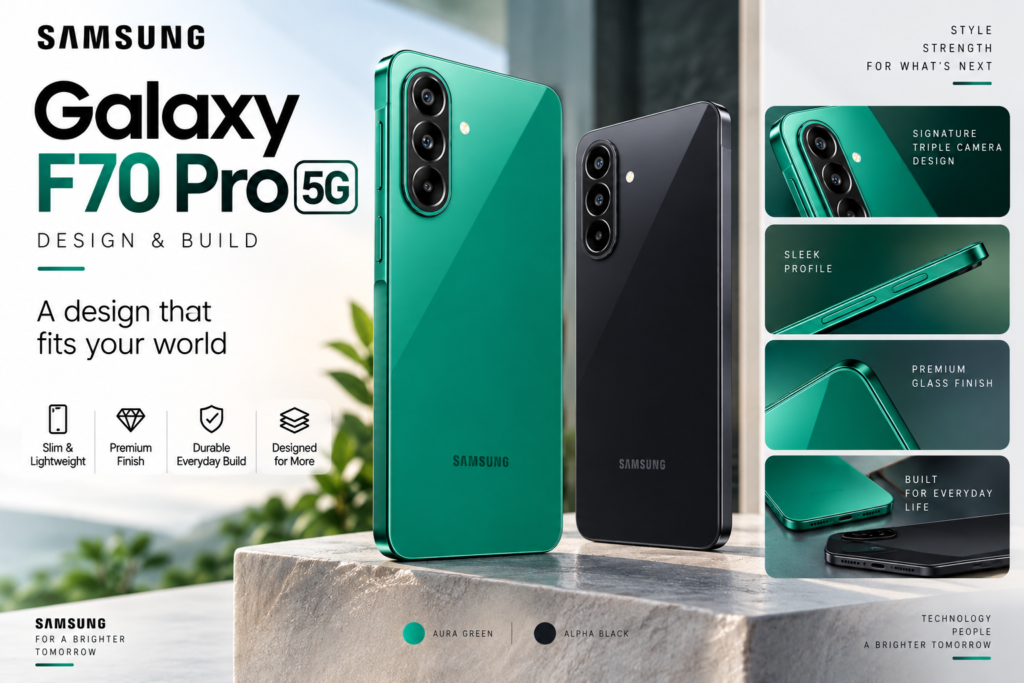
ColoursAlpha Black, Aura Green
Software support6 generations OS + 6 years security

Samsung’s official specification confirms the 6.7-inch FHD+ Super AMOLED panel, 120Hz refresh rate, Snapdragon-class 2.4GHz/1.8GHz processor configuration, 50MP + 5MP + 2MP rear camera system, 12MP front camera, 4K/30fps recording, microSD support up to 2TB, 6,000mAh battery and 45W charging.


Product & Market


Product Identity & Launch

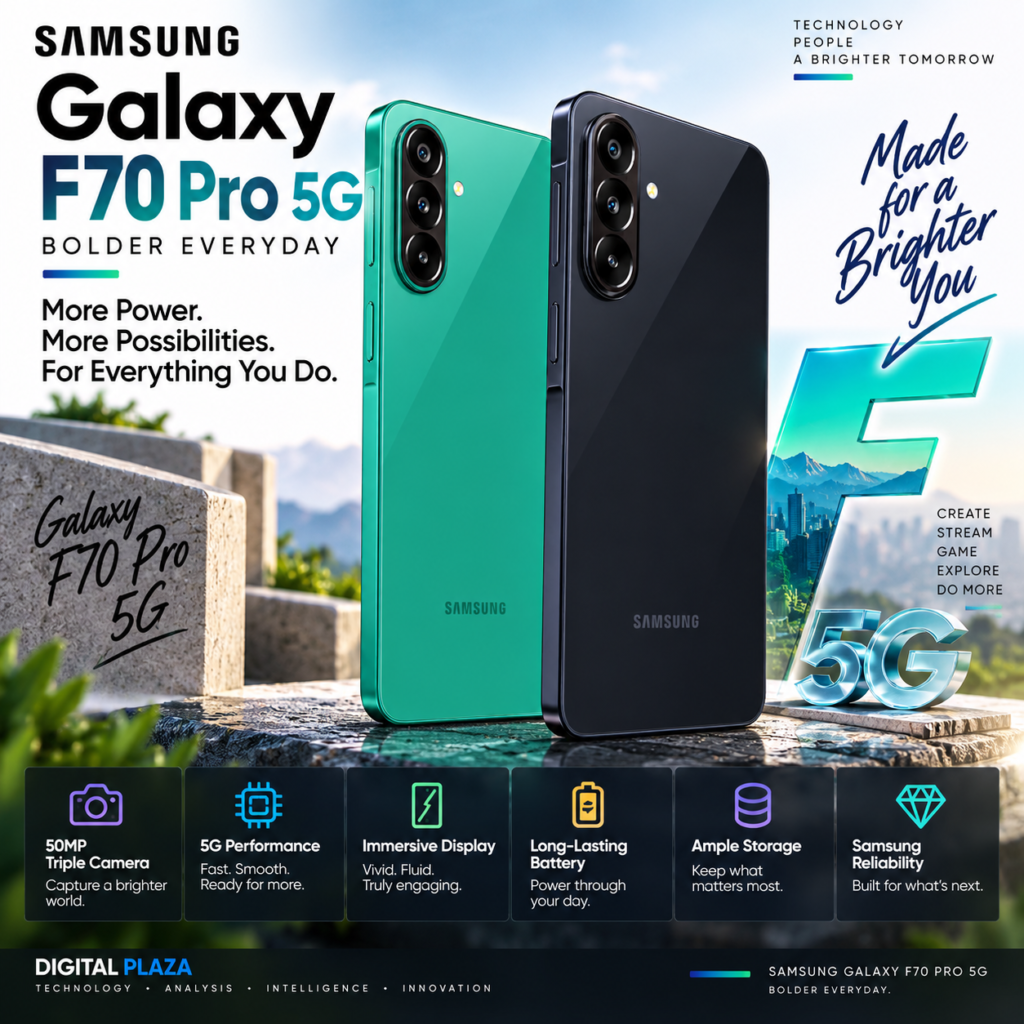
The Galaxy F70 Pro 5G is Samsung’s higher-positioned F-series smartphone for 2026. It launched in India on 3 August 2026, with Samsung positioning it around the idea of a creator-oriented, long-lasting smartphone rather than a pure performance device.

The launch range consisted of three configurations:

  • 6GB + 128GB — ₹25,999
  • 8GB + 128GB — ₹29,999
  • 8GB + 256GB — ₹34,999

Current market listings have already diverged from those launch prices, making configuration selection particularly important.

Market Positioning

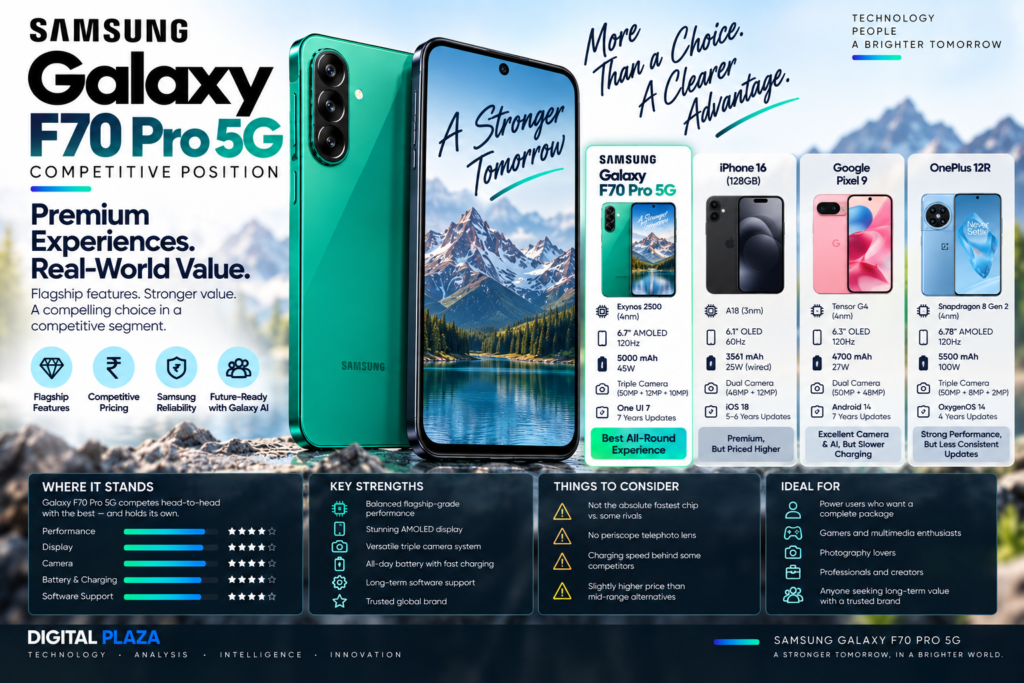
The F70 Pro sits in the increasingly competitive ₹25,000–₹35,000 segment.

Its positioning is unusual because Samsung is not trying to win primarily through silicon. The Snapdragon 6 Gen 3 is competent rather than class-leading. Instead, Samsung puts more emphasis on:

  • AMOLED quality
  • 120Hz smoothness
  • battery capacity
  • OIS
  • 4K video
  • NFC
  • long software support
  • Samsung’s One UI ecosystem

That makes the F70 Pro more of a long-term ownership smartphone than a benchmark-focused performance phone.

India Pricing & Variants

The entry 6GB/128GB model is the key to understanding the product.

At ₹25,999, it provides the core experience without forcing buyers into the ₹30,000-plus territory. The 8GB/128GB version becomes attractive for users planning longer ownership, while the 8GB/256GB version is aimed at users who need substantial local storage.

The problem is that the price ladder becomes increasingly difficult to justify as it approaches ₹35,000.

Current Market Price & Price Evolution

As of 5 September 2026, current listings show approximately ₹26,499 for 6GB/128GB, around ₹29,999–₹30,848 for 8GB/128GB and roughly ₹35,579 for 8GB/256GB, depending on retailer and configuration.

This means the F70 Pro should not have one static value judgment.

At ₹26,000: compelling.

At ₹30,000: selective.

At ₹35,000+: difficult to recommend on hardware value alone.

Design & Build

Design

The F70 Pro follows Samsung’s contemporary Galaxy design language: large display, relatively clean front, rounded corners and a substantial rear camera module.

It does not attempt to look radically different from Samsung’s other recent smartphones. That is a strength for users who prefer a familiar design, although buyers looking for a distinctive gaming-phone aesthetic will find it relatively restrained.


Dimensions, Weight & Ergonomics

The phone measures 162.4 × 78.2 × 8.1mm and weighs 206g.

That is a substantial handset.

The 6,000mAh battery inevitably contributes to the mass, but the 8.1mm thickness prevents it from becoming excessively bulky. The trade-off is straightforward: this is not a compact phone, but its size is justified by the display and battery.

For one-handed use, the width will matter more than the thickness.


Materials, Buttons & Ports

Independent reporting describes a glass front with a plastic frame and rear construction. The phone uses USB Type-C and a hybrid SIM/microSD arrangement.

The hybrid slot is useful for storage expansion but means users choosing microSD cannot simultaneously use two physical SIM cards in the conventional configuration.

There is no 3.5mm headphone jack.


Durability & Protection

Samsung officially highlights Corning Gorilla Glass Victus on the display and claims enhanced drop and scratch resistance.

Independent specifications list IP64 protection, meaning the device is dust-tight and protected against water splashes rather than designed for immersion.

That is a useful everyday protection package, but buyers should not interpret IP64 as equivalent to an IP67/IP68 water-resistance rating.


Display

Display Overview

The display is one of the F70 Pro’s strongest hardware arguments.

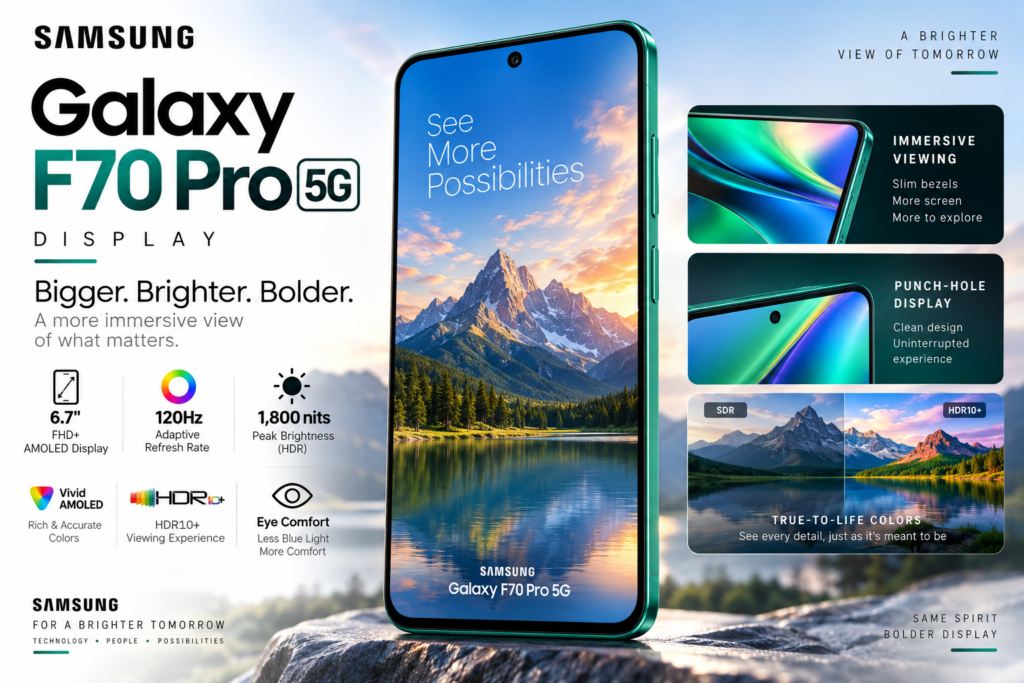
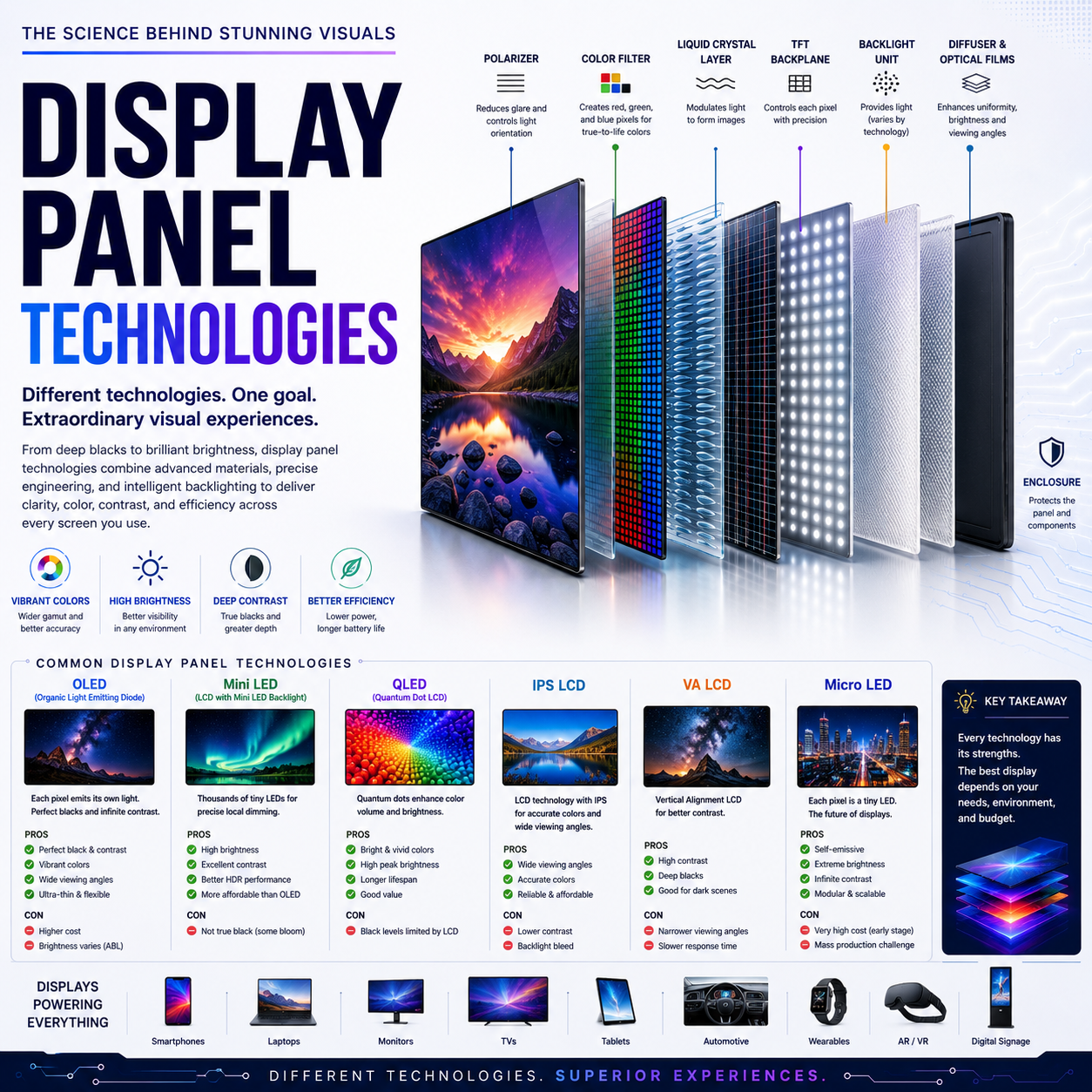
It uses a 6.7-inch FHD+ Super AMOLED panel with up to 120Hz refresh rate.

For this class, that combination provides the foundation for an excellent everyday visual experience.


Panel, Resolution & Pixel Density

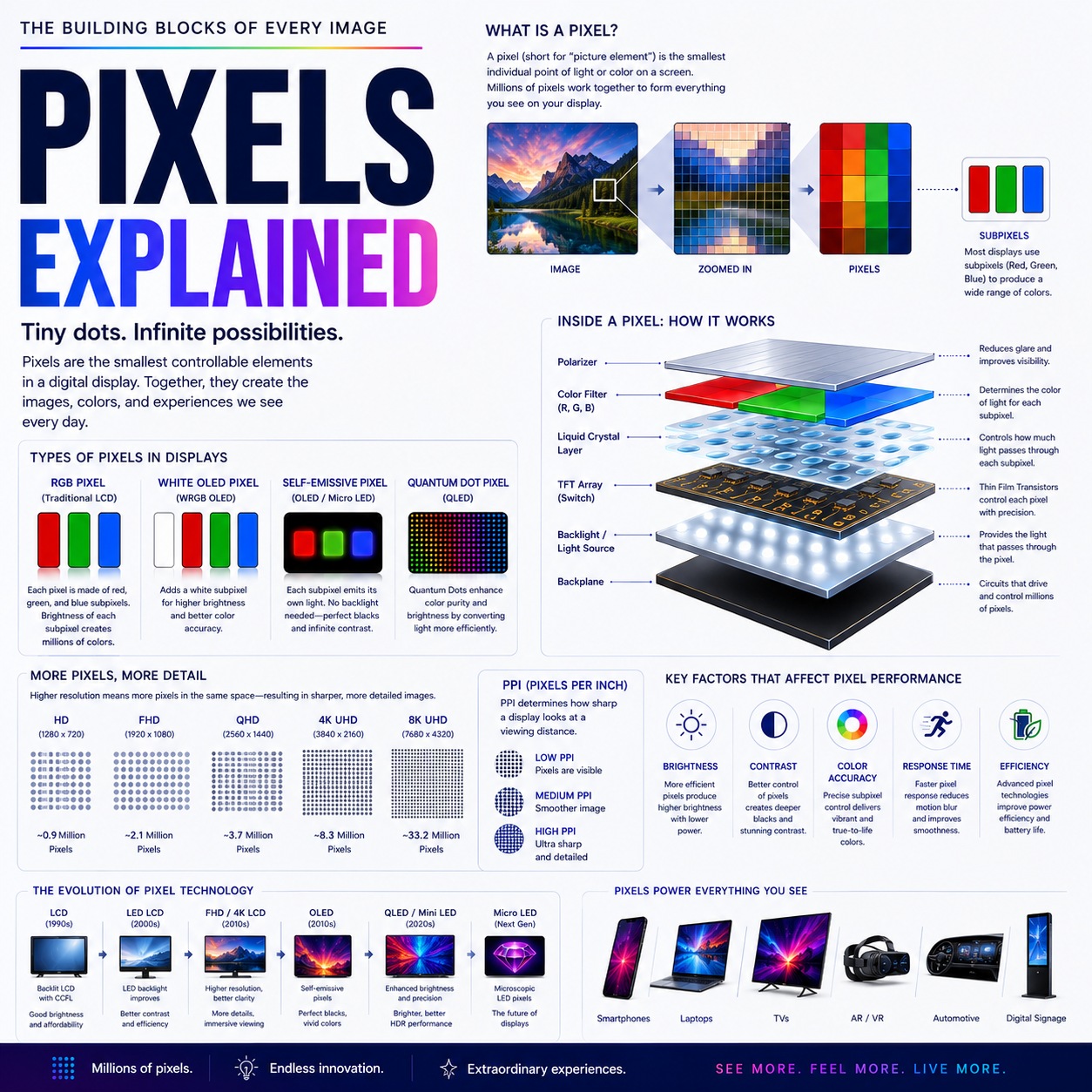
The resolution is 1080 × 2340 pixels, giving the panel sufficient pixel density for sharp text, images and video at normal viewing distances.

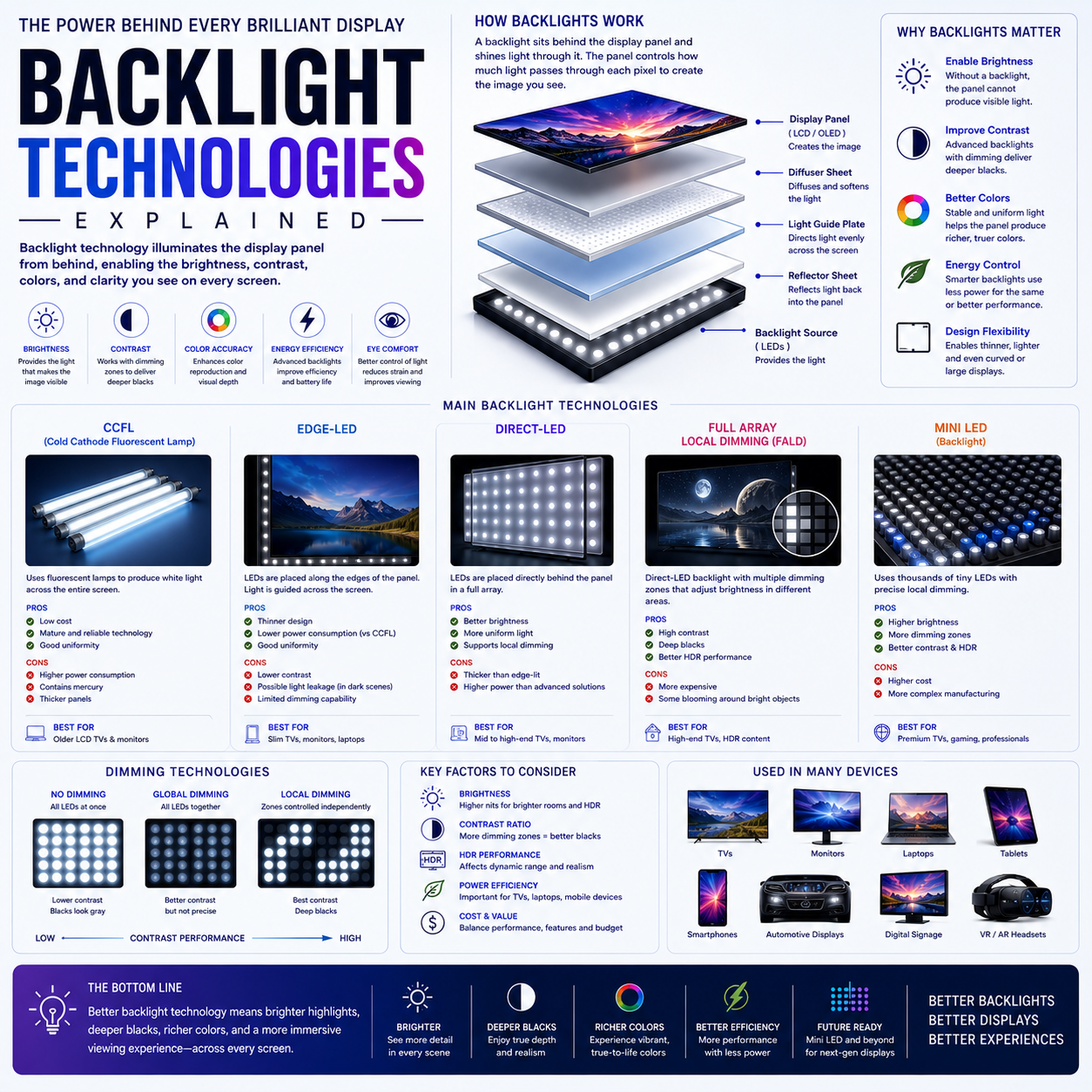
The Super AMOLED technology provides the usual strengths of OLED: deep blacks, high perceived contrast and strong colour separation.


Refresh Rate & Brightness

The maximum refresh rate is 120Hz, a meaningful upgrade over 60Hz and a useful advantage for scrolling, animations and supported games.

Samsung also promotes the phone’s outdoor visibility and reports a bright display experience, while independent reporting places peak brightness around the 1,200-nit territory.

The practical significance is greater than the headline number: the F70 Pro should remain much easier to view outdoors than a typical budget LCD.


Colour, Contrast & Outdoor Visibility

OLED’s fundamental contrast advantage makes the F70 Pro particularly well suited to:

  • Netflix and YouTube
  • photography
  • social media
  • reading
  • gaming
  • dark-mode interfaces

This is the type of display that can make a phone feel more expensive than its processor specification suggests.


Real-World Display Experience

The display is arguably the clearest reason to choose the F70 Pro over a more performance-oriented rival.

A 120Hz AMOLED panel changes the perceived responsiveness of the interface, while the large 6.7-inch size makes the phone well suited to video and document consumption.

For users who spend several hours per day looking at their phone, this is arguably more important than an incremental benchmark advantage.


Performance


Processor & Platform

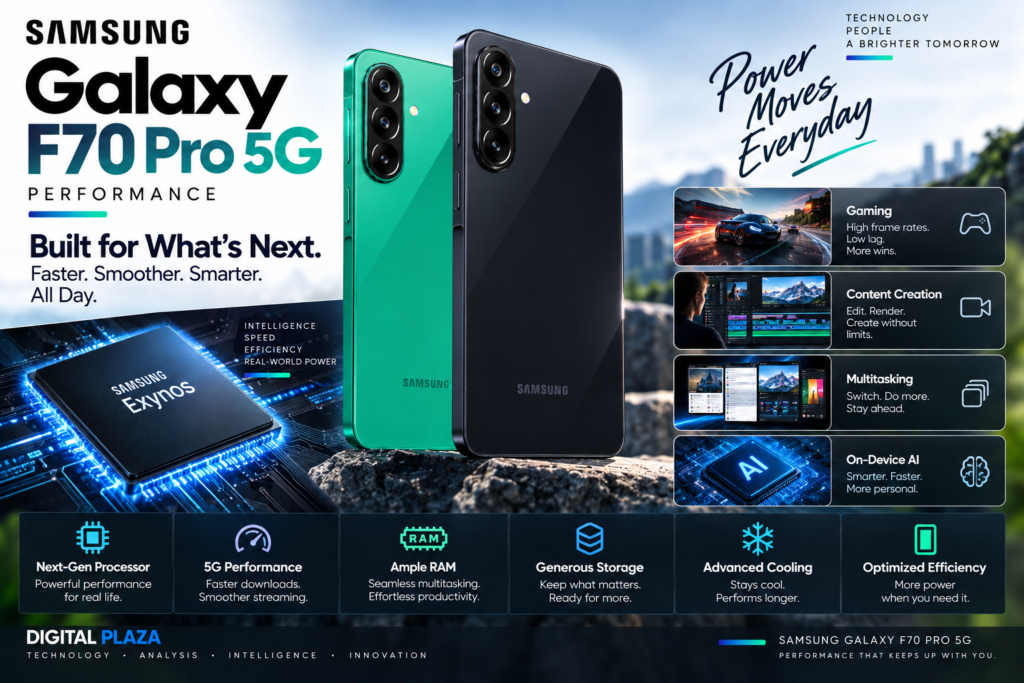
The Galaxy F70 Pro uses Qualcomm’s Snapdragon 6 Gen 3, manufactured on a 4nm process.

The CPU configuration consists of four performance-oriented Cortex-A78 cores at up to 2.4GHz and four efficiency Cortex-A55 cores at up to 1.8GHz, paired with an Adreno 710 GPU.

This is a modern mid-range platform, but not a performance flagship.


CPU & GPU Architecture

The architecture provides a sensible balance between everyday responsiveness and efficiency.

The four Cortex-A78 cores provide enough performance for mainstream applications, while the Cortex-A55 cluster handles lighter background tasks.

The Adreno 710 is capable of mainstream gaming, but it is not designed to compete with higher-end Snapdragon or Dimensity platforms.

That distinction matters.

The F70 Pro can be a good gaming phone for moderate users, but it should not be purchased primarily as a maximum-FPS device.


RAM & Storage

Samsung offers 6GB and 8GB RAM, with 128GB and 256GB storage options. LPDDR5X memory is advertised, although Samsung notes that the Snapdragon platform limits actual memory performance to approximately LPDDR5 levels.

The presence of microSD support up to 2TB is a major practical advantage for users who store large media libraries.

For long-term ownership, 8GB is preferable.


Benchmark Evidence

The available review evidence broadly characterises the Snapdragon 6 Gen 3 as competent rather than exceptional.

That matches the architecture.

There is no reason to expect flagship-level benchmark numbers from this platform, but neither is there a technical reason to expect poor everyday performance.

The appropriate interpretation is sufficient performance with a strong efficiency bias.


Everyday Performance & Multitasking

For normal use — Chrome, YouTube, WhatsApp, Instagram, banking, maps, email, photography and streaming — the F70 Pro should have enough processing capacity.

The 120Hz display also contributes to the perception of speed.

The more important question is long-term memory management. Here, 8GB has an advantage over 6GB, particularly as Android applications become larger and background processes become more demanding.


Heavy Workloads & Performance Longevity

This is where the F70 Pro gives ground to performance-oriented competitors.

The Snapdragon 6 Gen 3 is not a bad processor; it is simply not the reason to buy this phone.

If your workload includes sustained video editing, demanding 3D gaming, emulation or intensive AI processing, stronger silicon will deliver a more convincing experience.

For mainstream users, however, the platform should remain adequate for considerably longer than a low-end chipset would.

Gaming & Thermals


Gaming Performance

The F70 Pro is capable of mainstream gaming, but its priorities are clear.

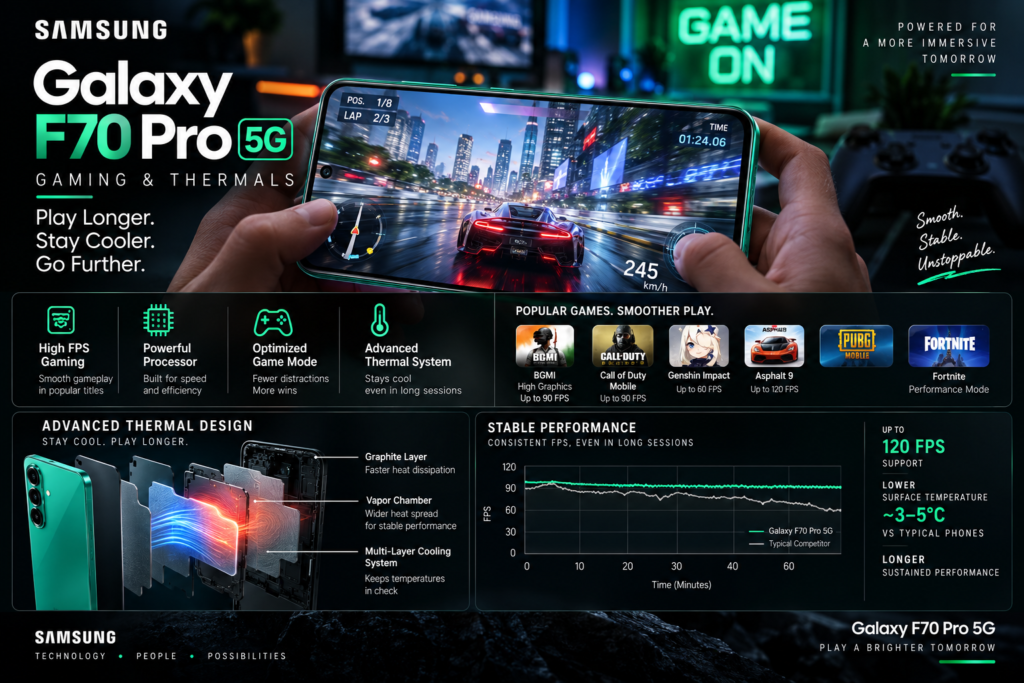
The combination of Snapdragon 6 Gen 3, 120Hz AMOLED and 6,000mAh battery creates a good casual-to-moderate gaming platform.

The important limitation is the GPU ceiling.

Games can run well at sensible settings, but users chasing the highest graphics settings and sustained frame rates should look toward phones using higher-tier Snapdragon or Dimensity silicon.


Game Settings & Frame Rates

External reviews describe the phone as suitable for moderate gaming, but available evidence does not justify presenting it as a gaming specialist.

That distinction is important because Samsung itself uses broad battery and gaming-duration claims under controlled conditions. Those claims should not be treated as equivalent to independent long-session benchmark testing.


Sustained Performance

The large battery gives the phone plenty of energy capacity, but battery size alone does not guarantee sustained peak performance.

The Snapdragon 6 Gen 3’s mid-range positioning means sustained workloads should be approached as an efficiency exercise rather than a performance showcase.


Thermal Behaviour

There is not enough independent, standardised thermal testing available to establish a precise sustained-temperature profile.

Accordingly, Digital Plaza should not claim a specific maximum temperature or thermal-throttling percentage.

The hardware configuration suggests a sensible balance between performance and efficiency, but thermal conclusions should remain provisional until comparable independent testing is available.

Camera


Camera System

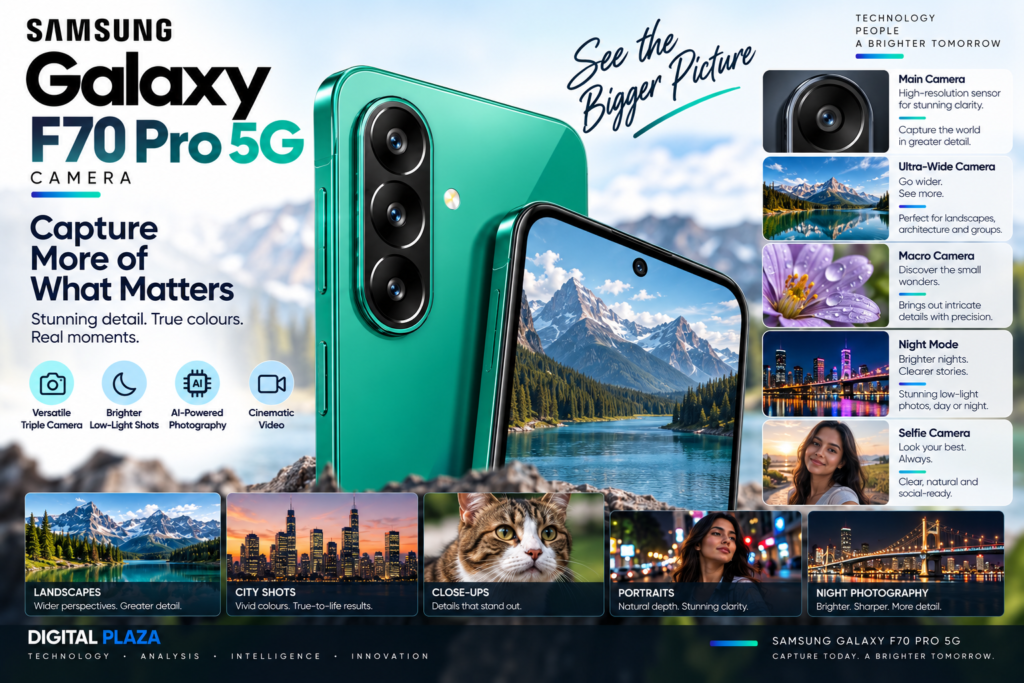
Samsung equips the F70 Pro with:

  • 50MP primary camera
  • 5MP ultrawide
  • 2MP macro
  • 12MP front camera

The main rear camera has OIS, while Samsung also promotes 4K video recording.

The system is therefore centred firmly on the primary camera.


Main Camera & OIS

The 50MP main sensor is the most important camera on the phone.

OIS is a meaningful advantage because it can reduce camera shake during handheld photography and video, particularly as light levels fall.

Samsung markets the F70 Pro’s main camera as a stabilised “No Shake Cam,” with the company specifically attributing that functionality to optical image stabilisation.

For this price class, OIS gives the primary camera a useful practical advantage.


Ultrawide, Macro & Selfie

The supporting cameras are considerably less ambitious.

The 5MP ultrawide provides compositional flexibility, but its lower resolution limits the amount of fine detail available compared with stronger 8MP, 12MP or higher-resolution ultrawide systems.

The 2MP macro camera is best understood as a supplementary feature rather than a major imaging capability.

The 12MP front camera is more interesting because Samsung positions it around HDR selfie performance.


Photography Quality

The F70 Pro’s camera philosophy is therefore straightforward:

Use the 50MP main camera whenever image quality matters.

The primary sensor benefits from OIS and a relatively wide f/1.8 aperture. In good lighting, it should provide the most convincing detail, dynamic range and colour consistency of the three rear cameras.

The ultrawide is useful when the wider perspective matters more than fine detail.


Low-Light & Night Photography

Low-light photography is one of the areas where the F70 Pro’s hardware limitations become more visible.

Independent reviews report that night photography can show noise and softness, particularly when compared with more camera-focused competitors.

OIS helps by allowing the camera to maintain steadier exposure, but stabilisation cannot completely compensate for sensor and image-processing limitations.

This is a capable everyday camera system, not a night-photography specialist.

Video


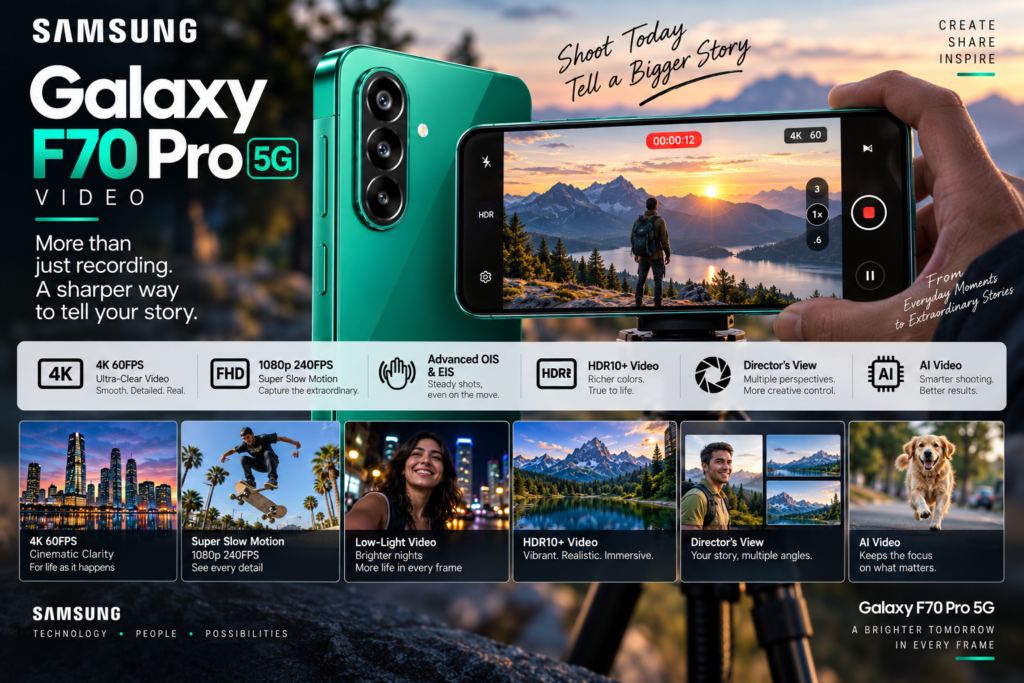
Video Recording & Stabilisation

The rear camera supports 4K video at 30fps, an important capability at this price. Samsung also lists HD slow motion at up to 240fps.

OIS provides a hardware foundation for steadier handheld recording.

This is a meaningful step above smartphones restricted to 1080p recording.

The caveat is that resolution alone does not determine video quality. Dynamic range, exposure transitions, stabilisation behaviour, audio quality and processing also matter.

Battery & Charging


Battery Capacity & Endurance

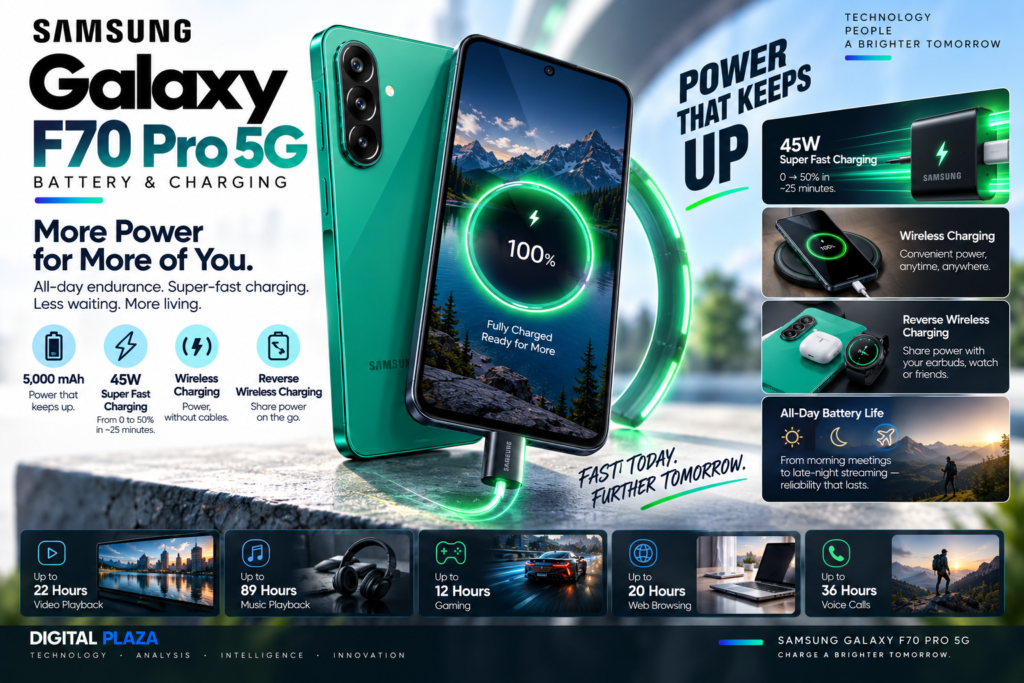
The 6,000mAh battery is one of the F70 Pro’s defining characteristics.

Samsung claims up to 24 hours of YouTube streaming under its controlled testing methodology.

That figure should not be treated as an expected universal runtime, but it establishes the phone’s battery-first design philosophy.

For normal mixed use, a 6,000mAh battery gives the F70 Pro substantial endurance headroom.


Real-World Battery Evidence

Independent assessments also identify battery life as one of the phone’s strongest characteristics.

The combination of a 4nm mid-range SoC, 6,000mAh battery and AMOLED display is inherently favourable for endurance.

Users who prioritise battery life over minimum weight should find this configuration particularly attractive.


Charging & Charger

Charging is rated at 45W.

That is respectable, but it is not class-leading in a market where some competitors offer 67W, 80W, 100W or faster charging.

The F70 Pro therefore chooses capacity over extreme charging speed.

That is a reasonable strategy, but the trade-off becomes more significant as the phone’s price rises.


Charger & Charging Ownership

The availability of a charger should be checked at the point of purchase because Samsung’s packaging and regional sales configurations can vary.

If the charger is not included, the effective ownership cost increases.

That should be incorporated into the purchase decision rather than treating ₹25,999 or ₹29,999 as the complete cost of ownership.

Software & Ownership


Android & One UI

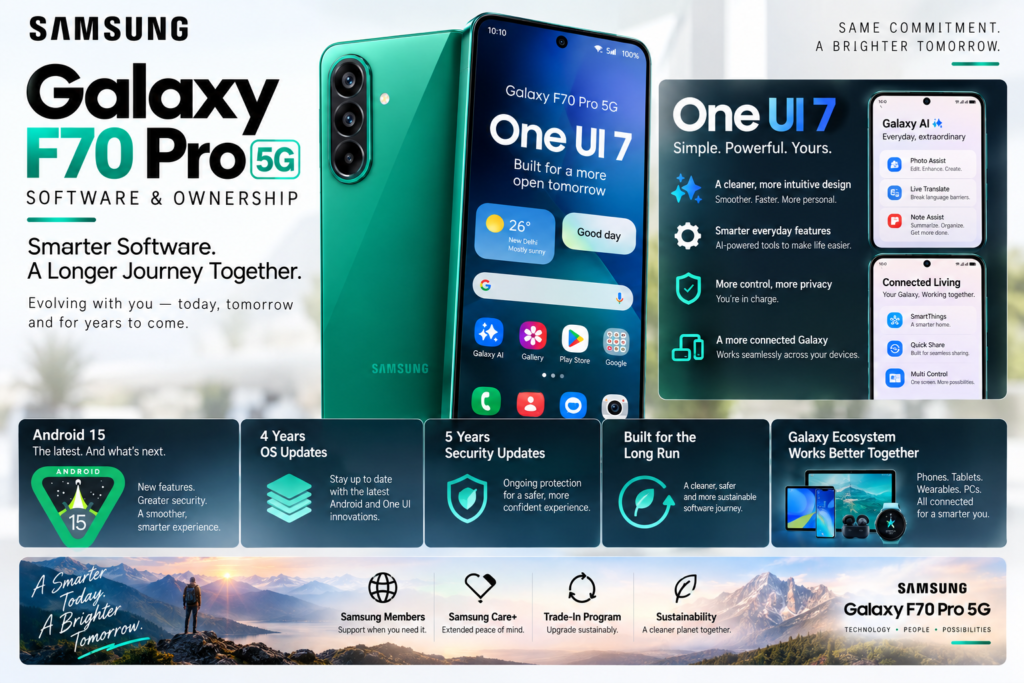
The Galaxy F70 Pro launched with Samsung’s current-generation software platform and is associated with One UI 8.5 / Android 16 in current product information.

Samsung’s software remains one of the phone’s strongest differentiators.

One UI provides a mature ecosystem, extensive customisation, Samsung services, Galaxy-device integration and a familiar interface for existing Samsung users.


AI Features

Samsung includes Circle to Search and Google Gemini functionality among the phone’s AI-oriented features.

These are more useful as practical interface tools than as reasons to buy the phone independently.

Circle to Search is particularly valuable for visual and contextual searches, while Gemini provides conversational assistance.

However, AI functionality is increasingly becoming a standard Android feature rather than a unique Galaxy differentiator.


Software Support & Long-Term Ownership

This is arguably the F70 Pro’s strongest long-term advantage.

Samsung promises six generations of OS upgrades and six years of security updates, with the official product information listing security support through 31 July 2032.

For a phone launched in 2026, that is a substantial ownership commitment.

It changes the economics of the purchase because a buyer can realistically plan to keep the device for many years without software support becoming the immediate reason for replacement.

This is one area where Samsung has a genuine strategic advantage over many competitors.

Connectivity & Everyday Experience


Connectivity, Audio & Sensors

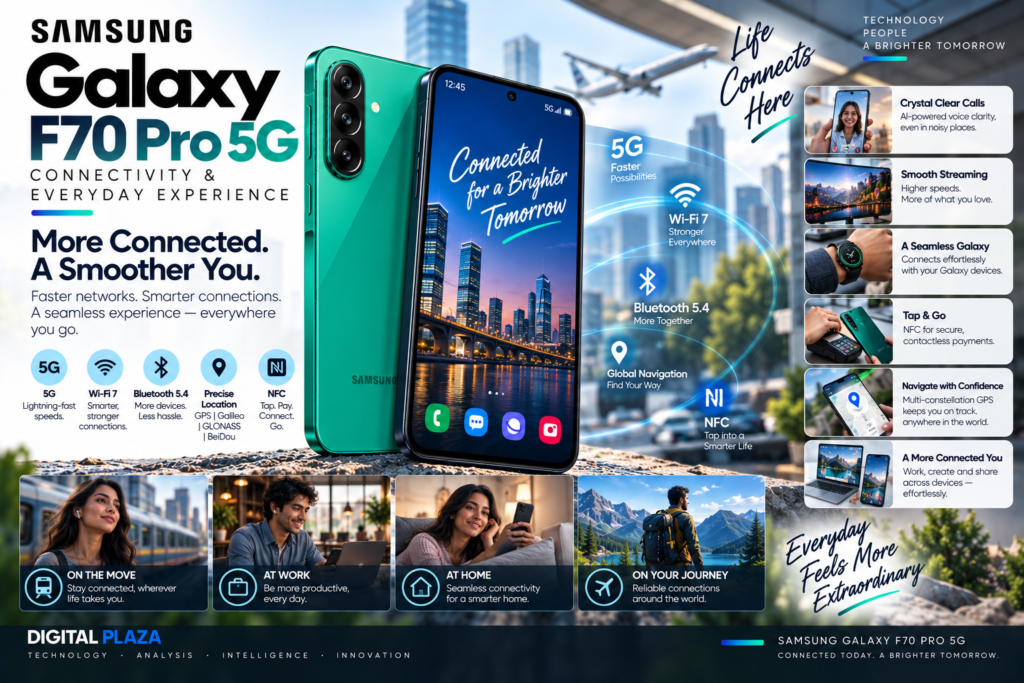
The F70 Pro supports 5G, Wi-Fi 5, Bluetooth 5.1, GPS, NFC and USB Type-C.

NFC is particularly useful for contactless payments and device-to-device functionality.

The phone also includes a gyroscope, accelerometer, geomagnetic sensor, light sensor, fingerprint sensor and virtual proximity sensing.

One notable limitation is the lack of stereo speakers.

Samsung’s official specifications list stereo support as unavailable, meaning media playback is less immersive than on phones equipped with dual-speaker systems.


Storage, SIM & Ecosystem

The hybrid SIM/microSD configuration gives users a choice between dual-SIM functionality and expandable storage.

That is increasingly unusual and therefore valuable.

Support for Samsung’s broader ecosystem also gives the F70 Pro an advantage for users who already own Galaxy Buds, Galaxy Watches or other Samsung devices.

Samsung lists extensive compatibility with its Galaxy ecosystem and SmartThings support.


Competitive Position

The Galaxy F70 Pro’s competitive position depends heavily on price.

At approximately ₹26,000, its combination of:

  • 120Hz Super AMOLED
  • 6,000mAh battery
  • 45W charging
  • 50MP OIS
  • 4K video
  • NFC
  • microSD
  • six generations of OS upgrades
  • six years of security support

creates a very complete ownership package.

Its weaknesses are equally clear:

  • Snapdragon 6 Gen 3 is not a performance leader
  • supporting cameras are modest
  • 45W charging is merely competitive
  • no stereo speakers
  • 206g weight
  • value deteriorates sharply above ₹30,000

The F70 Pro is therefore not the smartphone to buy when one specification matters above everything else.

It is the smartphone to consider when many fundamentals need to be good simultaneously.

Strengths

  • Excellent 120Hz Super AMOLED display
  • Large 6,000mAh battery
  • 50MP primary camera with OIS
  • 4K/30fps rear video
  • 45W charging
  • Snapdragon 6 Gen 3 is efficient and capable for mainstream workloads
  • microSD support up to 2TB
  • NFC
  • Gorilla Glass Victus
  • Long six-generation OS upgrade commitment
  • Six years of security support
  • Strong Samsung ecosystem integration

Weaknesses

  • Performance is not class-leading
  • 5MP ultrawide is relatively modest
  • 2MP macro camera adds limited value
  • Low-light photography is not a major strength
  • 45W charging trails faster competitors
  • No stereo speakers
  • 206g weight makes it a substantial handset
  • Value becomes questionable at ₹30,000+
  • 6GB RAM is less attractive for very long ownership

Who Should Buy / Skip

Buy the Galaxy F70 Pro 5G if:

You want a Samsung smartphone for several years, care about display quality and battery life, and want a dependable main camera with OIS.

It is especially compelling for people who spend a lot of time watching video, browsing social media, reading, using navigation and performing normal productivity tasks.

Skip it if:

Your primary priorities are maximum gaming performance, advanced zoom photography, extremely fast charging or the best possible hardware-per-rupee ratio.

In those cases, the F70 Pro’s balanced approach becomes a limitation rather than an advantage.


Recommended Configuration & Price

Best overall: 8GB + 256GB — if available close to ₹32,000 or below.

Best value: 6GB + 128GB — around ₹26,000–₹28,000.

The 8GB/128GB version is the middle ground, but its value depends entirely on how close its price is to the 256GB model.

The biggest rule is simple:

Do not overpay for the Galaxy F70 Pro merely because it is a Samsung.

At around ₹26,000, the overall package is strong.

At ₹35,000, the market changes dramatically.


Scorecard & Buying Decision

CategoryAssessment
Design & Build8.0/10
Display9.0/10
Performance7.0/10
Gaming6.8/10
Camera7.3/10
Video7.8/10
Battery9.0/10
Charging7.2/10
Software9.0/10
Connectivity8.2/10
Long-Term Ownership9.0/10
Value at ₹26K8.3/10
Value at ₹30K+7.0/10

Overall Score: 8.0/10

The 8.0/10 score represents the product as a whole, not a guarantee that it is worth every current asking price.

Its hardware strengths are concentrated in areas that affect everyday ownership: display, battery, software support, primary camera and ecosystem.

Its weaker areas — particularly raw performance and secondary cameras — prevent it from being a category leader.


Final Verdict

The Samsung Galaxy F70 Pro 5G is a well-balanced long-term Samsung smartphone rather than a performance monster.

Its strongest argument is the combination of a 120Hz Super AMOLED display, 6,000mAh battery, OIS-equipped 50MP main camera, 4K recording, NFC, expandable storage and an unusually long software-support commitment.

That combination gives the F70 Pro a very clear identity.

It is designed for the person who wants to buy a phone and keep it for years.

The Snapdragon 6 Gen 3 is capable enough for mainstream use, but it is not the reason to choose this phone. Similarly, the 5MP ultrawide and 2MP macro cameras provide flexibility but do not turn the F70 Pro into a camera specialist.

The real question is therefore price.

At approximately ₹26,000, the Galaxy F70 Pro 5G is a strong recommendation for buyers who value Samsung’s software ecosystem, AMOLED display quality and battery endurance.

Around ₹28,000–₹30,000, the decision becomes more dependent on personal priorities.

Above ₹30,000, the phone needs a meaningful discount or a specific Samsung/software/display/battery preference to remain compelling.

Digital Plaza Verdict: Buy it near the launch-price territory for the display, battery and long-term software support; at significantly higher prices, compare aggressively before buying.


Research Disclosure

This review is based on Samsung’s official product specifications, launch information and software-support commitments, supplemented by published third-party reviews and benchmark/usage evidence.

Digital Plaza does not claim to have physically tested the Galaxy F70 Pro 5G. Where battery, gaming, camera, thermal or benchmark results come from external publications or controlled manufacturer testing, they are treated as external evidence rather than Digital Plaza measurements.

Samsung’s own performance and battery claims are also interpreted within their stated testing conditions and should not be assumed to represent identical results for every user.

 

Deep Specification Chart

CategorySpecification
ProductSamsung Galaxy F70 Pro 5G
SeriesGalaxy F
Launch date3 August 2026
Starting price₹25,999
ColoursAlpha Black, Aura Green
Operating systemAndroid 16
UIOne UI 8.5
OS upgrades6 generations
Security support6 years
Security validityThrough 31 July 2032
Display size6.7-inch
Display technologySuper AMOLED
Resolution1080 × 2340
Aspect ratioApproximately 19.5:9
Refresh rateUp to 120Hz
Display protectionCorning Gorilla Glass Victus
ProcessorQualcomm Snapdragon 6 Gen 3
CPUOcta-core
CPU configuration4 × Cortex-A78 up to 2.4GHz + 4 × Cortex-A55 up to 1.8GHz
Process4nm
GPUAdreno 710
RAM6GB / 8GB
Memory technologyLPDDR5X hardware platform; Samsung notes effective platform performance up to LPDDR5 levels
Storage128GB / 256GB
Expandable storagemicroSD up to 2TB
SIMDual Nano-SIM
SIM configurationSIM 1 + Hybrid SIM/microSD
Rear camera50MP + 5MP + 2MP
Main camera aperturef/1.8
Ultrawide aperturef/2.2
Macro aperturef/2.4
AutofocusRear AF supported
OISMain rear camera
Digital zoomUp to 10×
Front camera12MP
Front aperturef/2.2
Front AFNo
Rear video4K 30fps
Slow motion240fps HD
Battery6,000mAh typical
Charging45W
Video playback claimUp to 28 hours listed by Samsung
5GSub-6 5G
5G bandsn1, n3, n5, n7, n8, n28, n66, n38, n40, n41, n78
Wi-Fi802.11a/b/g/n/ac, 2.4GHz + 5GHz
Bluetooth5.1
NFCYes
USBUSB Type-C
USB standardUSB 2.0
3.5mm jackNo
Stereo speakersNo
FingerprintYes
GyroscopeYes
AccelerometerYes
CompassYes
Proximity sensingVirtual
Dimensions162.4 × 78.2 × 8.1mm
Weight206g
DeXNo
SmartThingsYes
Expandable storageYes, up to 2TB
Ecosystem supportGalaxy accessories / SmartThings
Official support horizon2032 security support

Official specifications and support information are sourced primarily from Samsung’s India product pages.