Meta Description
Understand processor power and thermal architecture and why heat, voltage, frequency and cooling determine real-world performance. Explore dynamic power, leakage power, power density, DVFS, power gating, clock gating, TDP, peak and sustained power, thermal limits, thermal throttling, thermal resistance, heat spreaders, thermal interface materials, heat pipes, vapor chambers, active and passive cooling, performance per watt, energy efficiency and power management. Learn how CPU, GPU, NPU and SoC thermal behavior affects smartphones, tablets, laptops, desktops, workstations and servers, and why sustained performance matters beyond peak benchmarks.
In One Sentence
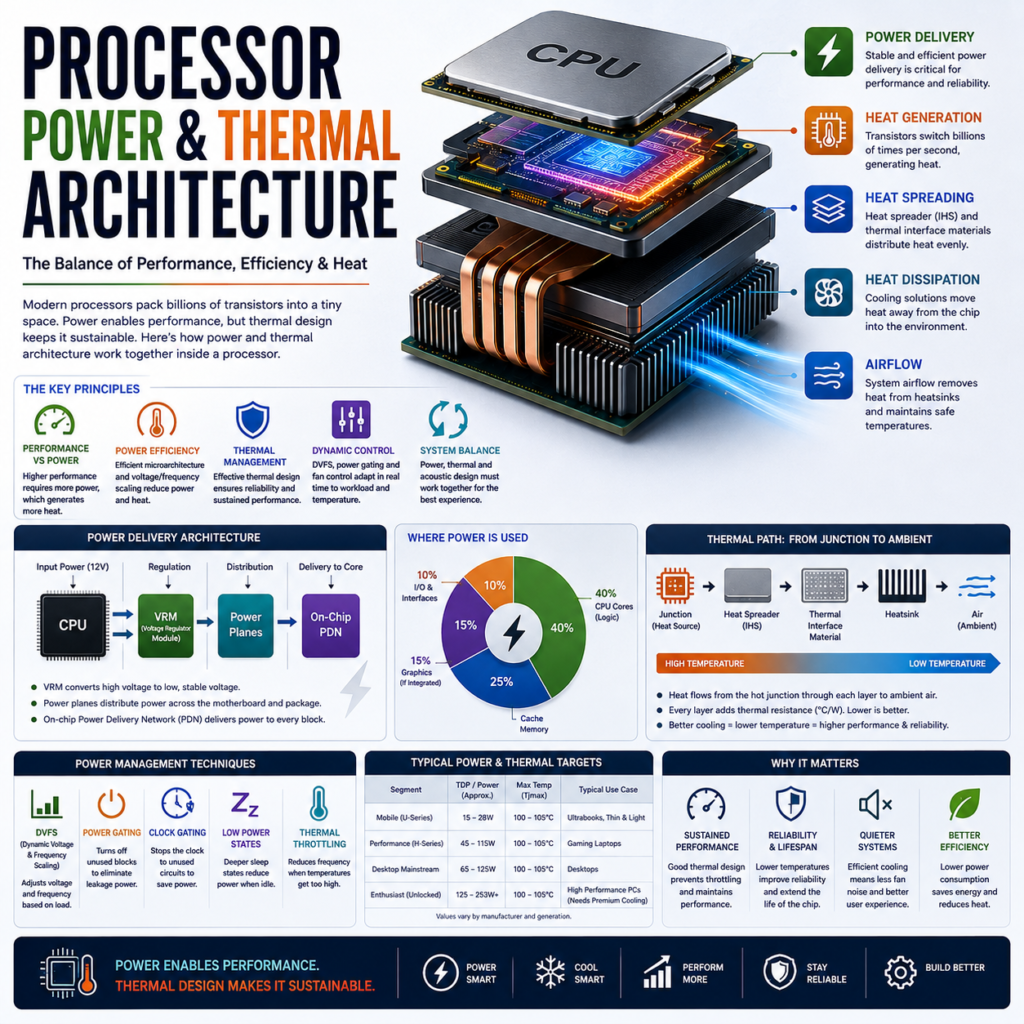
Processor power and thermal architecture determines how much electrical energy a CPU, GPU, NPU or SoC consumes, how that energy becomes heat, how effectively the system removes the heat, and ultimately how much performance the processor can sustain within its electrical, thermal, acoustic and physical limits.
Introduction: Performance Has a Physical Limit
Modern processors can execute enormous numbers of operations every second.
But there is a fundamental constraint:
electricity becomes heat.
The more power a processor consumes, the more heat the system generally has to remove.
The basic relationship is:
Electrical Power
      ↓
Energy Consumption
      ↓
Heat Generation
      ↓
Temperature
      ↓
Thermal Management
      ↓
Sustained Performance
This is why a processor’s peak benchmark score does not necessarily describe its long-term performance.
1. Full Definition: What Is Processor Power?
Processor power is the rate at which a processor or processing subsystem consumes electrical energy while performing work or remaining in a particular operating state.
It is measured in:
watts (W).
Power consumption can vary dramatically depending on:
- workload
- voltage
- frequency
- number of active cores
- instruction type
- memory activity
- accelerator utilization
- operating temperature
- software
2. What Is Thermal Architecture?
Thermal architecture is the combination of semiconductor, package, mechanical, cooling and control technologies used to manage heat generated by a processor.
It can include:
- heat spreaders
- thermal interface materials
- heat pipes
- vapor chambers
- heatsinks
- fans
- liquid cooling
- chassis materials
- thermal sensors
- power-management algorithms
The objective is:
Move heat away from the silicon fast enough to maintain safe and useful performance.
3. Power vs Energy
These terms are often confused.
Power
The rate of energy consumption.
Measured in watts.
Energy
The total amount consumed over time.
Measured in joules or watt-hours.
Conceptually:
Energy = Power × Time
A processor can consume high power for a short period and still use less total energy than a slower processor that runs for much longer.
4. Dynamic Power
A simplified CMOS dynamic-power relationship is:
P ≈ α × C × V² × f
Where:
- P = dynamic power
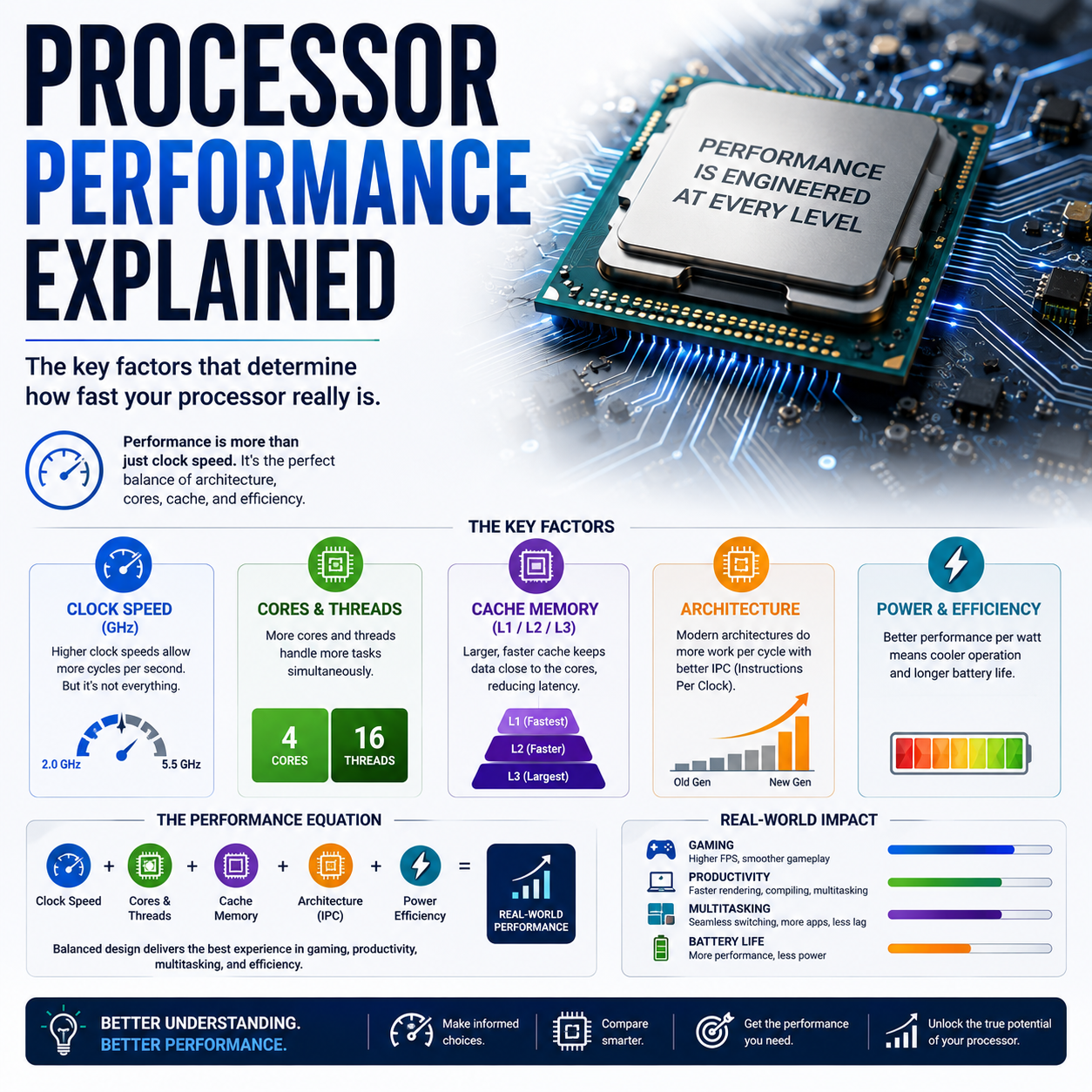
- α = switching activity
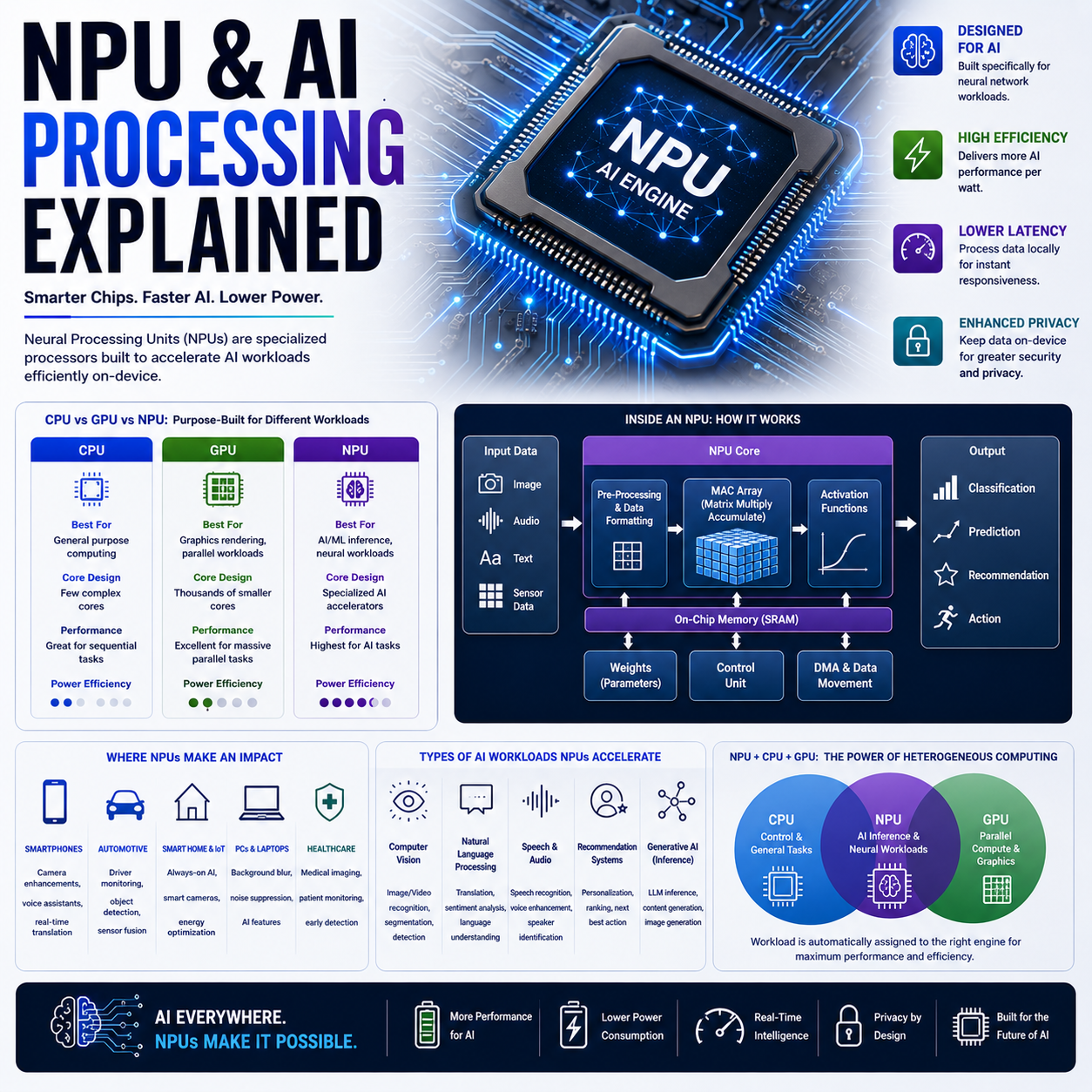
- C = effective capacitance
- V = voltage
- f = frequency
This equation reveals something extremely important:
Power increases strongly with voltage and frequency.
5. Why Voltage Matters So Much
Because voltage is squared in the simplified dynamic-power relationship:
P ∝ V²
reducing voltage can provide substantial dynamic-power savings.
But voltage cannot be reduced indefinitely.
At some point, transistors cannot switch reliably at the desired frequency.
This creates a fundamental trade-off:
Higher Frequency
      ↓
Higher Voltage
      ↓
Higher Power
      ↓
More Heat
6. Frequency and Power
Increasing frequency generally increases switching activity.
For a simplified model:
Higher f
 ↓
More switching per second
 ↓
Higher dynamic power
This is why simply increasing CPU or GPU clock speed eventually becomes expensive in power and thermal terms.
7. Leakage Power
Not all processor power comes from active switching.
Transistors can consume power even when they are not actively performing useful switching.
This is:
leakage power.
Leakage is affected by:
- transistor design
- voltage
- temperature
- semiconductor process
- device dimensions
8. Temperature and Leakage
Temperature can influence leakage.
Conceptually:
Higher Temperature
        ↓
Greater Leakage
        ↓
Higher Power
        ↓
More Heat
This creates a potentially undesirable feedback loop.
Modern semiconductor design therefore pays considerable attention to thermal and leakage management.
9. Static vs Dynamic Power
| Type | Description |
|---|
| Dynamic Power | Power associated primarily with switching activity |
| Leakage / Static Power | Power consumed due to transistor leakage and related mechanisms |
Modern processors experience both.
10. Power Density
A chip may consume a certain number of watts, but the physical concentration of that power matters.
Power density refers broadly to power consumed per unit area.
A small chip consuming substantial power can produce significant local heat density.
This becomes increasingly challenging as semiconductor integration rises.
11. Why Smaller Transistors Do Not Solve Everything
Advanced semiconductor processes can improve energy efficiency.
But modern chips also integrate more functionality.
For example:
New Process
 ↓
More Efficient Transistors
 ↓
More Transistors
 ↓
More Compute
 ↓
Potentially More Total Power
Therefore:
Better process technology can improve efficiency while total chip power still increases.
12. Power Management
Modern processors continuously adjust their operating state.
They may change:
- voltage
- frequency
- active cores
- power domains
- sleep states
according to workload.
This is called:
dynamic power management.
13. DVFS
DVFS = Dynamic Voltage and Frequency Scaling.
It adjusts voltage and frequency dynamically.
Conceptually:
Light Workload
 ↓
Lower Frequency
 ↓
Lower Voltage
 ↓
Lower Power

Heavy Workload
 ↓
Higher Frequency
 ↓
Higher Voltage
 ↓
Higher Performance
DVFS is fundamental to modern mobile and PC processors.
14. Performance States
Processors can operate at different performance states.
A simplified model:
P-State 1 → Low Power
P-State 2 → Moderate Power
P-State 3 → High Performance
P-State 4 → Peak Performance
The operating system and processor hardware can select appropriate states dynamically.
15. Idle States
When a processor is not actively working, it can enter lower-power states.
These may:
- reduce clock activity
- shut down parts of the processor
- save power
- reduce heat generation
Modern processors therefore spend substantial time operating below maximum performance.
16. Power Gating
Power gating turns off power to unused portions of a processor.
For example:
CPU
├── Core 1 → ON
├── Core 2 → ON
├── Core 3 → OFF
└── Core 4 → OFF
This reduces unnecessary power consumption.
17. Clock Gating
Clock gating stops the clock signal to inactive circuitry.
Conceptually:
Inactive Block
 ↓
Clock Disabled
 ↓
Less Switching
 ↓
Lower Dynamic Power
Clock gating can save dynamic power without completely removing power from the block.
18. Power Domains
Large SoCs can divide hardware into separate power domains.
For example:
SoC
│
├── CPU Domain
├── GPU Domain
├── NPU Domain
├── ISP Domain
├── DSP Domain
└── Media Domain
Each domain can be managed independently.
19. Why SoCs Need Fine-Grained Power Management
A smartphone does not need:
- GPU at maximum power while reading email
- NPU at maximum power while displaying a static image
- modem at maximum activity when disconnected
Fine-grained control allows unused hardware to consume much less power.
20. TDP
TDP = Thermal Design Power.
TDP is a platform/design concept associated with the amount of heat a cooling solution is expected to handle under defined conditions.
It should not automatically be interpreted as:
“the exact maximum electrical power the CPU consumes.“
Different manufacturers define and use TDP differently.
Therefore:
TDP should always be interpreted according to the manufacturer’s methodology.
21. TDP vs Actual Power
A processor may have:
TDP = X watts
while actual electrical power varies with workload and operating state.
For example:
Idle
 ↓
Low Power

Typical Workload
 ↓
Moderate Power

Heavy Workload
 ↓
High Power

Short Boost
 ↓
Potentially Higher Power
This is why measured power is valuable in reviews.
22. Peak Power
Peak power refers to power consumed during particularly demanding or transient conditions.
It can matter for:
- VRM design
- battery systems
- cooling
- power adapters
- motherboard design
Peak power and sustained power are different.
23. Sustained Power
Sustained power is the level of power a processor can maintain during a prolonged workload.
It depends on:
- cooling
- thermal limits
- power limits
- chassis
- ambient temperature
A laptop processor may operate very differently from the same silicon in a desktop system.
24. Thermal Design Power vs Thermal Limit
These are different concepts.
Thermal Design Power
A design target associated with cooling requirements.
Thermal Limit
A temperature or control boundary at which the processor takes action to protect itself.
When a processor approaches its thermal limit, it may reduce performance.
25. Thermal Throttling
Thermal throttling occurs when processor performance is reduced because temperature reaches a defined limit.
Conceptually:
Heavy Workload
 ↓
High Power
 ↓
Heat
 ↓
Temperature Rises
 ↓
Thermal Limit
 ↓
Frequency / Voltage Reduction
 ↓
Lower Power
This protects the device but can reduce sustained performance.
26. Thermal Throttling vs Power Throttling
Performance can be reduced for different reasons.
Thermal throttling
Temperature is too high.
Power limiting
The processor has reached an electrical power budget.
Therefore:
Performance Limit
├── Thermal
├── Power
└── Other System Constraints
These should not be treated as identical.
27. Thermal Headroom
Thermal headroom is the remaining temperature margin before a defined thermal limit is reached.
More headroom allows the processor to maintain higher performance for longer under suitable conditions.
28. Sustained Performance
Sustained performance describes how well a processor maintains useful performance over an extended workload.
This is particularly important for:
- gaming
- video rendering
- long AI workloads
- compiling
- scientific computing
- extended benchmarks
Peak performance tells only part of the story.
29. Peak vs Sustained Performance
| Metric | Meaning |
|---|
| Peak Performance | Maximum or near-maximum short-duration capability |
| Sustained Performance | Performance maintained over extended workloads |
| Burst Performance | Short high-performance periods |
| Throttled Performance | Performance after thermal/power constraints intervene |
For mobile devices, sustained performance can be especially revealing.
30. Heat
Electrical power consumed by processor circuitry ultimately contributes to heat generation.
A simplified conceptual relationship is:
Power
 ↓
Heat Generation
 ↓
Thermal Load
The challenge is then moving the heat away from the silicon.
31. Thermal Resistance
Thermal resistance describes how difficult it is for heat to move from one point to another.
It is commonly expressed in:
°C/W
Lower thermal resistance generally means that a given amount of power produces a smaller temperature rise relative to the reference point.
A simplified relationship is:
Temperature Rise
≈
Power × Thermal Resistance
32. Heat Spreader
A heat spreader distributes heat over a larger area.
Conceptually:
Hot Die
  ↓
Heat Spreader
  ↓
Larger Area
  ↓
Cooling System
This reduces localized thermal concentration.
33. Thermal Interface Material
TIM = Thermal Interface Material.
TIM fills microscopic gaps between surfaces to improve thermal conduction.
For example:
Die
 ↓
TIM
 ↓
Heat Spreader
 ↓
Cooler
The quality and thickness of the interface affect thermal performance.
34. Heat Sink
A heat sink increases the surface area available for heat transfer.
Processor
 ↓
Heat Sink
 ↓
Large Surface Area
 ↓
Air
Desktop processors commonly use substantial heatsinks.
35. Heat Pipes
Heat pipes transfer heat efficiently from a hot area to a cooler area.
They are common in:
- laptops
- gaming systems
- compact computers
36. Vapor Chambers
A vapor chamber is a flat heat-transfer device that spreads heat across a larger area.
It is increasingly used in:
- smartphones
- tablets
- laptops
- graphics hardware
Conceptually:
Hot SoC
  ↓
Vapor Chamber
  ↓
Heat Spread
  ↓
Chassis / Cooler
This is particularly useful in thin devices.
37. Active Cooling
Active cooling uses powered airflow or another active mechanism.
Examples include:
The advantage is greater heat-removal capability.
The disadvantage can include:
- noise
- power consumption
- size
- mechanical complexity
38. Passive Cooling
Passive cooling relies primarily on:
- heat spreading
- natural convection
- chassis materials
- thermal conduction
It is common in:
- smartphones
- tablets
- fanless laptops
It is silent but thermally constrained.
39. Smartphone Thermal Architecture
A smartphone has extremely limited physical space.
A simplified system:
SoC
 ↓
Thermal Interface
 ↓
Vapor Chamber
 ↓
Graphite / Chassis
 ↓
Ambient Air
Because there is no large desktop-style heatsink and fan, sustained performance is heavily constrained by thermal design.
40. Laptop Thermal Architecture
A laptop may use:
- heat pipes
- vapor chambers
- fans
- heatsinks
- multiple thermal zones
A simplified system:
CPU / GPU
    ↓
Heat Pipe / Vapor Chamber
    ↓
Heatsink
    ↓
Fan
    ↓
Exhaust
The available cooling capacity strongly influences sustained performance.
41. Desktop Thermal Architecture
Desktop PCs have substantially more room for cooling.
They can use:
- large air coolers
- liquid coolers
- multiple fans
- large heatsinks
This enables higher sustained power levels.
42. Server Thermal Architecture
Data centers face an even larger challenge.
Thousands of processors operating continuously produce enormous heat loads.
Cooling can involve:
- high-volume airflow
- sophisticated heat exchangers
- liquid cooling
- direct-to-chip cooling
- immersion approaches in specialized systems
Therefore:
Thermal architecture is an infrastructure-level concern in data centers.
43. Power Delivery
Processors require stable electrical power.
A computing platform therefore includes:
- voltage regulators
- power-management controllers
- power rails
- filtering
- power-delivery networks
Conceptually:
Power Supply
 ↓
Voltage Regulation
 ↓
Processor Power Rails
 ↓
CPU / GPU / NPU
44. Voltage Regulator
A voltage regulator converts incoming electrical power into the voltages required by processor circuitry.
Modern processors can require multiple voltage domains.
Power delivery must respond rapidly to changing workload demand.
45. Transient Power
Processor workloads can change rapidly.
For example:
Idle
 ↓
Sudden Workload
 ↓
Rapid Power Increase
The power-delivery system must respond without unacceptable voltage instability.
This is known as managing:
transient load behavior.
46. Battery-Powered Devices
For smartphones and laptops, power efficiency directly affects:
- battery life
- device temperature
- sustained performance
- chassis thickness
Therefore:
Processor Efficiency
 ↓
Lower Energy / Work
 ↓
Longer Battery Potential
 ↓
Less Heat
 ↓
Better Sustained Performance
47. Performance Per Watt
One of the most important modern processor metrics is:
performance per watt.
Conceptually:
Performance
────────────
   Power
Higher performance per watt generally means better energy efficiency.
48. Energy Per Task
Another useful metric is:
energy per completed task.
For example:
Processor A
→ 100 J to complete workload

Processor B
→ 70 J to complete workload
Processor B is more energy-efficient for that workload, assuming equivalent output and conditions.
49. Race to Idle
A processor may sometimes complete a task quickly at higher power and then return to an efficient idle state.
Conceptually:
Fast Execution
 ↓
Task Complete
 ↓
Deep Idle
This can sometimes be more energy-efficient than running at low performance for a much longer period.
Therefore:
Lower instantaneous power does not always mean lower total energy consumption.
50. Smartphone Performance Management
Smartphones continuously balance:
Performance
     ↕
Power
     ↕
Temperature
     ↕
Battery
The operating system and SoC power-management hardware dynamically adjust resources.
51. CPU + GPU + NPU Power Sharing
A modern SoC may have several active engines:
CPU ─┐
GPU ─┤
NPU ─┼── Shared Power / Thermal Budget
ISP ─┤
DSP ─┘
If CPU, GPU and NPU all run intensive workloads simultaneously, the SoC may need to redistribute power.
52. Thermal Budget
A system has a practical limit on how much heat it can continuously dissipate.
This is the:
thermal budget.
A processor may have enormous theoretical performance but cannot sustain it indefinitely if the device cannot remove the resulting heat.
53. Thermal Density
Two processors can consume the same total power but behave differently thermally.
For example:
Chip A
100 W across large area

Chip B
100 W concentrated in small area
Chip B may be more difficult to cool because of higher local thermal density.
54. Ambient Temperature
Cooling performance depends partly on the environment.
A device operating at:
20°C ambient
can have substantially more thermal headroom than the same device operating at:
40°C ambient.
Therefore thermal testing should report environmental conditions.
55. Cooling and Form Factor
Physical size strongly influences thermal capability.
A simplified hierarchy:
Smartphone
 ↓
Tablet
 ↓
Thin Laptop
 ↓
Desktop
 ↓
Server
This is not an absolute performance ranking, but larger systems generally have more options for heat dissipation.
56. Processor Power Specification Table
| Metric | Meaning |
|---|
| Power | Rate of energy consumption |
| Energy | Total energy consumed |
| TDP | Thermal design metric defined by platform/vendor methodology |
| Peak Power | Short-duration high power |
| Sustained Power | Long-duration operating power |
| Voltage | Electrical potential applied to circuitry |
| Frequency | Clock cycles per second |
| DVFS | Dynamic voltage/frequency control |
| Leakage | Unwanted transistor current |
| Thermal Limit | Temperature boundary |
| Thermal Headroom | Remaining temperature margin |
| Thermal Resistance | Resistance to heat transfer |
| Performance/Watt | Performance relative to power |
57. Thermal Testing
A strong processor review should test:
Short benchmark
Measures peak performance.
Long benchmark
Measures sustained performance.
Temperature
Measures thermal behavior.
Power
Measures electrical consumption.
Performance retention
Measures how much performance remains after prolonged load.
Conceptually:
Peak Score
     ↓
10 min
     ↓
20 min
     ↓
30 min
     ↓
Sustained Score
58. Performance Retention
A useful metric for mobile devices is:
Sustained Performance
──────────────────────
 Peak Performance
Expressed as a percentage.
For example:
Peak = 100
Sustained = 80

Retention = 80%
This provides a useful indication of long-duration behavior.
59. Why Reviews Should Measure Temperature
Two processors may achieve similar benchmark results.
But:
CPU A
→ 75°C

CPU B
→ 95°C
If performance is similar, CPU A may have an important efficiency and thermal advantage.
Temperature alone is not enough, however; power and environmental conditions must also be considered.
60. Why Reviews Should Measure Power
Suppose:
CPU A
→ 100 performance units
→ 50 W

CPU B
→ 95 performance units
→ 25 W
CPU B may be substantially more efficient.
For laptops and smartphones, that efficiency can matter more than a small peak-performance advantage.
61. Processor Power by Device Class
| Device | Major Constraint |
|---|
| Smartphone | Battery + compact thermal system |
| Tablet | Battery + thin chassis |
| Ultrabook | Battery + compact cooling |
| Gaming Laptop | Cooling + power adapter + battery |
| Desktop | Power + cooling |
| Workstation | Sustained power + cooling |
| Server | Performance density + energy + data-center cooling |
62. Power Management and Software
The operating system plays a major role.
It can decide:
- which cores are active
- CPU frequency
- scheduling
- accelerator utilization
- sleep states
Hardware and software therefore cooperate in power management.
63. Hardware Sensors
Modern processors and SoCs contain thermal and power-monitoring mechanisms.
They can monitor:
- temperature
- voltage
- current
- frequency
- utilization
These measurements feed power-management decisions.
64. Thermal Throttling Is Not Always Bad Design
Throttling is sometimes misunderstood.
A processor reducing performance to remain within safe limits is an intentional protection mechanism.
The important question is:
How often does it occur, how severe is it, and how much performance is retained?
A well-designed system may throttle only after sustained extreme workloads.
65. Thermal Design vs Processor Efficiency
Two systems can achieve similar performance through different strategies.
Strategy A
High power + aggressive cooling.
Strategy B
Lower power + efficient architecture.
For mobile computing, Strategy B is often preferable.
66. Process Node and Thermal Efficiency
Advanced semiconductor processes can reduce the energy required for individual operations.
But total thermal behavior still depends on:
- architecture
- frequency
- voltage
- transistor count
- workload
- packaging
- cooling
Therefore:
A smaller process node does not guarantee a cooler device.
67. Architecture and Thermal Efficiency
A more efficient microarchitecture can complete more work per cycle.
This can reduce the frequency needed for a given workload.
Conceptually:
Higher IPC
 ↓
Less Frequency Needed
 ↓
Potentially Lower Power
 ↓
Less Heat
This is one reason architectural improvements can be as important as process improvements.
68. Specialization and Power Efficiency
Dedicated accelerators can perform certain tasks more efficiently.
For example:
AI Task
 ↓
NPU
 ↓
Efficient Inference
instead of:
AI Task
 ↓
CPU
 ↓
Higher General-Purpose Overhead
This is one reason heterogeneous SoCs are becoming increasingly important.
69. The Power-Performance Curve
Processor performance does not scale linearly with power.
Conceptually:
Performance
   │
   │       ______
   │     /
   │   /
   │ /
   └────────────── Power
At some point, additional power produces progressively smaller performance gains.
This creates an important design trade-off.
70. The Efficiency Sweet Spot
Every processor can have an operating region where:
performance per watt is particularly strong.
Operating beyond that point may deliver more performance but at disproportionately higher power.
Therefore maximum performance and maximum efficiency are not necessarily the same operating point.
71. Data Center Perspective
For data centers, processor efficiency has enormous economic significance.
If a processor requires less energy for the same workload:
Lower Energy
 ↓
Lower Electricity Cost
 ↓
Lower Cooling Requirement
 ↓
Higher Compute Density
This is why performance per watt is a strategic metric in server computing.
72. The Modern Processor Power Stack
Semiconductor
      ↓
Transistor Efficiency
      ↓
Microarchitecture
      ↓
Power Management
      ↓
Package
      ↓
Cooling System
      ↓
Chassis
      ↓
Environment
Thermal behavior is therefore a complete-system characteristic.
73. Digital Plaza Power & Thermal Analysis Framework
For future processor and device reviews, evaluate:
1. Peak Power
What is the maximum measured consumption?
2. Sustained Power
What can the system maintain?
3. Temperature
How hot does the processor become?
4. Thermal Throttling
When and how severely does performance decline?
5. Performance Retention
How much peak performance remains?
6. Efficiency
How much performance is delivered per watt?
7. Energy per Task
How much energy is required to complete a defined workload?
8. Cooling
What thermal solution is being used?
9. Ambient Conditions
Under what environmental conditions was testing performed?
10. Workload
What was actually being measured?
74. Strong Processor Review Methodology
A strong review should present:
Benchmark
   ↓
Power
   ↓
Temperature
   ↓
Sustained Performance
   ↓
Efficiency
   ↓
Editorial Interpretation
This is much stronger than publishing benchmark scores alone.
75. Common Power & Thermal Misconceptions
Myth 1: Higher wattage always means faster.
False.
Efficiency and architecture matter.
Myth 2: TDP is the exact maximum power.
Not necessarily.
It is a defined design metric whose meaning varies by vendor/platform.
Myth 3: Higher temperature always means worse processor.
Not necessarily.
Temperature must be considered alongside power, performance and thermal limits.
Myth 4: Thermal throttling means the processor is defective.
False.
Throttling is a normal protection mechanism.
Myth 5: Lower instantaneous power always means better efficiency.
False.
Energy-to-completion matters too.
Myth 6: A smaller node always means a cooler chip.
False.
Total architecture and workload matter.
76. The Fundamental Processor Trade-Off
Modern processor design continuously balances:
Performance
     ↕
Power
     ↕
Temperature
     ↕
Size
     ↕
Cost
Improving one dimension can negatively affect another.
This is why processor design is an optimization problem rather than a simple race for maximum clock speed.
77. Final Takeaway
Processor power and thermal architecture determine whether theoretical performance can become usable sustained performance.
The key relationships are:
Voltage + frequency + switching → power
Power → heat
Heat → temperature
Temperature + power limits → performance constraints
And therefore:
Peak performance tells you what a processor can do briefly. Thermal and power architecture tell you what it can keep doing.
For modern smartphones, tablets and laptops, this distinction is critical.
The best processor is not necessarily the one with the highest peak benchmark.
It may be the one that delivers:
high performance + low energy consumption + manageable temperature + strong sustained performance.
That is the foundation of modern processor efficiency.