Meta Description
Explore the future of display technology, from MicroLED, QD-LED and tandem OLED to printed OLED, phosphorescent blue OLED, perovskite LEDs, Micro-OLED, MicroLED microdisplays, transparent, stretchable, rollable and advanced flexible displays. Understand the technologies, manufacturing challenges, efficiency, brightness, color, lifetime, yield, cost and scalability that determine whether an emerging display can move from laboratory research to commercial products. Discover how next-generation displays could transform smartphones, tablets, laptops, TVs, monitors, wearables, automotive systems, AR, VR and mixed-reality devices.
In One Sentence
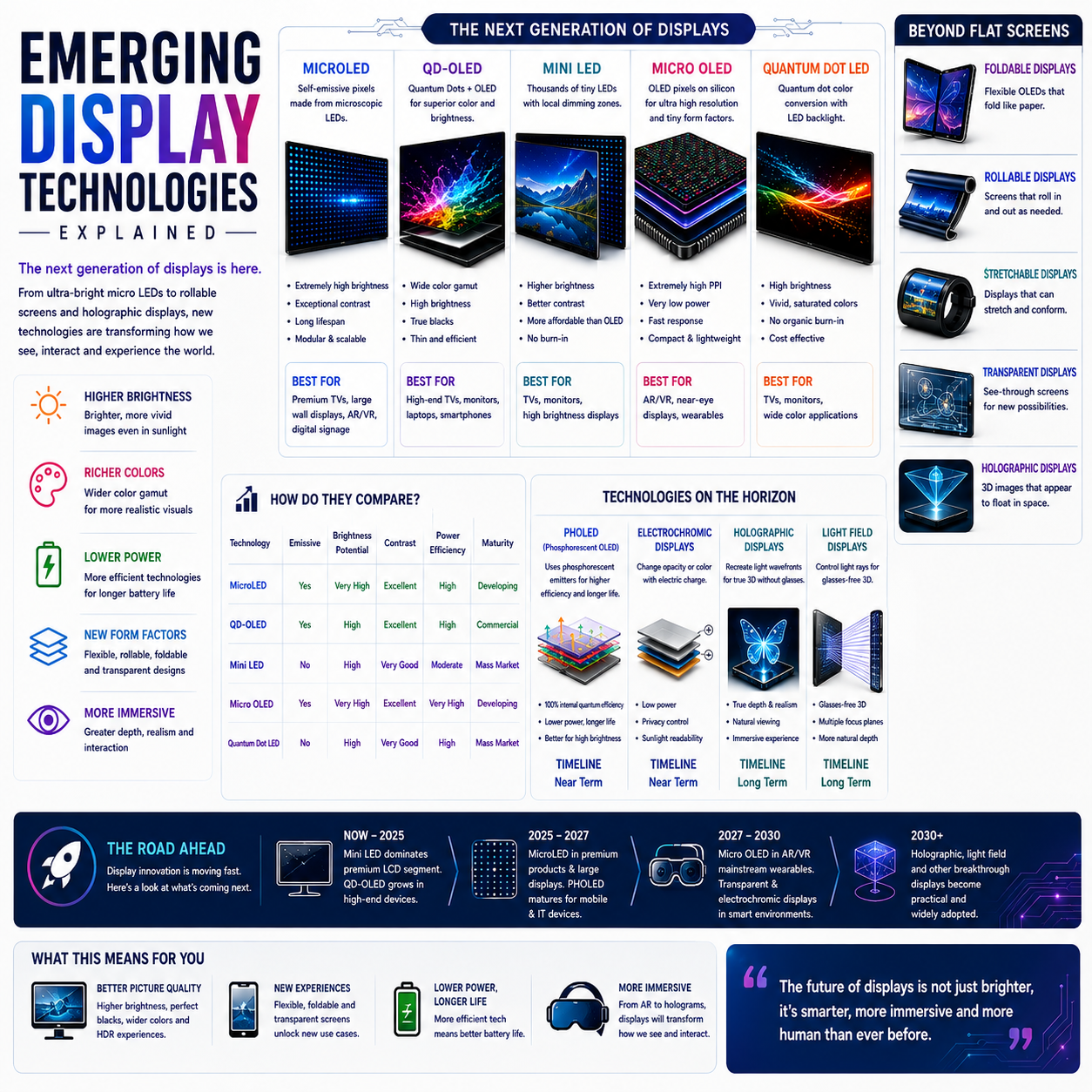
The future of displays is moving beyond conventional LCD and OLED toward technologies such as MicroLED, tandem OLED, QD-based electroluminescent displays, printed OLED, perovskite LEDs, Micro-OLED, MicroLED microdisplays, transparent and flexible displays, but each faces different challenges involving manufacturing yield, efficiency, lifetime, cost, brightness, resolution and scalability.
Introduction: What Comes After OLED?
Today’s display industry is dominated by several major architectures:
- LCD
- OLED
- Mini-LED LCD
- QD-OLED
- advanced LTPS/LTPO displays
But display research is moving rapidly.
Engineers are working toward displays that are:
- brighter
- thinner
- more efficient
- more durable
- more flexible
- smaller at the pixel level
- easier to manufacture
- capable of higher resolution
- better suited to AR/VR
- capable of entirely new form factors
The emerging-display landscape can be visualized as:
TODAY
│
├── LCD
├── Mini-LED LCD
├── OLED
└── QD-OLED
       │
       ↓
EMERGING
│
├── MicroLED
├── Tandem OLED
├── Printed OLED
├── QD-LED
├── Perovskite LEDs
├── Micro-OLED
├── MicroLED Microdisplays
├── Transparent Displays
├── Stretchable Displays
└── Advanced Flexible Displays
But the key editorial principle is:
A technology being demonstrated in a laboratory does not mean it is ready for mass production.
1. What Makes a Display Technology “Emerging”?
An emerging display technology generally has not yet reached the same level of commercial maturity as mainstream LCD or OLED.
It may exist at several stages:
Research
   ↓
Laboratory Prototype
   ↓
Engineering Prototype
   ↓
Pilot Production
   ↓
Limited Commercial Product
   ↓
Mass Production
   ↓
Mainstream Technology
This distinction is critical.
A technology can be technically impressive but commercially impractical.
2. The Six Questions That Matter
When evaluating an emerging display, ask:
1. Can it produce the required image quality?
2. Can it be manufactured at scale?
3. Can manufacturers achieve acceptable yield?
4. Is it efficient enough?
5. Can it survive real-world operating conditions?
6. Can it reach an acceptable cost?
These six questions should become Digital Plaza’s standard framework for evaluating future display technologies.
3. MicroLED
MicroLED is one of the most important potential successors to today’s premium display technologies.
Instead of using:
- an LCD layer with a backlight
- or organic OLED emitters
MicroLED uses microscopic inorganic LEDs as individual light-emitting pixels.
Conceptually:
MicroLED Pixel
     ↓
Red / Green / Blue
     ↓
Individual Light Emission
Like OLED, it is:
self-emissive.
4. Why MicroLED Is So Interesting
MicroLED potentially combines several attractive characteristics:
- high brightness
- excellent contrast
- pixel-level control
- fast response
- long operational life
- high efficiency potential
- no conventional LCD backlight
- potentially strong HDR performance
This makes it one of the most compelling long-term display technologies.
5. MicroLED vs OLED
| Characteristic | OLED | MicroLED |
|---|
| Self-emissive | Yes | Yes |
| Pixel-level control | Yes | Yes |
| Black level | Excellent | Excellent |
| Peak brightness potential | High | Very high potential |
| Response | Very fast | Very fast potential |
| Organic material | Yes | No |
| Burn-in risk | Exists | Different risk profile |
| Manufacturing | Mature relative to MicroLED | Extremely challenging |
| Current cost | Lower | Very high |
MicroLED’s biggest problem is not whether it can produce an excellent image.
It is:
Can millions of microscopic LEDs be manufactured, transferred, aligned and controlled economically with extremely high yield?
6. MicroLED Mass-Production Challenge
A high-resolution MicroLED display requires enormous numbers of tiny LED elements.
Manufacturing therefore involves:
- LED fabrication
- separation
- transfer
- alignment
- bonding
- testing
- repair
Conceptually:
LED Wafer
   ↓
MicroLEDs
   ↓
Mass Transfer
   ↓
Pixel Placement
   ↓
Electrical Connection
   ↓
Testing
Even a tiny failure rate can produce a significant number of defective pixels.
7. Mass Transfer
One of the central MicroLED challenges is:
mass transfer.
Thousands or millions of microscopic LEDs must be transferred from a source substrate to the display backplane.
The process must achieve:
- extreme positional accuracy
- high throughput
- low damage
- high yield
This is one of the key technologies determining whether MicroLED can become mainstream.
8. MicroLED Repair
Defective microscopic LEDs may need to be identified and replaced.
This creates another manufacturing requirement:
Inspection + repair at microscopic scale.
A commercially viable process needs to make this economical.
Otherwise, manufacturing losses can become too large.
9. QD-LED
Another emerging direction is:
Quantum Dot LED : QD-LED
This should not be confused with today’s:
QLED LCD
or:
QD-OLED.
The crucial distinction is the light-generation mechanism.
A true electroluminescent quantum-dot display aims to have quantum dots themselves produce light electrically.
Conceptually:
Electrical Current
      ↓
Quantum Dots
      ↓
Light
This would potentially create a new self-emissive display architecture.
10. Why QD-LED Is Interesting
Potential advantages include:
- excellent color purity
- wide color gamut
- self-emission
- potentially high efficiency
- high pixel density
- scalable thin-display architecture
But major challenges remain around:
- material stability
- efficiency
- lifetime
- fabrication
- charge injection
- large-area uniformity
11. QLED vs QD-LED
This distinction should be emphasized.
QLED
Usually refers to an LCD display enhanced by a quantum-dot layer.
LED Backlight
 ↓
Quantum Dots
 ↓
LCD
QD-OLED
Uses OLED emission combined with quantum-dot color conversion.
OLED
 ↓
Quantum Dots
 ↓
Color
QD-LED
Aims for electrically driven quantum-dot emission.
Electrical Drive
 ↓
Quantum Dots
 ↓
Light
These are fundamentally different architectures.
12. Tandem OLED
Tandem OLED uses multiple emissive OLED stacks.
Instead of relying on one emissive stack:
OLED Stack
a tandem architecture can use:
OLED Stack
+
OLED Stack
The purpose is to improve characteristics such as:
- efficiency
- brightness
- lifetime
depending on implementation.
13. Why Tandem OLED Matters
One of OLED’s long-term engineering challenges is balancing:
brightness + efficiency + lifetime.
Tandem structures can distribute the electrical load across multiple emissive units.
Potential benefits include:
- higher luminance
- improved efficiency
- longer operating life
This makes tandem OLED particularly interesting for:
- premium laptops
- tablets
- monitors
- automotive displays
14. Tandem OLED and Mobile Devices
Tandem OLED can also become relevant where manufacturers want:
- high brightness
- thinness
- low power
- long lifetime
However, additional layers can increase:
- manufacturing complexity
- material requirements
- process cost
Again:
Performance improvement must justify manufacturing complexity.
15. Phosphorescent Blue OLED
Blue is one of the hardest OLED emission problems.
Historically, blue OLED efficiency and lifetime have been more difficult than red and green.
Research into:
phosphorescent blue OLED
aims to improve blue-emitter efficiency.
Potential benefits:
- higher efficiency
- lower power
- improved lifetime
- improved overall OLED performance
A successful high-performance blue emitter could have enormous implications for OLED displays.
16. Why Blue OLED Matters So Much
OLED systems often use blue emission as a critical part of the architecture.
Improving blue efficiency could affect:
Blue Efficiency
      ↓
OLED Efficiency
      ↓
Brightness / Power
      ↓
Battery Life
This is therefore not a small incremental improvement.
It could influence the economics and performance of the entire OLED industry.
17. Printed OLED
Another emerging manufacturing direction is:
printed OLED.
Instead of relying primarily on conventional vacuum deposition techniques, printing technologies can deposit functional materials directly onto selected areas.
Conceptually:
OLED Material
      ↓
Printing System
      ↓
Pixel Pattern
      ↓
OLED Display
Potential advantages include:
- reduced material waste
- scalable manufacturing
- potentially simpler large-area production
- new form-factor possibilities
But achieving high uniformity and long-term reliability remains challenging.
18. Inkjet OLED
Inkjet printing can potentially place emissive materials with high spatial precision.
This becomes especially interesting for:
- large displays
- high-resolution panels
- unusual form factors
The key challenge is achieving:
uniformity + precision + throughput + reliability
at industrial scale.
19. Perovskite LEDs
Perovskite materials have attracted significant attention in optoelectronics.
PeLEDs : Perovskite LEDs
can potentially provide:
- high color purity
- tunable emission
- efficient light generation
- potentially low-cost solution processing
But major challenges remain.
20. Perovskite Display Challenges
Important issues include:
- operational stability
- moisture sensitivity
- material degradation
- lifetime
- encapsulation
- manufacturing consistency
A laboratory prototype can demonstrate excellent efficiency while still being far from a durable consumer display.
This distinction is crucial.
21. Micro-OLED
Micro-OLED is particularly important for:
- AR
- VR
- MR
- electronic viewfinders
- high-resolution wearable displays
Instead of a large television-like panel, Micro-OLED creates extremely small displays with very high pixel densities.
Conceptually:
Tiny Display
┌──────────┐
│██████████│
│██████████│
│██████████│
└──────────┘
The pixels are extremely small.
22. Micro-OLED and Silicon
Micro-OLED systems can use silicon-based backplanes.
This is commonly associated with:
OLED on Silicon
or:
OLEDoS
The approach combines display technology with semiconductor manufacturing techniques.
This enables extremely high pixel density.
23. Why Micro-OLED Matters for AR/VR
AR/VR systems require:
- very high pixel density
- compact displays
- low persistence
- high contrast
- high refresh
- low latency
The display is viewed through optics at a very close apparent distance.
Therefore pixel structure that would be invisible on a phone can become noticeable in a headset.
Micro-OLED is well suited to this requirement.
24. MicroLED Microdisplays
MicroLED can also be developed for extremely small displays.
Potential advantages include:
- very high brightness
- high pixel density
- strong efficiency potential
- fast response
This makes MicroLED particularly interesting for:
AR optical systems.
But manufacturing extremely small, high-resolution MicroLED displays is exceptionally difficult.
25. AR Display Technology
Augmented-reality displays introduce a completely different design problem.
The system needs to combine:
Digital Image
      ↓
Microdisplay
      ↓
Optical Engine
      ↓
Lens / Waveguide
      ↓
Human Eye
      ↓
Real World + Digital Overlay
The display panel is therefore only one part of the AR system.
26. Waveguide Displays
Many AR systems use optical waveguides to deliver light toward the user’s eye.
The system can use:
- diffractive waveguides
- reflective waveguides
- holographic optical elements
The goal is to create a virtual image while maintaining visibility of the physical environment.
27. Transparent Displays
Transparent displays attempt to allow viewers to see through the display while also showing digital content.
Potential applications include:
- automotive
- retail
- architecture
- industrial equipment
- AR-like interfaces
But transparency introduces a fundamental trade-off:
More Transparency
      ↕
Less Optical Blocking
      ↕
Potentially Lower Image Contrast
Producing a bright, high-contrast image while maintaining high transparency is difficult.
28. Stretchable Displays
Stretchable displays go beyond flexible displays.
Flexible:
can bend
Stretchable:
can deform in multiple dimensions.
Potential applications include:
- wearable electronics
- medical devices
- robotics
- soft interfaces
The challenge is maintaining:
- electrical continuity
- pixel integrity
- mechanical reliability
during repeated deformation.
29. Rollable Displays
Rollable displays extend flexible-display technology.
Conceptually:
Compact
[██████]

      ↓ Roll Out

[████████████████]
Potential advantages:
- compact storage
- larger viewing area
- unusual device designs
Challenges include:
- mechanical reliability
- crease control
- bending stress
- hinge/roller systems
- layer durability
30. Sliding Displays
Sliding displays use mechanical movement to increase display area.
Instead of folding:
Closed
████████

     ↓

Expanded
██████████████
This can avoid some fold-crease problems but introduces:
- mechanical complexity
- moving components
- sealing challenges
- durability requirements
31. Stretchable and Deformable Electronics
The ultimate goal is to make electronics mechanically compatible with surfaces that:
This could enable displays integrated into:
- clothing
- skin-like electronics
- robotics
- curved surfaces
But these technologies remain significantly less mature than OLED.
32. Holographic Displays
“Holographic display” is a broad term covering several different technologies.
True holographic systems attempt to control light in ways that reproduce wavefront information.
This is much more demanding than ordinary stereoscopic 3D.
Potential technologies include:
- spatial light modulators
- holographic optical elements
- computational holography
The biggest challenges include:
- computational requirements
- optical efficiency
- viewing angle
- resolution
- hardware complexity
33. Light-Field Displays
Light-field displays attempt to reproduce directional light information.
Instead of simply showing a flat image:
2D Image
they attempt to provide:
Multiple Light Directions
↗ ↑ ↖
← Object →
↘ ↓ ↙
This can create more natural three-dimensional viewing experiences.
But the approach can require enormous amounts of optical and computational data.
34. Retinal Projection
Another future-facing approach is projecting information toward the eye rather than creating a conventional image plane.
Potential advantages include:
- compact optical systems
- high apparent resolution
- novel AR experiences
But the engineering and safety requirements are substantial.
Retinal projection should therefore be treated as a specialized future-display architecture rather than a direct replacement for OLED panels.
35. Displays Without Conventional Screens
The long-term evolution could move from:
screen
toward:
optical information environment.
Instead of asking:
“How large is the screen?”
future devices may ask:
- What is the field of view?
- What is the apparent image size?
- How bright is the virtual image?
- How much of the real world remains visible?
- What is the angular resolution?
- How accurately can digital objects be anchored?
This is particularly important for AR.
36. Emerging Display Technologies by Maturity
A useful editorial framework is:
| Technology | Primary opportunity | Main challenge |
|---|
| MicroLED | Brightness, efficiency, HDR | Mass transfer, yield, cost |
| Tandem OLED | Brightness, efficiency, lifetime | Manufacturing complexity |
| QD-LED | Color, self-emission | Efficiency, stability, scale |
| Printed OLED | Manufacturing efficiency | Uniformity, reliability |
| Perovskite LED | Color, efficiency potential | Lifetime, stability |
| Micro-OLED | AR/VR pixel density | Size, brightness, cost |
| MicroLED microdisplay | AR brightness | Manufacturing complexity |
| Transparent display | New interfaces | Contrast/brightness |
| Stretchable display | Wearables/robotics | Mechanical reliability |
| Rollable display | New form factors | Mechanical durability |
This table is more useful than simply ranking technologies as “better” or “worse.”
37. The Technology Readiness Ladder
Digital Plaza should evaluate future displays using a maturity ladder:
Research
   ↓
Prototype
   ↓
Pilot Manufacturing
   ↓
Limited Commercialization
   ↓
Mass Production
   ↓
Cost Competitive
   ↓
Mainstream Adoption
This prevents speculative technologies from being presented as imminent products.
38. What Determines Commercial Success?
An emerging display technology needs more than excellent specifications.
It must achieve:
Performance
    +
Manufacturability
    +
Yield
    +
Reliability
    +
Efficiency
    +
Cost
    +
Supply Chain
    =
Commercial Viability
This should become a recurring Digital Plaza analytical framework.
39. The Future Display Race
The competition is unlikely to have one winner.
Different technologies are likely to dominate different applications.
Smartphones
Likely emphasis:
- advanced OLED
- LTPO
- tandem OLED
- improved emitters
TVs
Potential competition:
- OLED
- QD-OLED
- Mini-LED
- MicroLED
Laptops
Potential:
- OLED
- tandem OLED
- Mini-LED
- advanced LCD
AR/VR
Potential:
- Micro-OLED
- MicroLED
- advanced silicon-based microdisplays
Wearables
Potential:
- flexible OLED
- MicroLED
- stretchable displays
Automotive
Potential:
- OLED
- Mini-LED
- MicroLED
- transparent/curved displays
40. The Real Competition Is Efficiency + Manufacturing
Future display leadership will not necessarily go to the technology with the highest theoretical specification.
The winner may be the technology that achieves:
90% of the theoretical performance
at:
50% of the manufacturing cost
with:
10× better yield.
That is why manufacturing deserves equal attention alongside display physics.
41. The Complete Future Display Landscape
                 FUTURE DISPLAYS
                       │
       ┌───────────────┼────────────────┐
       │               │                │
    SELF-EMISSIVE   FLEXIBLE        IMMERSIVE
       │               │                │
   ┌───┼────┐      ┌───┼────┐       ┌───┼────┐
   │   │    │      │   │    │       │   │    │
MicroLED QD-LED OLED Roll Stretch Micro-OLED AR
   │         │      │        │          │
Tandem    Perovskite Foldable Rollable  MicroLED
OLED      LED                          Microdisplay