Meta Description
Explore audio technology from analog and digital sound to ADCs, DACs, DSP, audio codecs, amplifiers, speakers, headphones, microphones, ANC, Bluetooth, spatial audio and AI processing. Learn how modern audio systems capture, process, transmit and reproduce sound, and discover the technologies shaping smartphones, earbuds, laptops, vehicles, hearables and the future of intelligent audio.
Thank you for reading this post, don't forget to subscribe!In One Sentence
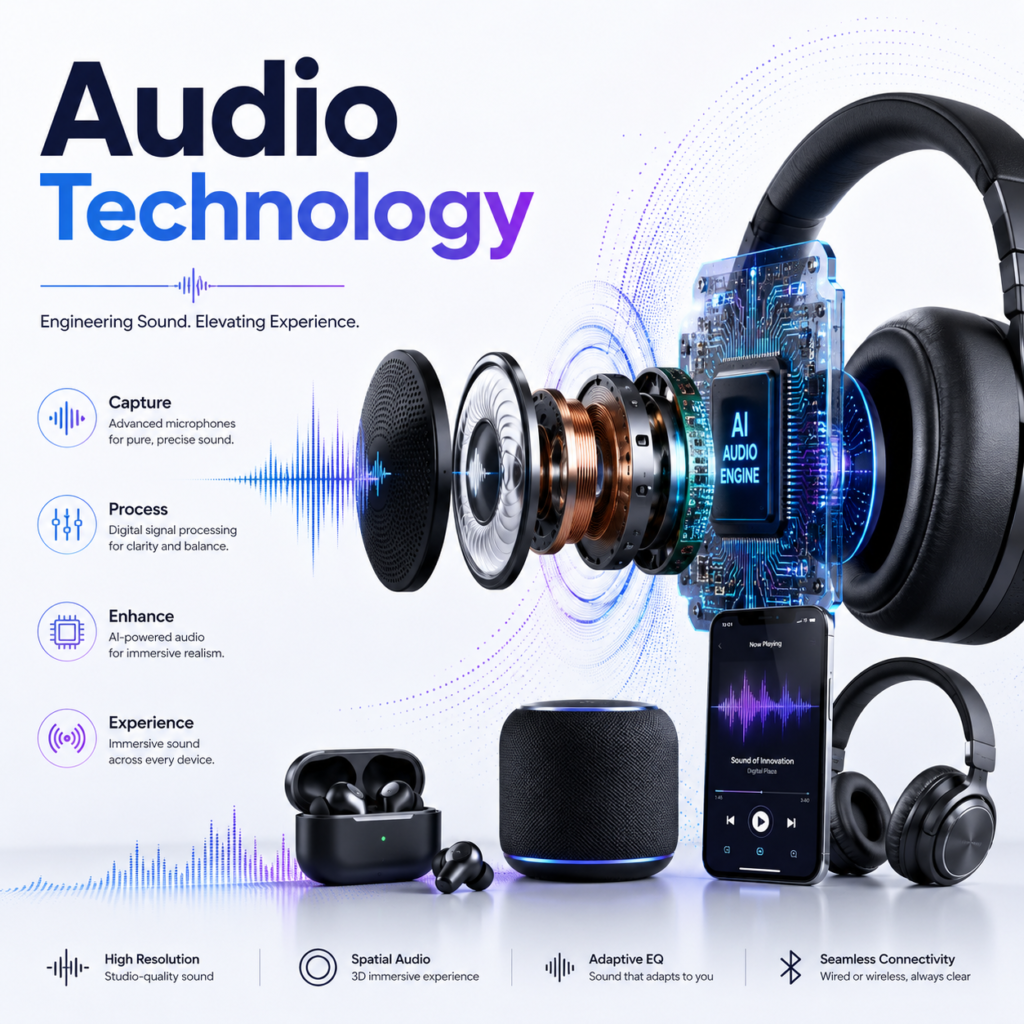
Audio technology is the complete system used to capture, convert, process, transmit, store, reproduce and measure sound from microphones and ADCs to DSPs, codecs, DACs, amplifiers, speakers, headphones and spatial-audio systems.
Introduction: Audio Is a Technology System, Not Just Sound
Every time a smartphone records a voice, wireless earbuds play music, a laptop processes a video call, a television produces dialogue, or a car creates an immersive sound field, a complex chain of hardware and software is working behind the scenes.
Modern audio systems combine:
- acoustic engineering
- electronics
- semiconductor technology
- digital signal processing
- wireless communication
- software
- psychoacoustics
- mechanical engineering
- artificial intelligence
The result is a technology stack that transforms physical sound waves into electrical signals, electrical signals into digital information, and digital information back into physical sound.
A modern smartphone, for example, may contain multiple microphones, audio codecs, ADCs, DACs, amplifiers, speakers, DSP hardware, Bluetooth connectivity and software-based audio processing.
Understanding audio therefore requires understanding the entire signal path.
1. Full Definition: What Is Audio Technology?
Audio technology is the collection of hardware, software, algorithms, interfaces and engineering techniques used to capture, convert, process, transmit, store, reproduce and analyze sound.
The technology can be divided into several major stages:
| Stage | Primary Technology | Function |
|---|---|---|
| Capture | Microphone | Converts sound into electrical signal |
| Conversion | ADC | Converts analog signal into digital data |
| Processing | DSP | Modifies and analyzes audio |
| Encoding | Codec | Compresses/decompresses audio |
| Transmission | Bluetooth, USB, Wi-Fi | Moves audio data |
| Conversion | DAC | Converts digital data into analog signal |
| Amplification | Amplifier | Provides power to drive output device |
| Reproduction | Speaker/Headphone Driver | Converts electrical energy into sound |
| Acoustics | Enclosure/Ear/Room | Shapes the final sound |
| Perception | Human Hearing | Interprets the resulting sound |
This is the audio technology stack.
2. What Is Sound?
Sound is a mechanical wave produced by changes in pressure within a medium such as air.
When a speaker moves its diaphragm, it pushes and pulls surrounding air. Those pressure variations travel outward as a sound wave.
Important properties include:
- frequency
- amplitude
- wavelength
- phase
- waveform
- harmonic content
These physical properties ultimately determine what humans perceive as pitch, loudness and timbre.
3. Frequency: The Foundation of Pitch
Frequency describes how many cycles of a periodic waveform occur per second.
It is measured in hertz (Hz).
For example:
- 100 Hz = 100 cycles per second
- 1 kHz = 1,000 cycles per second
- 10 kHz = 10,000 cycles per second
Frequency strongly influences perceived pitch.
Lower frequencies generally correspond to bass.
Higher frequencies generally correspond to treble.
Human hearing is commonly described as approximately 20 Hz to 20 kHz, although actual hearing varies substantially with age, individual physiology and listening conditions.
4. Amplitude and Loudness
Amplitude describes the magnitude of a waveform.
Higher amplitude generally produces a stronger acoustic signal, but amplitude and perceived loudness are not identical concepts.
Human perception of loudness depends on:
- sound pressure level
- frequency
- duration
- hearing sensitivity
- listening environment
Sound pressure level is commonly expressed in decibels (dB SPL).
A decibel is logarithmic rather than linear, which makes it particularly useful for representing the enormous range of sound pressures encountered in audio.
Lorem ipsum dolor sit amet, consectetur adipiscing elit. Ut elit tellus, luctus nec ullamcorper mattis, pulvinar dapibus leo.
5. Waveform and Timbre
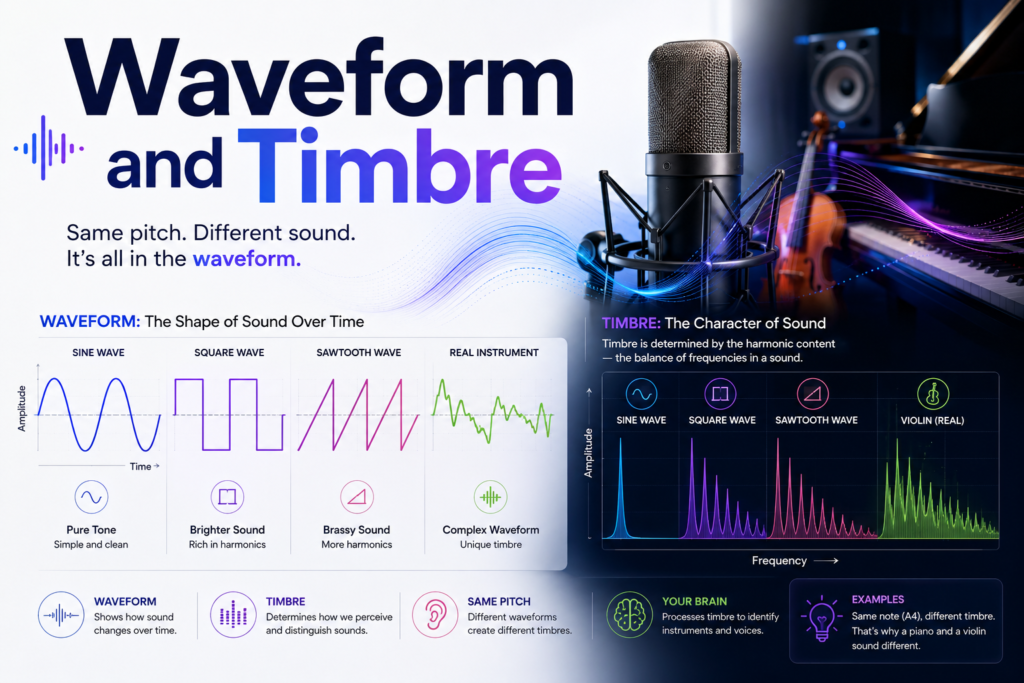
Two instruments can play the same fundamental frequency while sounding completely different.
Why?
Because their waveforms contain different combinations of harmonics.
This characteristic contributes to timbre.
A pure sine wave contains a single fundamental frequency.
A musical instrument produces a much more complex waveform containing:
- fundamental frequency
- harmonics
- transient information
- noise components
- resonances
Audio technology attempts to capture and reproduce these characteristics accurately.
6. Analog Audio vs Digital Audio
There are two fundamental representations of audio.
Analog Audio
An analog audio signal continuously represents changes in sound pressure.
Examples include:
- microphone voltage
- amplifier output
- turntable cartridge output
Digital Audio
Digital audio represents the waveform as numerical samples.
Examples include:
- PCM
- WAV
- FLAC
- AAC
- Opus
The transition between the two worlds requires conversion.
Analog → ADC → Digital
and later:
Digital → DAC → Analog
7. Sampling Rate
A digital system does not continuously store an analog waveform.
Instead, it takes measurements called samples.
The number of samples captured per second is the sampling rate.
Common rates include:
| Sampling Rate | Common Use |
|---|---|
| 8 kHz | Traditional narrowband voice |
| 16 kHz | Wideband speech |
| 44.1 kHz | Music/CD ecosystem |
| 48 kHz | Video and professional production |
| 96 kHz | High-resolution production |
| 192 kHz | Specialized production |
According to the Nyquist-Shannon sampling principle, reproducing frequencies up to a certain maximum requires a sampling rate greater than twice that maximum frequency.
This is why a 44.1 kHz system can represent frequencies up to roughly 22.05 kHz under ideal sampling conditions.
8. Bit Depth
Bit depth describes how many bits are available to represent each audio sample.
Common formats include:
- 16-bit
- 24-bit
- 32-bit floating point
Higher bit depth provides greater numerical resolution and dynamic-range capability.
For ideal quantization, theoretical signal-to-quantization-noise performance increases by approximately 6.02 dB per bit.
Therefore:
- 16-bit ≈ 96 dB theoretical dynamic range
- 24-bit ≈ 144 dB theoretical dynamic range
Real-world systems are limited by analog circuitry, noise, distortion and other factors.
9. PCM: The Foundation of Digital Audio
Pulse-Code Modulation (PCM) is one of the fundamental representations of digital audio.
PCM stores numerical samples representing the amplitude of an analog waveform at successive points in time.
A PCM stream therefore has characteristics such as:
- sampling rate
- bit depth
- number of channels
- sample format
For example, stereo 48 kHz / 24-bit PCM contains two channels sampled 48,000 times per second with 24-bit sample representation.
PCM is fundamental to many digital-audio workflows even when users ultimately interact with compressed formats.
10. ADC: Analog-to-Digital Conversion
An Analog-to-Digital Converter (ADC) converts an analog electrical signal into digital data.
A simplified process is:
Microphone → Analog Signal → ADC → Digital Samples
The ADC performs several functions, including:
- sampling
- quantization
- numerical encoding
Important ADC characteristics include:
- resolution
- sampling rate
- dynamic range
- signal-to-noise ratio
- total harmonic distortion
- input range
ADC quality can influence recording quality because information lost or corrupted during conversion cannot simply be reconstructed later.
11. DAC: Digital-to-Analog Conversion
A Digital-to-Analog Converter (DAC) performs the opposite transformation.
Digital Audio → DAC → Analog Signal
The DAC produces an analog electrical signal that can then be amplified and sent to a speaker or headphone driver.
Important DAC characteristics include:
- resolution
- sampling-rate support
- signal-to-noise ratio
- dynamic range
- distortion
- output level
However, a DAC is only one component of the complete playback system.
A high-quality DAC cannot compensate for a poor speaker, poor acoustic design or badly tuned headphones.
12. DSP: The Intelligence Layer of Audio
Digital Signal Processing (DSP) uses mathematical algorithms to manipulate audio signals.
DSP is now one of the most important technologies in modern consumer audio.
A DSP can perform:
- equalization
- noise reduction
- active noise cancellation
- dynamic-range control
- beamforming
- echo cancellation
- spatial processing
- virtual surround
- speaker protection
- bass enhancement
- room correction
- microphone processing
- voice enhancement
Modern DSP may run on:
- dedicated audio DSPs
- application processors
- SoCs
- GPUs
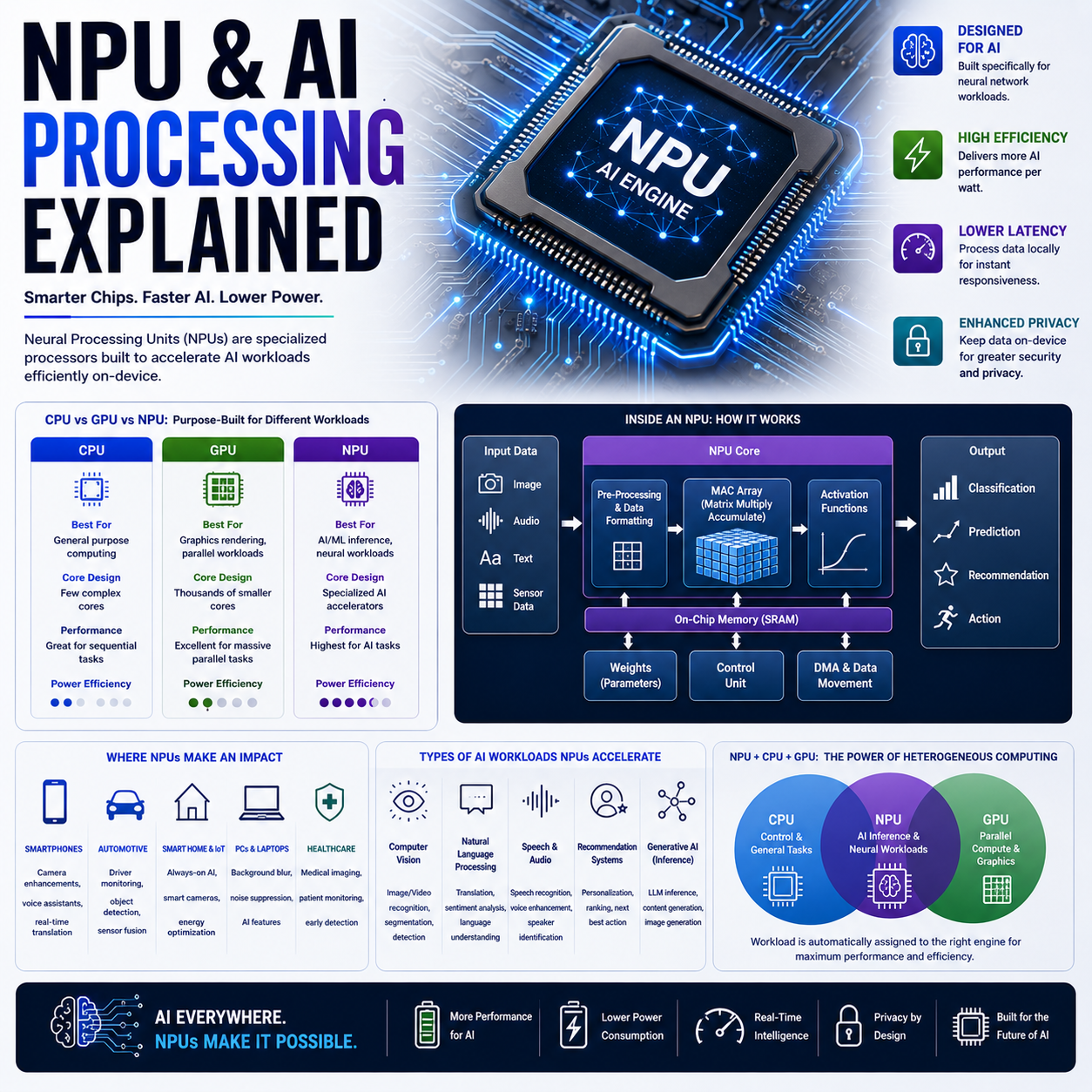
- NPUs
- microcontrollers
13. Equalization
Equalization (EQ) changes the relative level of different frequency ranges.
A simple system might divide sound into:
- bass
- midrange
- treble
More sophisticated parametric EQ systems can control:
- center frequency
- gain
- bandwidth/Q
EQ can compensate for:
- speaker characteristics
- headphone frequency response
- room acoustics
- user preference
But EQ cannot solve every physical limitation of a transducer.
14. Dynamic Range Compression
A compressor reduces the difference between loud and quiet portions of an audio signal.
Important parameters include:
- threshold
- ratio
- attack
- release
- knee
Compression is widely used in:
- music production
- broadcasting
- smartphones
- televisions
- gaming
- voice communication
In consumer devices, dynamic processing can also help prevent speakers from being driven beyond safe operating limits.
15. Noise Reduction
Noise reduction attempts to distinguish unwanted signal components from desired audio.
Modern systems can use:
- spectral filtering
- adaptive filtering
- beamforming
- statistical models
- machine learning
- neural networks
AI-based noise suppression has become particularly important for:
- video conferencing
- smartphones
- laptops
- gaming headsets
- wireless earbuds
16. Active Noise Cancellation
Active Noise Cancellation (ANC) uses microphones and signal processing to reduce unwanted external sound.
A simplified system is:
External Noise → Microphone → DSP → Inverted/Corrective Signal → Speaker → Reduced Acoustic Noise
The concept relies on destructive interference.
However, ANC effectiveness depends on:
- microphone placement
- acoustic seal
- DSP latency
- speaker performance
- frequency
- enclosure design
- fit
ANC is generally particularly effective against relatively predictable low-frequency noise such as:
- aircraft engines
- trains
- air conditioners
- vehicle noise
17. Passive Noise Isolation
Passive isolation does not electronically cancel noise.
Instead, it physically blocks or attenuates sound.
Techniques include:
- earbud seals
- headphone pads
- enclosure materials
- mechanical barriers
The strongest systems combine:
Passive Isolation + ANC
18. Microphones
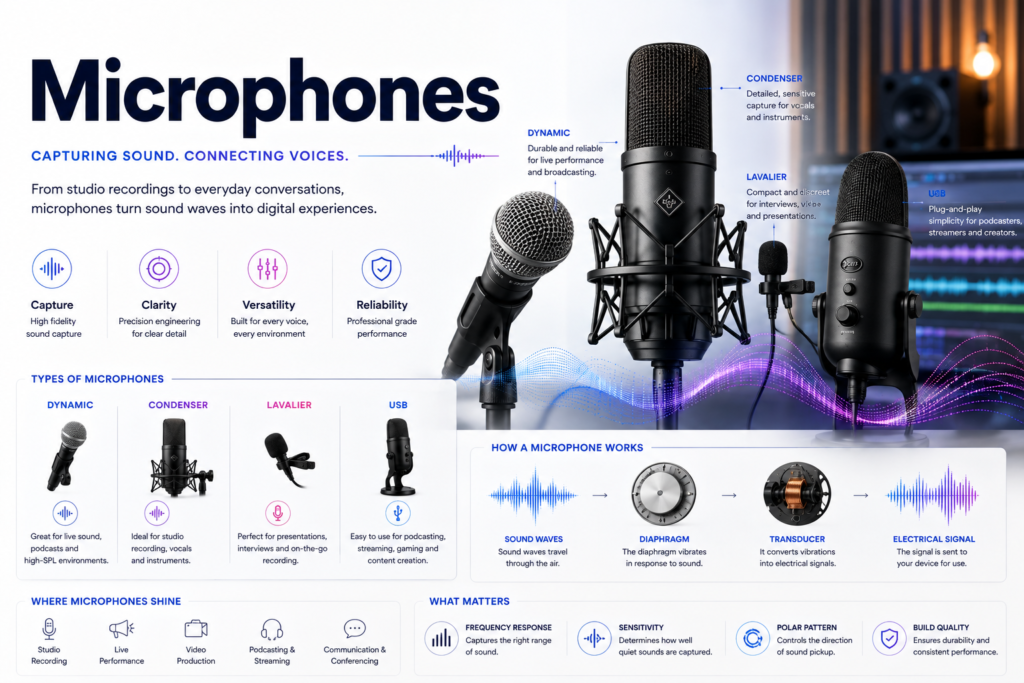
A microphone converts acoustic pressure into an electrical signal.
Major microphone technologies include:
Dynamic Microphones
Use electromagnetic induction.
Advantages:
- rugged
- high sound-pressure tolerance
- relatively simple construction
Condenser Microphones
Use a capacitive sensing mechanism.
Advantages:
- high sensitivity
- detailed response
- excellent studio applications
MEMS Microphones
Micro-Electro-Mechanical Systems microphones integrate miniature mechanical structures with semiconductor manufacturing techniques.
They are particularly important in:
- smartphones
- earbuds
- laptops
- smart speakers
- wearables
- automotive systems
19. Microphone Arrays and Beamforming
Modern devices frequently use multiple microphones.
Multiple microphones allow the system to estimate the direction of incoming sound.
Beamforming combines signals from multiple microphones to emphasize desired sound and suppress unwanted sources.
Applications include:
- voice assistants
- smartphones
- conference systems
- laptops
- earbuds
- automotive systems
This is a major reason why a modern smartphone can isolate a person’s voice much better than a single basic microphone.
20. Audio Drivers
A driver is the transducer that converts electrical energy into acoustic energy.
Common headphone driver technologies include:
- dynamic
- balanced armature
- planar magnetic
- electrostatic
Dynamic Drivers
Use a moving diaphragm driven by a magnetic voice-coil system.
They dominate consumer headphones and earbuds.
Balanced Armature Drivers
Use a miniature electromagnetic mechanism.
They are widely used in multi-driver in-ear monitors.
Planar Magnetic Drivers
Use a thin diaphragm with conductive traces interacting with a magnetic field.
They can provide:
- low distortion
- high detail
- fast transient response
Electrostatic Drivers
Use an electrically charged diaphragm suspended between electrodes.
They require specialized drive electronics and are generally used in premium systems.
21. Speaker Architecture
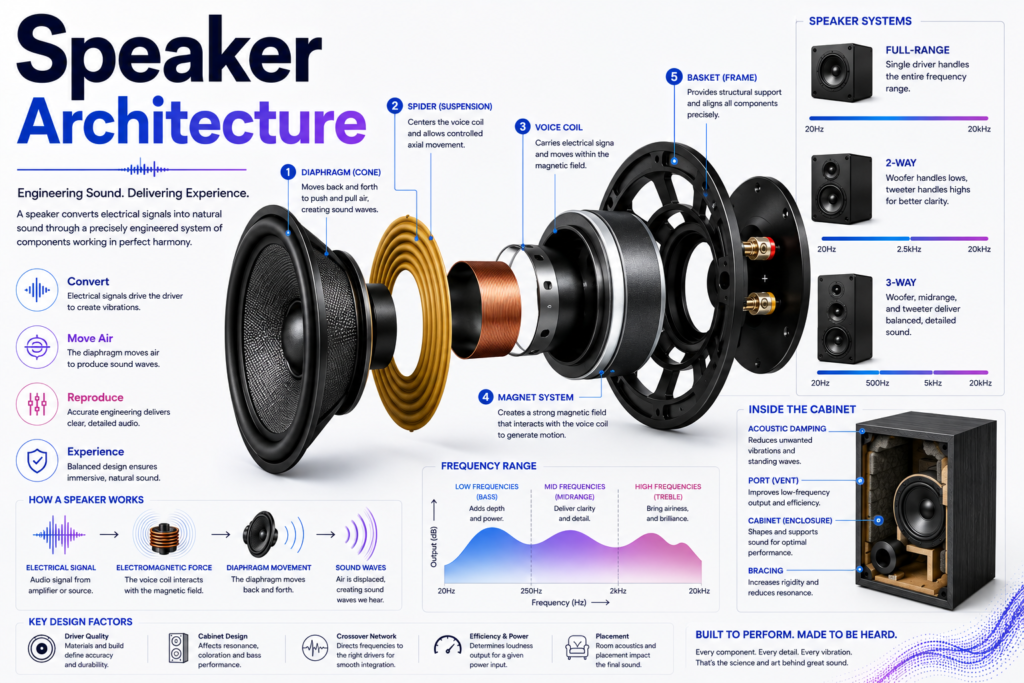
A speaker system converts electrical energy into acoustic output.
A simplified chain is:
Audio Signal → Amplifier → Voice Coil → Magnetic Force → Diaphragm Movement → Air Pressure → Sound
Speaker performance depends on:
- driver design
- diaphragm material
- magnet system
- enclosure
- amplifier
- crossover
- DSP
- acoustic environment
The driver alone does not determine final sound quality.
22. Speaker Enclosures
The enclosure surrounding a speaker driver strongly affects its acoustic behavior.
Common approaches include:
- sealed enclosure
- bass-reflex enclosure
- passive radiator
- acoustic chambers
- transmission-line designs
In smartphones, tablets and laptops, extremely limited physical volume makes acoustic engineering particularly challenging.
Manufacturers therefore use:
- computational modeling
- DSP
- vibration analysis
- optimized chambers
- multiple drivers
- mechanical reinforcement
23. Amplifiers
An amplifier increases the electrical power available to a transducer.
Important amplifier characteristics include:
- output power
- efficiency
- distortion
- noise
- impedance compatibility
- thermal behavior
Modern mobile devices often use highly integrated amplifier solutions within audio subsystems or SoCs.
24. Class-D Amplification
Class-D amplifiers use switching techniques to achieve high efficiency.
They are especially useful in:
- smartphones
- laptops
- televisions
- Bluetooth speakers
- automotive systems
Their efficiency reduces wasted energy as heat, which is particularly important in battery-powered devices.
25. Audio Codecs
The word codec combines encoding and decoding.
An audio codec converts audio into a particular encoded representation and reconstructs it during playback.
Codecs can be:
- lossless
- lossy
- optimized for music
- optimized for speech
- optimized for low latency
- optimized for bandwidth efficiency
Examples include:
| Codec | Typical Characteristic |
|---|---|
| PCM | Uncompressed representation |
| FLAC | Lossless compression |
| AAC | Lossy compression |
| Opus | Highly flexible, efficient codec |
| MP3 | Legacy lossy music codec |
| ALAC | Apple lossless format |
| LDAC | Bluetooth-oriented high-bitrate codec |
Codec quality is determined by the entire encoding configuration, not simply the codec name.
26. Lossless vs Lossy Audio
Lossless
The original digital data can be reconstructed exactly.
Examples:
- FLAC
- ALAC
Lossy
Some information is discarded to reduce data size.
Examples:
- AAC
- MP3
- Opus
Lossy compression attempts to remove information that is considered less perceptually important.
The objective is not necessarily to preserve every numerical sample but to preserve the perceived audio quality while reducing bitrate.
27. Bluetooth Audio
Bluetooth enables wireless audio transmission between devices.
A simplified path is:
Source Device → Audio Codec → Bluetooth Radio → Wireless Link → Receiver → Decoder → DAC/DSP → Amplifier → Driver
Bluetooth audio performance depends on:
- codec
- bitrate
- latency
- radio conditions
- implementation
- power consumption
- device compatibility
Bluetooth therefore represents an entire system rather than simply a “wireless audio quality” specification.
28. Audio Latency
Latency is the time between an event occurring and the corresponding sound being produced.
Low latency is particularly important for:
- gaming
- musical instruments
- live monitoring
- video synchronization
- augmented reality
- virtual reality
Sources of latency include:
- ADC conversion
- DSP processing
- buffering
- codec processing
- wireless transmission
- decoding
- DAC conversion
A system can have excellent sound quality and still be poor for gaming if its end-to-end latency is excessive.
29. Spatial Audio
Traditional stereo primarily represents left and right channels.
Spatial audio attempts to create the perception that sound originates from positions around the listener.
Technologies include:
- binaural audio
- object-based audio
- head-related transfer functions
- head tracking
- virtual surround
- immersive audio
Spatial audio is particularly important in:
- movies
- gaming
- VR
- AR
- premium headphones
- automotive entertainment
30. Head-Related Transfer Functions
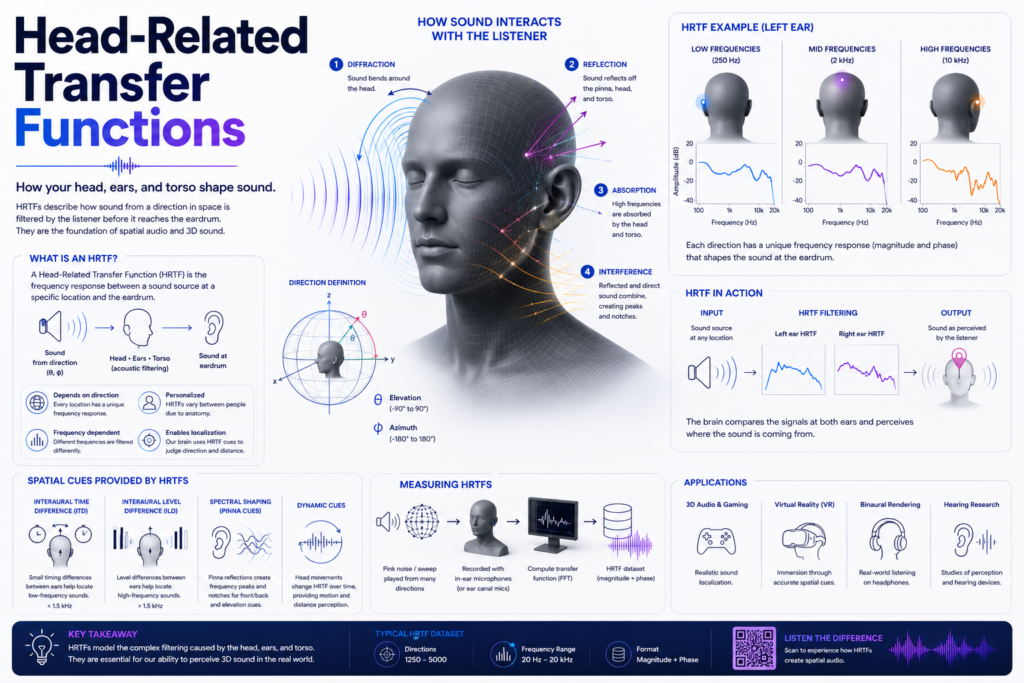
A Head-Related Transfer Function (HRTF) describes how the human head, ears and torso modify sound arriving from different directions.
The brain uses these acoustic differences to infer spatial location.
Digital audio systems can model these effects to create virtual three-dimensional sound fields over headphones.
This is one of the foundations of headphone-based spatial audio.
31. Object-Based Audio
Traditional channel-based audio sends fixed channels such as:
- left
- right
- center
- surround
Object-based audio instead describes individual sound objects together with spatial information.
The playback system can then render those objects for a particular speaker arrangement.
This approach enables more flexible immersive audio systems.
32. Dolby Atmos and Immersive Audio
Immersive audio technologies can represent sound in three dimensions rather than limiting it to traditional horizontal channels.
A playback system may attempt to reproduce:
- sounds beside the listener
- sounds behind the listener
- sounds above the listener
On headphones, spatial rendering is usually virtual rather than physically reproducing sound from multiple directions.
33. Audio Interfaces
Modern devices expose audio through several interfaces.
| Interface | Primary Role |
|---|---|
| 3.5 mm | Analog audio |
| USB | Digital audio |
| HDMI | Digital audio/video |
| Bluetooth | Wireless audio |
| Wi-Fi | Networked audio |
| Optical | Digital audio |
| I²S | Internal digital audio interconnect |
The distinction between digital and analog interfaces is important.
A 3.5 mm headphone connection generally carries analog audio.
USB can carry digital audio, meaning the receiving device may perform the DAC conversion.
34. Internal Audio Architecture
A modern smartphone or laptop can contain a complex audio subsystem.
A conceptual architecture is:
Microphones
↓
ADC
↓
Audio DSP
↓
Application Processor / SoC
↓
OS + Audio Framework
↓
DSP / Codec
↓
DAC
↓
Amplifier
↓
Speaker / Headphone Driver
At the same time, wireless audio may branch through:
SoC → Bluetooth Controller → Radio → Wireless Headphones
This demonstrates why audio is increasingly an SoC-level engineering problem.
35. Audio Processing in Smartphones
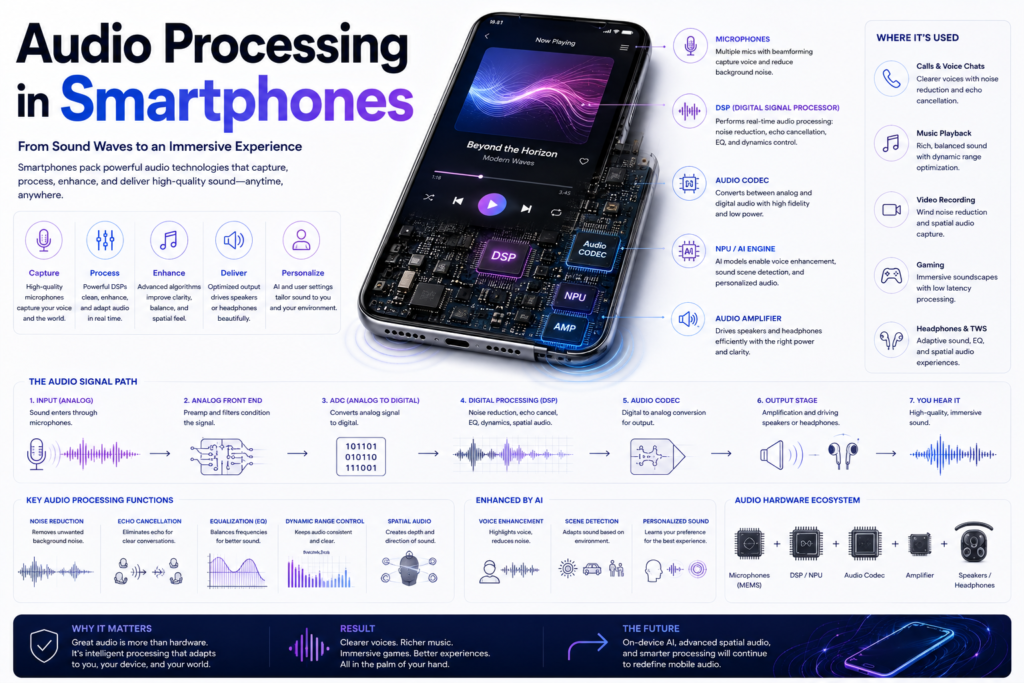
Smartphones combine multiple audio technologies in an extremely small physical volume.
A typical system may include:
- multiple MEMS microphones
- speaker drivers
- receiver speaker
- audio codec
- ADCs
- DACs
- amplifiers
- DSP
- ANC
- beamforming
- echo cancellation
- voice enhancement
- spatial audio
AI can further improve:
- speech separation
- background-noise removal
- voice isolation
- automatic mixing
- acoustic scene recognition
36. Audio in True Wireless Earbuds
TWS earbuds represent one of the most sophisticated miniature audio platforms.
A modern earbud can integrate:
- microphone array
- Bluetooth radio
- audio codec
- DSP
- ANC processing
- amplifier
- driver
- battery management
- motion sensors
- touch controls
The system must balance four competing objectives:
Sound Quality + Latency + Battery Life + Physical Size
This makes TWS engineering a highly constrained optimization problem.
37. Audio Quality: What Actually Matters?
Audio quality is multidimensional.
Important variables include:
- frequency response
- distortion
- noise
- dynamic range
- channel separation
- transient response
- phase behavior
- maximum output level
- spatial accuracy
- latency
- acoustic tuning
There is therefore no single specification that completely defines audio quality.
A higher sample rate or higher bitrate does not automatically mean better-sounding hardware.
38. Frequency Response
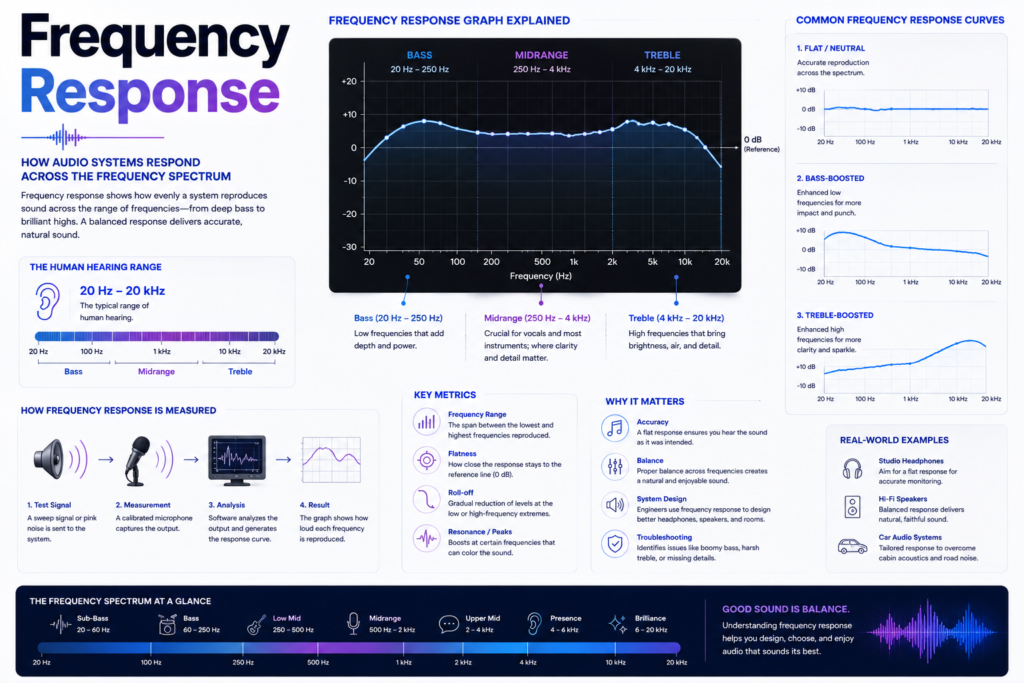
Frequency response describes how strongly a system reproduces different frequencies.
An idealized flat response would reproduce frequencies equally.
Real devices intentionally shape frequency response.
For example, consumer headphones may emphasize bass or treble according to a target tuning.
Frequency-response measurements are therefore essential when comparing audio products.
39. Signal-to-Noise Ratio
Signal-to-Noise Ratio (SNR) describes the strength of the desired signal relative to background noise.
Higher SNR generally means cleaner reproduction or recording.
Noise can originate from:
- electronics
- power supplies
- amplifiers
- ADCs
- DACs
- microphones
- wireless transmission
- environmental sources
40. Total Harmonic Distortion
Total Harmonic Distortion (THD) measures unwanted harmonic components introduced by a system.
Lower distortion generally indicates more accurate signal reproduction.
However, a single THD figure does not completely characterize perceived audio quality.
Measurement conditions matter.
41. Dynamic Range
Dynamic range is the difference between the quietest usable signal and the maximum signal level before unacceptable noise or distortion.
It matters for:
- recording
- microphones
- DACs
- amplifiers
- speakers
- mastering
A larger dynamic range provides greater separation between very quiet and very loud signals.
42. Hi-Res Audio
High-resolution audio generally refers to digital audio formats using specifications beyond traditional CD-quality parameters.
Examples can include:
- 24-bit audio
- 96 kHz
- 192 kHz
However, the presence of a high-resolution specification does not automatically guarantee superior audible quality.
The complete recording, mastering, playback chain and listening environment matter.
43. Audio Quality vs Audio Specification
This distinction is critical.
A product may advertise:
- 32-bit processing
- 192 kHz support
- high-bitrate Bluetooth
- multiple drivers
- high-power amplification
Yet those specifications alone cannot establish that the product sounds better.
A better evaluation framework considers:
Source + Codec + Conversion + DSP + Amplifier + Driver + Acoustic Design + Tuning + Environment
44. Audio Power and Battery Life
Portable audio systems operate under severe power constraints.
More processing can improve:
- noise cancellation
- spatial audio
- voice processing
- personalization
But it can also consume more power.
Designers therefore optimize:
Audio Performance per Watt
This has become increasingly important for:
- smartphones
- TWS earbuds
- smart speakers
- wearables
- AR glasses
45. AI and Audio Technology
Artificial intelligence is rapidly becoming part of the audio stack.
AI can be used for:
- speech enhancement
- source separation
- noise suppression
- voice cloning
- acoustic classification
- automatic equalization
- personalized hearing profiles
- spatial audio rendering
- transcription
- real-time translation
This is moving audio processing from fixed algorithms toward increasingly adaptive systems.
46. NPU-Assisted Audio
Modern SoCs increasingly contain NPUs or AI accelerators.
Audio workloads can potentially use them for:
- neural noise cancellation
- voice isolation
- acoustic event detection
- speech recognition
- speaker identification
- real-time translation
This creates a direct connection between the processor architecture and audio experience.
The audio system is no longer isolated from the compute architecture.
47. Computational Audio
Computational audio uses software and algorithms to compensate for physical limitations or create capabilities that would be difficult to achieve mechanically.
Examples include:
- virtual bass
- speaker protection
- acoustic beamforming
- room correction
- personalized EQ
- virtual spatialization
- AI noise removal
A small smartphone speaker can therefore produce an experience that depends heavily on computation rather than physical driver size alone.
48. Personalized Audio
Audio systems are moving toward individualized profiles.
A system can potentially account for:
- hearing characteristics
- ear geometry
- headphone fit
- listening environment
- content type
- personal preference
This creates a shift from:
One Audio Profile → Personalized Audio Profile
Machine learning can make this adaptation increasingly automatic.
49. Hearing Technology
Audio technology also overlaps with hearing assistance.
Modern hearing systems use:
- microphones
- DSP
- directional processing
- adaptive filtering
- feedback cancellation
- wireless connectivity
The distinction between consumer audio, hearables and hearing-assistance technology is increasingly becoming less rigid.
50. Automotive Audio
Vehicles provide a particularly complex audio environment.
Challenges include:
- road noise
- engine noise
- changing cabin acoustics
- multiple listeners
- speaker placement
- cabin reflections
Advanced automotive systems can use:
- multiple microphones
- dozens of speakers
- DSP
- ANC
- spatial audio
- seat-specific sound zones
The vehicle itself effectively becomes part of the audio system.
51. Audio Measurement
Audio engineering relies heavily on objective measurement.
Important measurements include:
| Measurement | What It Indicates |
|---|---|
| Frequency Response | Spectral reproduction |
| THD | Harmonic distortion |
| THD+N | Distortion plus noise |
| SNR | Signal relative to noise |
| Dynamic Range | Usable signal range |
| Channel Separation | Stereo isolation |
| Output Power | Driving capability |
| Sensitivity | Output relative to input |
| Impedance | Electrical load |
| Latency | Signal delay |
| SPL | Acoustic output level |
Measurements should always be interpreted together with their test conditions.
52. Audio Technology Specification Framework
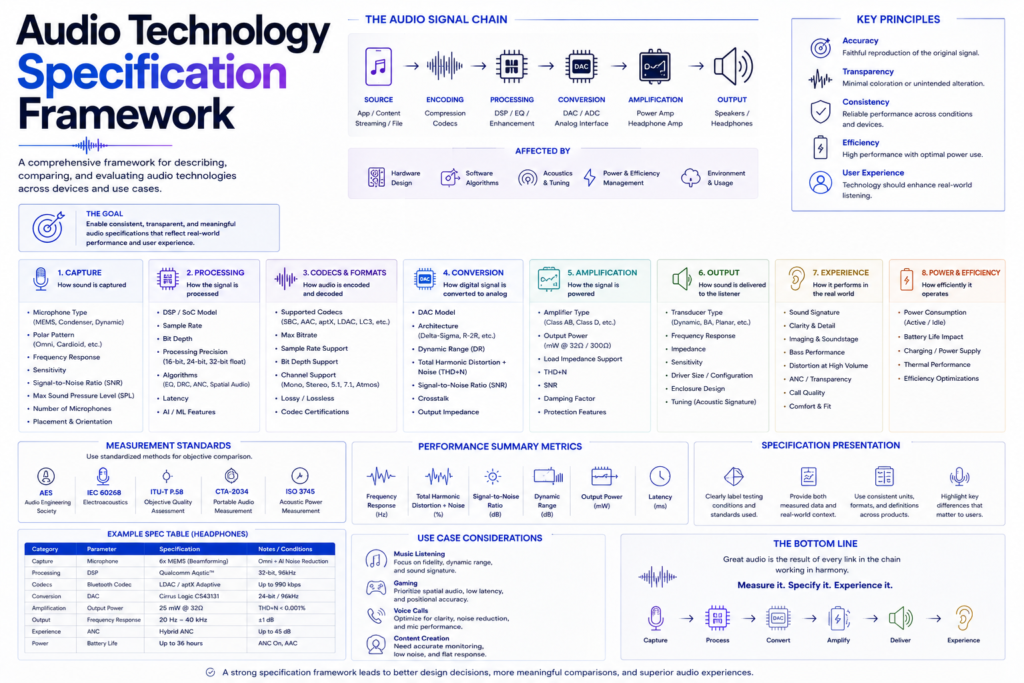
For Digital Plaza, audio products can be analyzed through the following framework:
Capture
- microphone type
- microphone count
- sensitivity
- frequency response
Conversion
- ADC
- DAC
- resolution
- sampling rates
- dynamic range
Processing
- DSP
- EQ
- ANC
- beamforming
- AI processing
Transmission
- Bluetooth version
- codec support
- bitrate
- latency
Amplification
- amplifier architecture
- output power
- efficiency
Transducer
- driver type
- driver size
- number of drivers
- enclosure
Acoustic Performance
- frequency response
- distortion
- maximum SPL
- isolation
Experience
- tuning
- spatial audio
- comfort
- battery life
- software support
53. Complete Audio Technology Stack
The modern audio system can be represented as:
Physical Sound
↓
Microphone / Acoustic Sensor
↓
Analog Front End
↓
ADC
↓
Digital Audio
↓
DSP / AI Processing
↓
Codec / Audio Framework
↓
Storage or Transmission
↓
Decoder
↓
DSP
↓
DAC
↓
Amplifier
↓
Transducer
↓
Acoustic Environment
↓
Human Hearing
This is the complete conceptual audio pipeline.
54. Where the SoC Fits
The modern SoC increasingly integrates several audio functions.
A smartphone SoC may contain or control:
- audio DSP
- CPU
- GPU
- NPU
- Bluetooth
- memory controller
- ISP
- power management
This creates opportunities for cross-domain processing.
For example:
Microphone → Audio DSP → NPU → CPU → AI Assistant
or:
Music → DSP → GPU/Audio Engine → Spatial Renderer → DAC
The boundary between audio hardware and general-purpose computing is therefore becoming increasingly blurred.
55. Common Audio Technology Misconceptions
Misconception 1: More drivers always mean better sound.
False.
Driver integration and acoustic tuning matter more than driver count alone.
Misconception 2: Higher sample rate automatically means better sound.
False.
Recording quality, mastering and playback hardware matter.
Misconception 3: More watts automatically mean better audio.
False.
Amplifier power is only one component of system performance.
Misconception 4: ANC and isolation are the same.
False.
Isolation is passive; ANC is active electronic processing.
Misconception 5: A better DAC automatically makes headphones sound better.
False.
The complete playback chain and transducer dominate the final result.
Misconception 6: Bluetooth determines all wireless audio quality.
False.
Codec, bitrate, implementation, DSP, radio conditions and transducer quality all matter.
Misconception 7: Human hearing is the only factor.
False.
Perceived audio depends on hearing, room acoustics, device response, psychoacoustics and signal processing.
56. Audio Technology by Device
| Device | Key Audio Technologies |
|---|---|
| Smartphone | MEMS microphones, DSP, speakers, ANC, spatial audio |
| Laptop | Microphone arrays, beamforming, speakers, AI noise suppression |
| TWS Earbuds | ANC, MEMS microphones, Bluetooth, DSP, miniature drivers |
| Headphones | Drivers, amplifier, ANC, spatial audio |
| Smart Speaker | Microphone arrays, beamforming, DSP, voice recognition |
| Television | Speaker arrays, DSP, Dolby/immersive audio |
| Car | Multi-speaker systems, DSP, ANC, spatial audio |
| Gaming Headset | Low-latency wireless, spatial audio, microphone processing |
| Professional Studio | High-quality ADC/DAC, microphones, interfaces, monitoring |
| Hearing Device | Adaptive DSP, directional microphones, feedback cancellation |
57. The Future of Audio Technology
Audio is moving toward a more computational and personalized architecture.
Major future directions include:
AI-Native Audio
Neural processing will increasingly perform real-time:
- separation
- enhancement
- translation
- personalization
Spatial Computing
Audio will increasingly respond to:
- head movement
- position
- environment
- virtual objects
Intelligent Hearables
Earbuds may increasingly function as:
- communication devices
- health sensors
- hearing enhancement systems
- AI interfaces
- environmental monitors
Software-Defined Audio
More of the audio experience will be controlled through firmware and software updates.
Personalized Acoustic Profiles
Devices may automatically optimize sound according to an individual’s hearing characteristics and preferences.
Ultra-Low-Latency Wireless Audio
Gaming, AR and immersive applications will push wireless systems toward lower end-to-end latency.
AI-Generated and AI-Transformed Audio
AI will increasingly create, reconstruct, translate and modify audio in real time.
58. What Comes Next: From Audio to Intelligent Hearables
The convergence of:
Audio + AI + Sensors + Connectivity + Semiconductor Processing
is producing a new class of devices.
Future earbuds and hearables could combine:
- microphones
- speakers
- IMUs
- biometric sensors
- AI accelerators
- wireless connectivity
- voice interfaces
- spatial awareness
The result could be an always-available personal audio and AI interface.
Digital Plaza Audio Analysis Framework
Digital Plaza should evaluate audio technology through five layers:
Layer 1 — Physical
- driver
- microphone
- enclosure
- acoustics
Layer 2 — Electrical
- amplifier
- ADC
- DAC
- power
Layer 3 — Digital
- DSP
- codec
- sampling
- bit depth
Layer 4 — Intelligent
- AI
- personalization
- adaptive processing
- spatial computation
Layer 5 — Experience
- sound quality
- clarity
- immersion
- latency
- comfort
- battery life
This prevents a review from becoming a simple specification checklist.
60. The New Audio Equation
Traditional audio evaluation often focused on:
Driver + Amplifier + Recording
Modern audio requires a broader model:
Audio Experience = Transducer + Acoustics + Conversion + DSP + Codec + Connectivity + AI + Software + Human Perception
This is the more useful framework for evaluating modern audio technology.
61. Audio Technology Is Becoming Computational
The biggest transformation in modern audio is not simply better speakers.
It is the increasing ability to use computation to overcome physical constraints.
A tiny speaker can be dynamically protected.
A microphone array can isolate a voice.
ANC can reduce environmental noise.
AI can separate multiple speakers.
Spatial algorithms can create virtual sound sources.
Personalized DSP can adapt the output to the listener.
The result is a fundamental change:
Audio hardware increasingly provides the physical foundation, while software and computation shape the final experience.
Final Takeaway
Audio technology is a complete engineering ecosystem spanning acoustics, transducers, analog electronics, ADCs, DACs, amplifiers, DSP, codecs, wireless connectivity, software and AI.
The basic signal chain remains:
Sound → Capture → Conversion → Processing → Transmission/Storage → Conversion → Amplification → Reproduction → Perception
But modern systems are becoming substantially more sophisticated.
The most important shift is the transition from purely hardware-defined audio toward computational, adaptive and personalized audio.
Tomorrow’s audio system will not simply reproduce a recording.
It may understand the environment, identify voices, suppress unwanted sound, adapt to the listener, render spatial objects and communicate with other devices in real time.
That makes audio increasingly connected to the broader technology stack:
Semiconductor → SoC → DSP/NPU → Connectivity → Software → AI → Acoustics → Human Experience
And that is why understanding audio technology is essential to understanding the next generation of smartphones, laptops, earbuds, wearables, vehicles, AR/VR systems and intelligent devices.