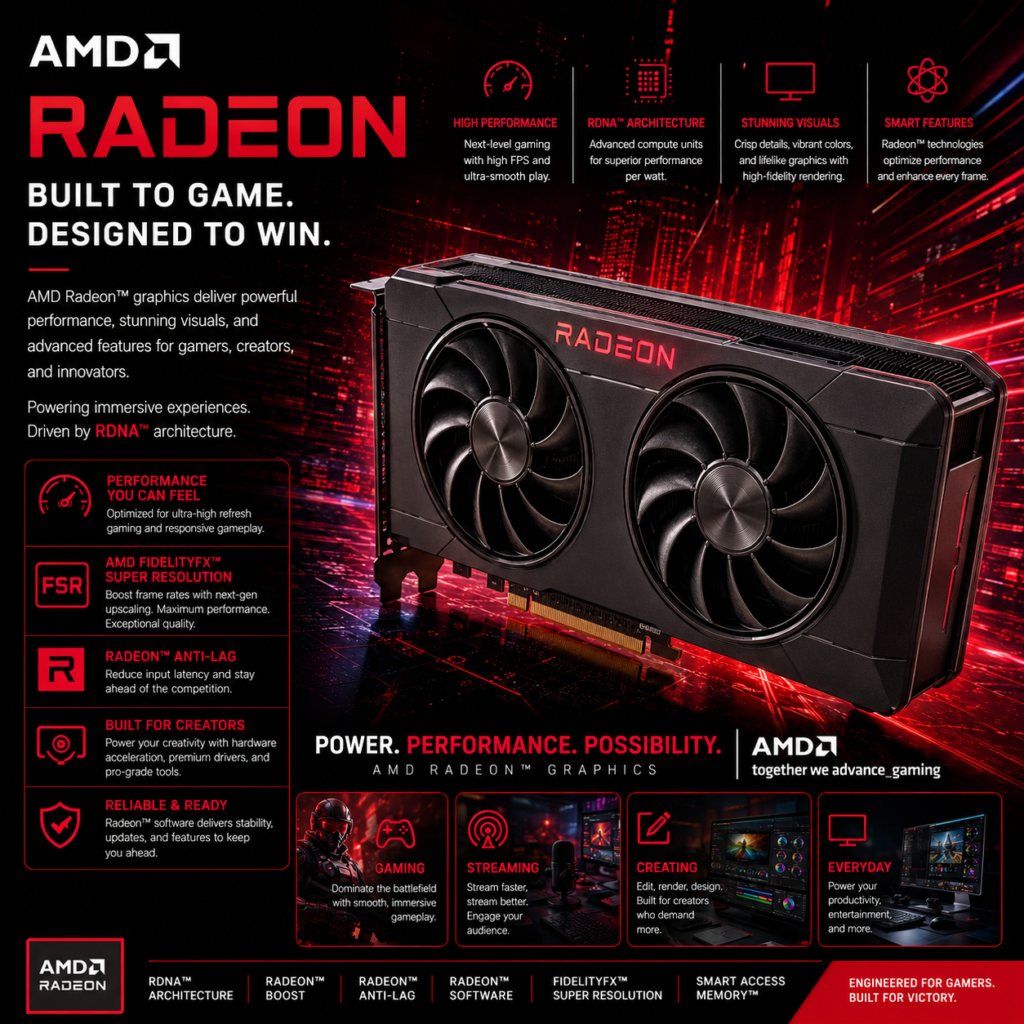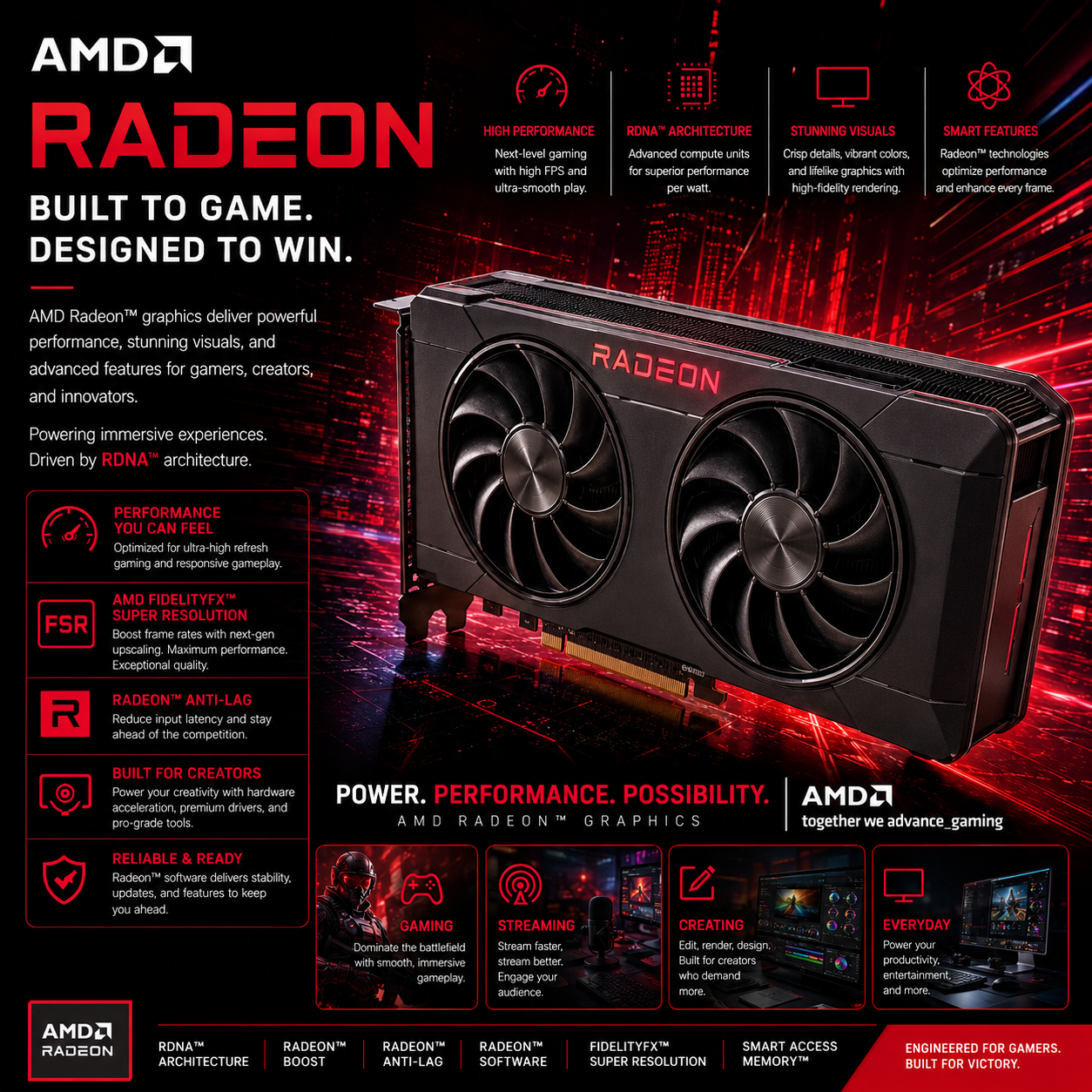
AMD Radeon has evolved from a conventional graphics brand into a heterogeneous GPU platform spanning gaming, ray tracing, AI acceleration, content creation and high-performance computing. With RDNA 4 and the Radeon RX 9000 series, AMD is pushing the architecture further toward AI-assisted graphics while retaining its long-standing focus on performance, efficiency, open software and value.
Thank you for reading this post, don't forget to subscribe!Article Type: Deep Technology Analysis
Category: GPUs / Graphics
Subcategory: Radeon / Consumer GPUs
Editorial Confidence: High for announced architecture and specifications; Medium for long-term strategic interpretation.
Meta Description
AMD Radeon has evolved from traditional GPU architecture into an AI-accelerated graphics platform. Explore RDNA, ray tracing, AI, FSR, Infinity Cache and Radeon’s future.
AMD Radeon has undergone a fundamental architectural transformation from GCN to RDNA and now RDNA 4. The latest Radeon RX 9000 series combines new compute units, third-generation ray-tracing accelerators, second-generation AI accelerators, Infinity Cache and ML-powered FSR technologies. The result is AMD’s most ambitious attempt yet to compete not only on conventional GPU performance, but also on ray tracing, AI-assisted rendering and the broader future of graphics computing.
In One Sentence
Radeon is AMD’s long-running effort to build a GPU platform around efficient programmable graphics, increasingly capable ray tracing and AI acceleration—while differentiating itself through architecture, memory design, software and value rather than following NVIDIA’s RTX strategy exactly.
Key Takeaways
- RDNA replaced GCN as AMD’s gaming-focused GPU architecture, prioritizing performance-per-watt and graphics efficiency.
- RDNA 2 introduced hardware ray tracing, bringing dedicated ray accelerators to Radeon gaming GPUs.
- RDNA 3 introduced chiplet-based GPU design at the high end, a major architectural experiment for consumer graphics.
- RDNA 4 substantially increases ray-tracing and AI capabilities, with third-generation ray-tracing accelerators and second-generation AI accelerators.
- The Radeon RX 9000 series brings RDNA 4 to desktop gaming, led by the RX 9070 XT and RX 9070.
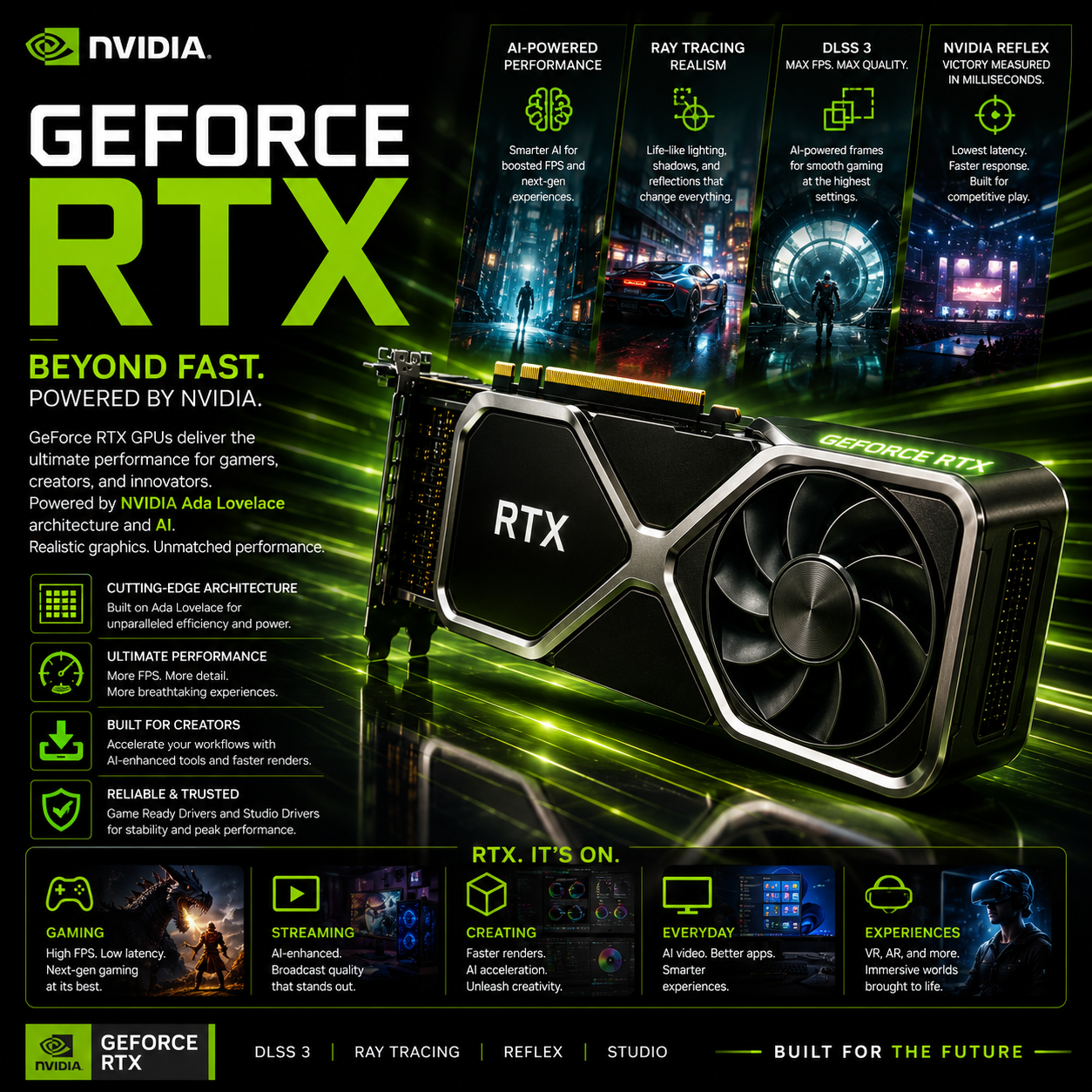
- AMD’s graphics strategy increasingly includes machine-learning-based rendering, particularly through the FSR technology family.
- Radeon therefore represents more than a graphics-card brand: it is becoming an increasingly heterogeneous graphics + AI computing platform.
1. Radeon Is More Than a Graphics Card
The word Radeon is often used as if it simply means an AMD graphics card.
That description is increasingly inadequate.
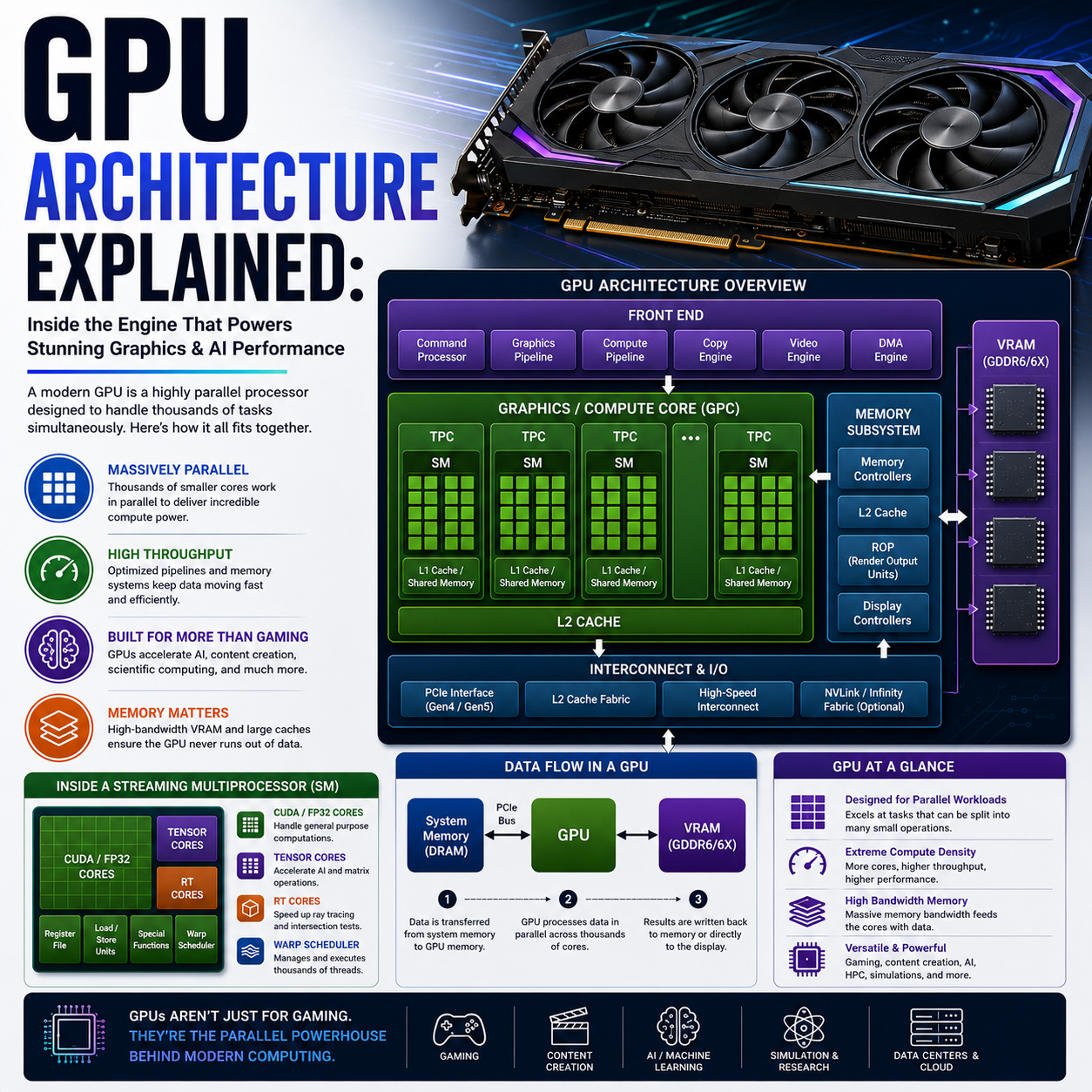
Modern Radeon GPUs contain several specialized processing capabilities designed for different workloads:
Programmable compute
Ray tracing
AI acceleration
Video processing
Display processing
High-bandwidth memory
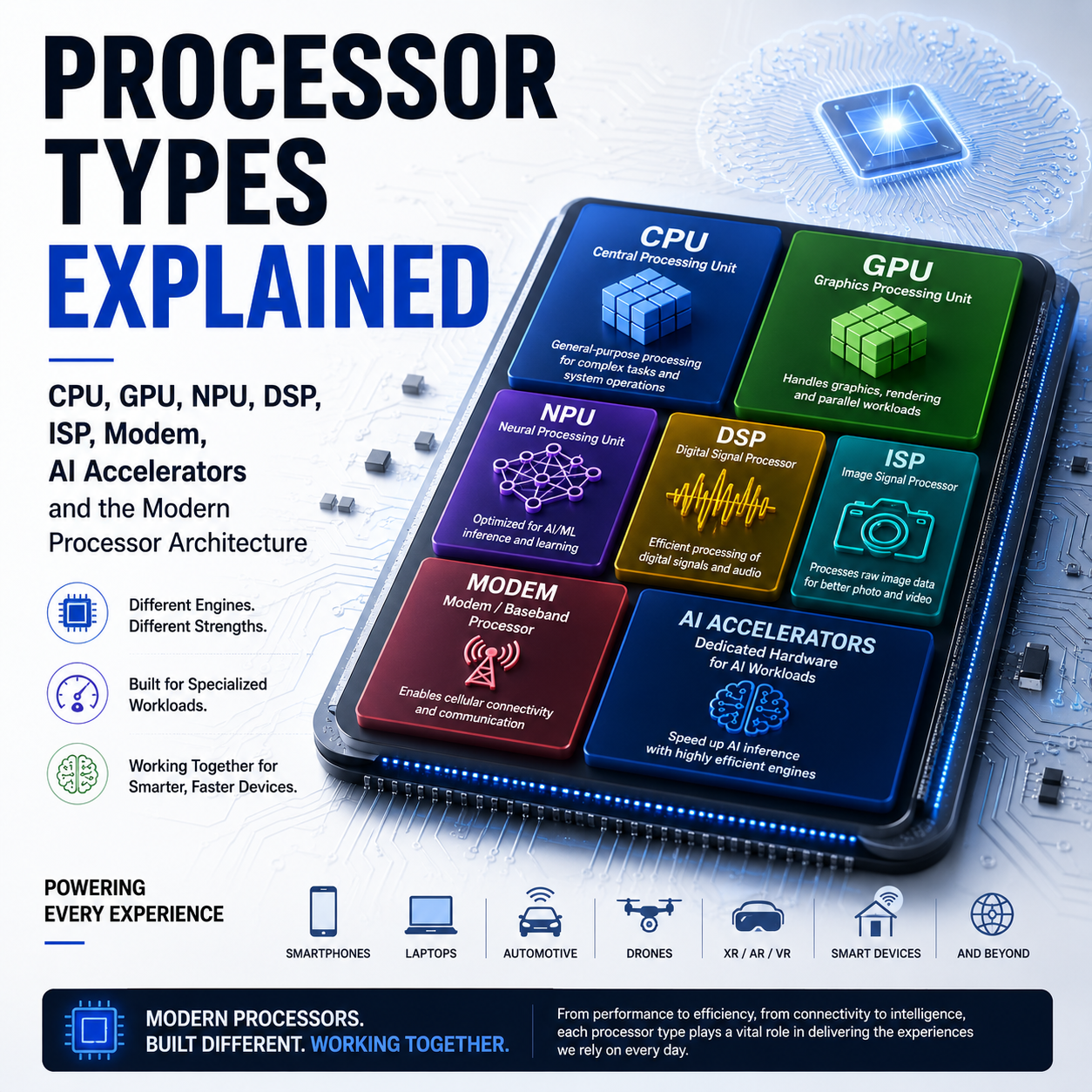
Together, these components create a heterogeneous computing platform.
That transformation has taken years.
Radeon moved from AMD’s long-running Graphics Core Next (GCN) architecture toward RDNA, then RDNA 2, RDNA 3 and now RDNA 4.
Each generation reflects a different stage of AMD’s attempt to solve the same fundamental problem:
How do you deliver more useful graphics performance without allowing power, complexity and silicon cost to rise at the same rate?
RDNA 4 is the latest answer.
2. Before RDNA: The GCN Era
Before RDNA, AMD’s graphics strategy was dominated by Graphics Core Next.
GCN was an important architecture because it was designed not simply for gaming but for a much broader range of GPU workloads.
That made it useful for:
- graphics
- compute
- professional workloads
- high-performance computing
- consoles
But gaming performance and power efficiency became increasingly important as the consumer GPU market evolved.
AMD therefore needed an architecture more explicitly optimized for modern graphics workloads.
That became RDNA.
The shift was not simply a branding exercise.
It represented a change in priorities.
3. RDNA: A New Graphics Philosophy
AMD introduced RDNA as a gaming-oriented architecture designed to improve performance and efficiency.
The central idea was to reorganize the GPU’s compute resources around the workloads that modern games actually produce.
AMD has continued to describe RDNA as an architecture designed to improve performance and efficiency across gaming hardware, from PCs and notebooks to consoles and handheld systems.
This is important because AMD’s graphics business has an unusually broad footprint.
Radeon technology exists not only in discrete desktop graphics cards but also in:
- gaming laptops
- integrated graphics
- handheld PCs
- game consoles
That gives AMD an architectural advantage of its own.
An RDNA design can influence several categories of devices.
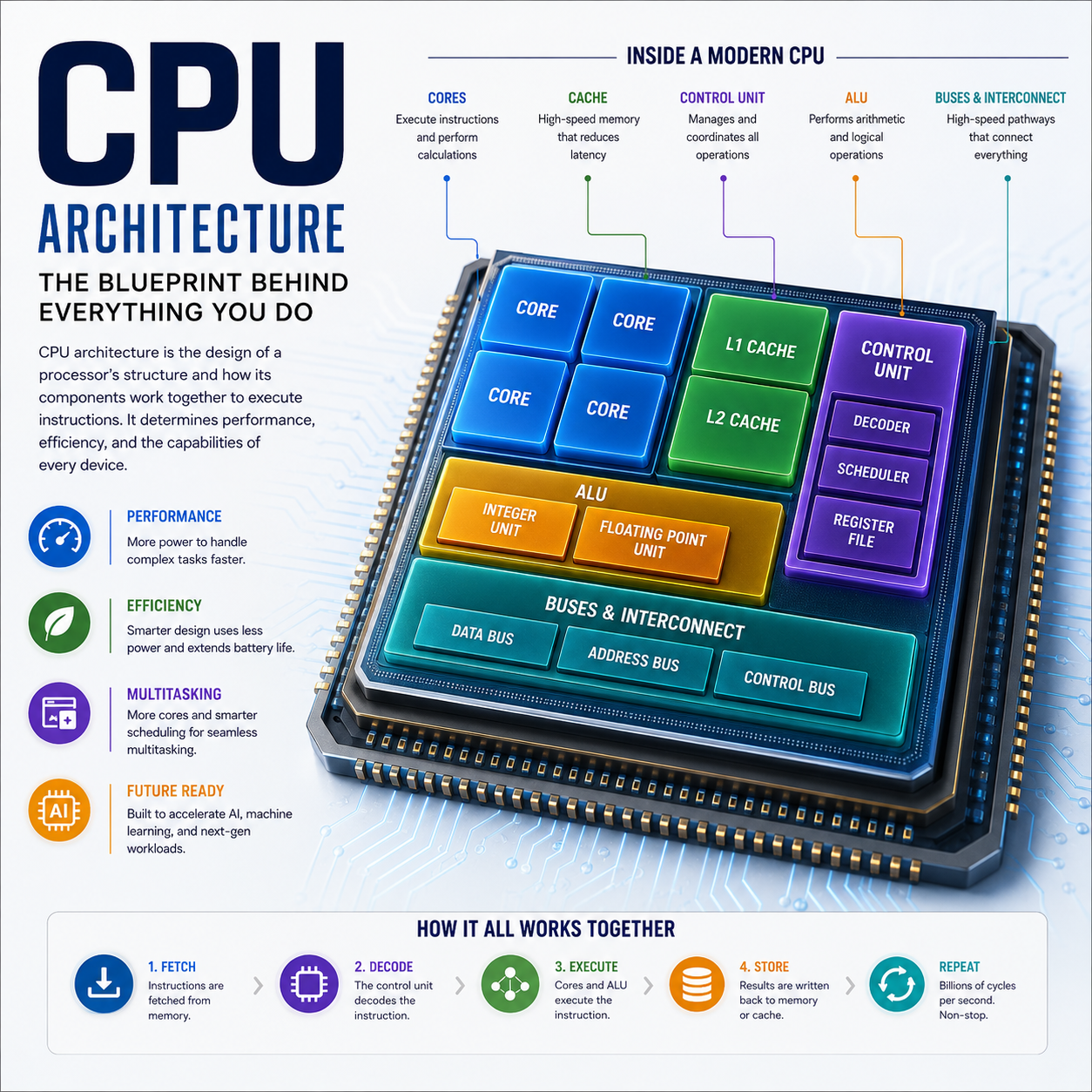
4. Compute Units: The Building Block of RDNA
At the center of RDNA is the Compute Unit, or CU.
A CU contains the programmable resources responsible for executing graphics and compute workloads.
The important point is that a modern GPU is not simply a collection of “cores” analogous to CPU cores.
A GPU is a hierarchy of:
Compute Units
↓
SIMD / vector processing
↓
Caches
↓
Memory subsystem
↓
GPU-wide resources
This architecture allows enormous numbers of relatively simple operations to be executed in parallel.
The resulting performance depends on far more than the number of compute units.
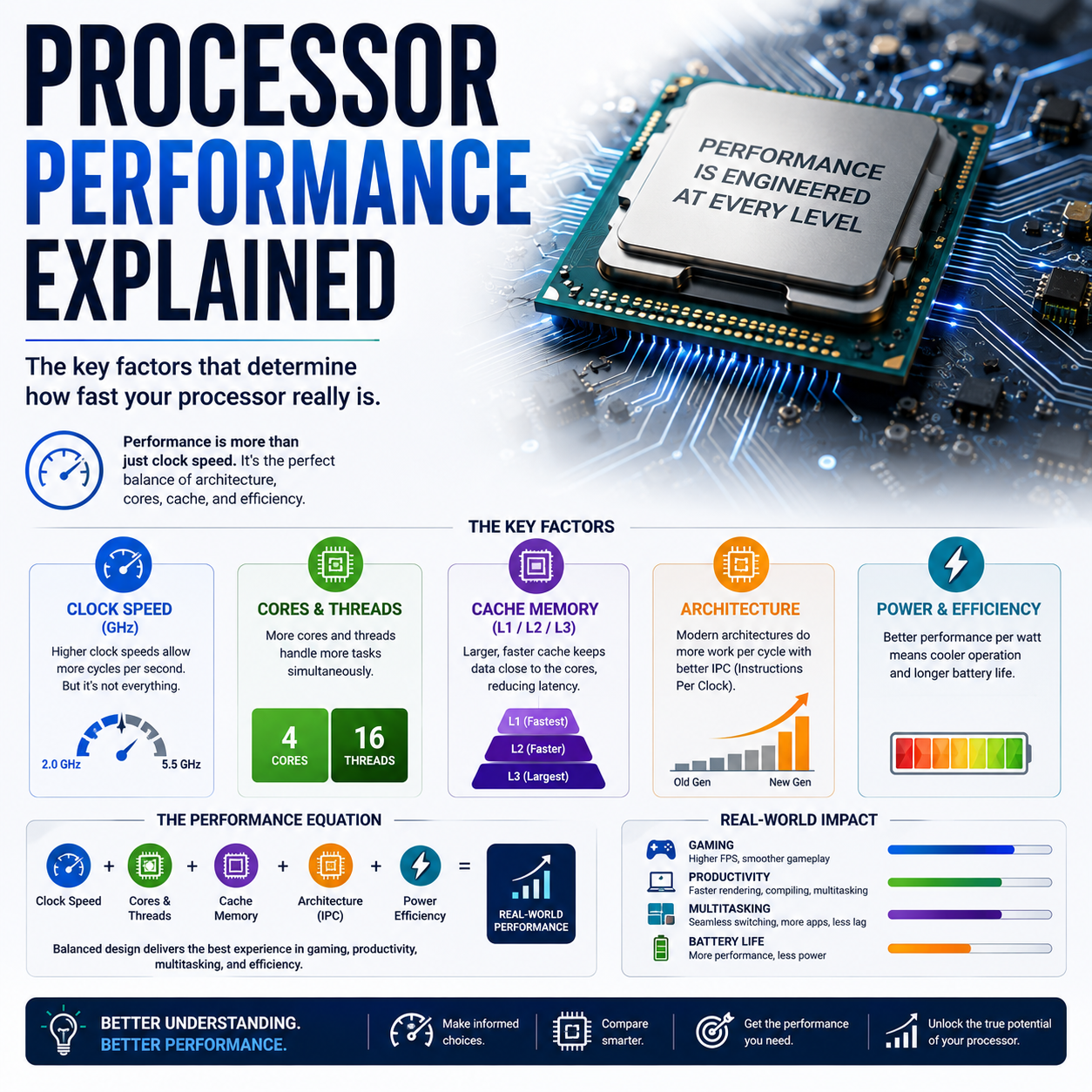
It depends on:
- architecture
- clock speed
- instructions per clock
- cache
- memory bandwidth
- workload characteristics
- power limits
- software optimization
This is why comparing GPUs using only “core counts” can be misleading.
5. RDNA 2: Ray Tracing Enters Radeon
The next major shift came with RDNA 2.
AMD introduced hardware ray-tracing acceleration through dedicated Ray Accelerators.
That placed Radeon on the same broad architectural path as NVIDIA RTX:
Traditional graphics
Dedicated ray-tracing hardware
The objective was similar.
Ray tracing can produce more realistic:
- reflections
- shadows
- lighting
- global illumination
but it is computationally expensive.
Dedicated hardware allows the GPU to accelerate specific ray-tracing operations without forcing the general shader architecture to handle every operation itself.
This transformed Radeon from a primarily rasterization-focused architecture into a more heterogeneous graphics platform.
6. Ray Tracing Is Still a Different Challenge for Radeon
Ray tracing is one area where architectural comparisons become particularly interesting.
A conventional rasterization workload is extremely parallel and predictable.
Ray tracing introduces more irregular workloads.
Rays can travel in different directions.
They can intersect different objects.
They can require different numbers of calculations.
That creates challenges involving:
- traversal
- intersection
- memory access
- shader execution
- denoising
AMD’s ray accelerators therefore have to work alongside the broader compute architecture.
The important architectural principle is:
Ray accelerators are not the whole GPU.
They accelerate part of the ray-tracing workload.
The rest still depends on programmable GPU resources and software.
7. RDNA 3: The Chiplet Experiment
One of AMD’s most interesting GPU architecture decisions arrived with RDNA 3.
AMD introduced a chiplet-oriented design for high-end GPUs.
The motivation was obvious from a semiconductor perspective.
Large monolithic dies become increasingly difficult and expensive as transistor counts increase.
Chiplets can allow designers to separate functions into multiple pieces of silicon and potentially improve manufacturing flexibility.
AMD explicitly identified RDNA 3 as using chiplet technology and highlighted improvements in performance-per-watt over RDNA 2.
The significance extends beyond one generation.
AMD had already demonstrated the benefits of chiplets extensively in its CPU business.
Applying the philosophy to GPUs represented a major architectural experiment.
8. Why Chiplets Matter
A monolithic GPU looks conceptually like:
One very large die
A chiplet design can instead separate parts of the architecture into:
Compute dies
Supporting dies
High-speed interconnect
This can provide potential benefits in:
- manufacturing yield
- scalability
- cost
- product segmentation
- reuse of design blocks
But GPU chiplets also create challenges.
Graphics workloads require enormous internal bandwidth.
Latency between chiplets matters.
Memory access must remain efficient.
The architecture therefore has to make chiplets behave as much like a unified GPU as possible.
This makes RDNA 3 an important milestone in AMD’s broader semiconductor strategy.
9. RDNA 4: AMD’s AI and Ray-Tracing Push
RDNA 4 represents a significant change in emphasis.
AMD describes the architecture as delivering improvements in:
- performance
- efficiency
- ray tracing
- AI acceleration
The architecture includes third-generation ray-tracing accelerators and second-generation AI accelerators.
AMD says RDNA 4 provides a substantial generational increase in performance and efficiency per compute unit compared with RDNA 3. It also claims up to twice the ray-tracing throughput of the previous generation.
This is important because AMD’s competitive position is increasingly being determined by the same technologies shaping the broader GPU industry:
Ray tracing + AI + efficient rendering
10. Inside RDNA 4’s AI Architecture
RDNA 4’s AI accelerators represent a more deliberate move into neural computation.
AMD says its second-generation AI accelerators support multiple data types and matrix operations, including FP16, INT8 and FP8-related workloads. Its architecture material describes a 64-unit matrix accelerator and increased throughput compared with RDNA 3.
AMD also says RDNA 4 delivers more than four times the AI compute of RDNA 3 at the architecture level and provides two AI accelerators per compute unit.
This is a critical development.
AI is no longer an incidental compute workload on Radeon.
It is becoming a designed-in architectural capability.
11. Radeon RX 9000: RDNA 4 in the Real World
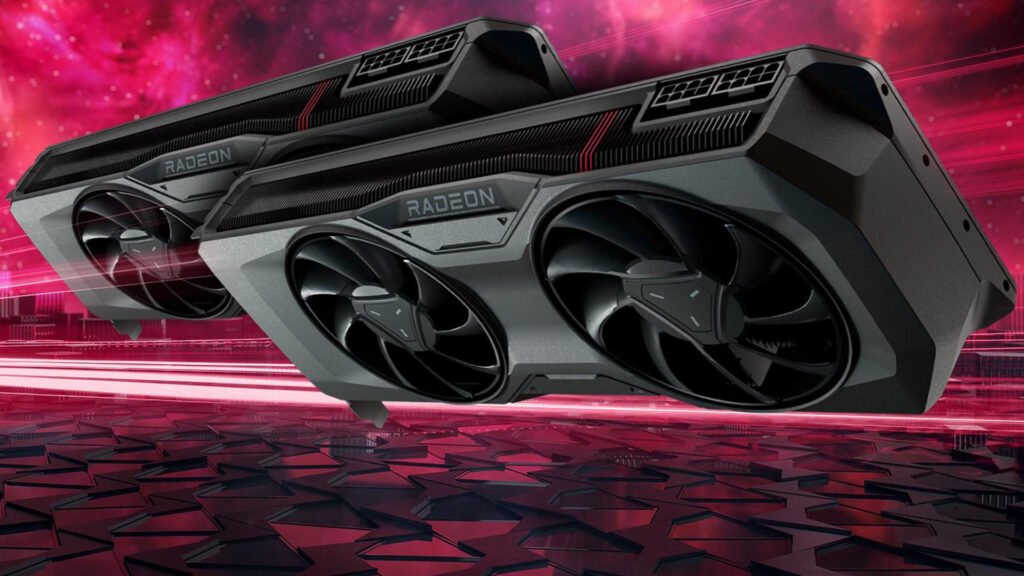
The Radeon RX 9000 series is the first major consumer implementation of RDNA 4.
The Radeon RX 9070 XT provides a useful architectural example.
It includes:
- 64 Compute Units
- 4,096 Stream Processors
- 64 Ray Accelerators
- 128 AI Accelerators
- 16GB GDDR6
- 256-bit memory interface
- 64MB Infinity Cache
- Up to 640GB/s memory bandwidth
- 304W typical board power
AMD lists a boost frequency of up to 2,970MHz.
The RX 9070 uses:
- 56 Compute Units
- 3,584 Stream Processors
- 56 Ray Accelerators
- 112 AI Accelerators
- 16GB GDDR6
- 64MB Infinity Cache
- up to 640GB/s bandwidth
with a lower 220W typical board power.
The architecture therefore scales without changing the fundamental model.
12. Infinity Cache: AMD’s Memory Strategy
One of AMD’s distinctive GPU technologies is Infinity Cache.
The basic problem is familiar:
Modern GPUs require enormous memory bandwidth.
But wider memory buses and faster external memory increase:
- power consumption
- board complexity
- cost
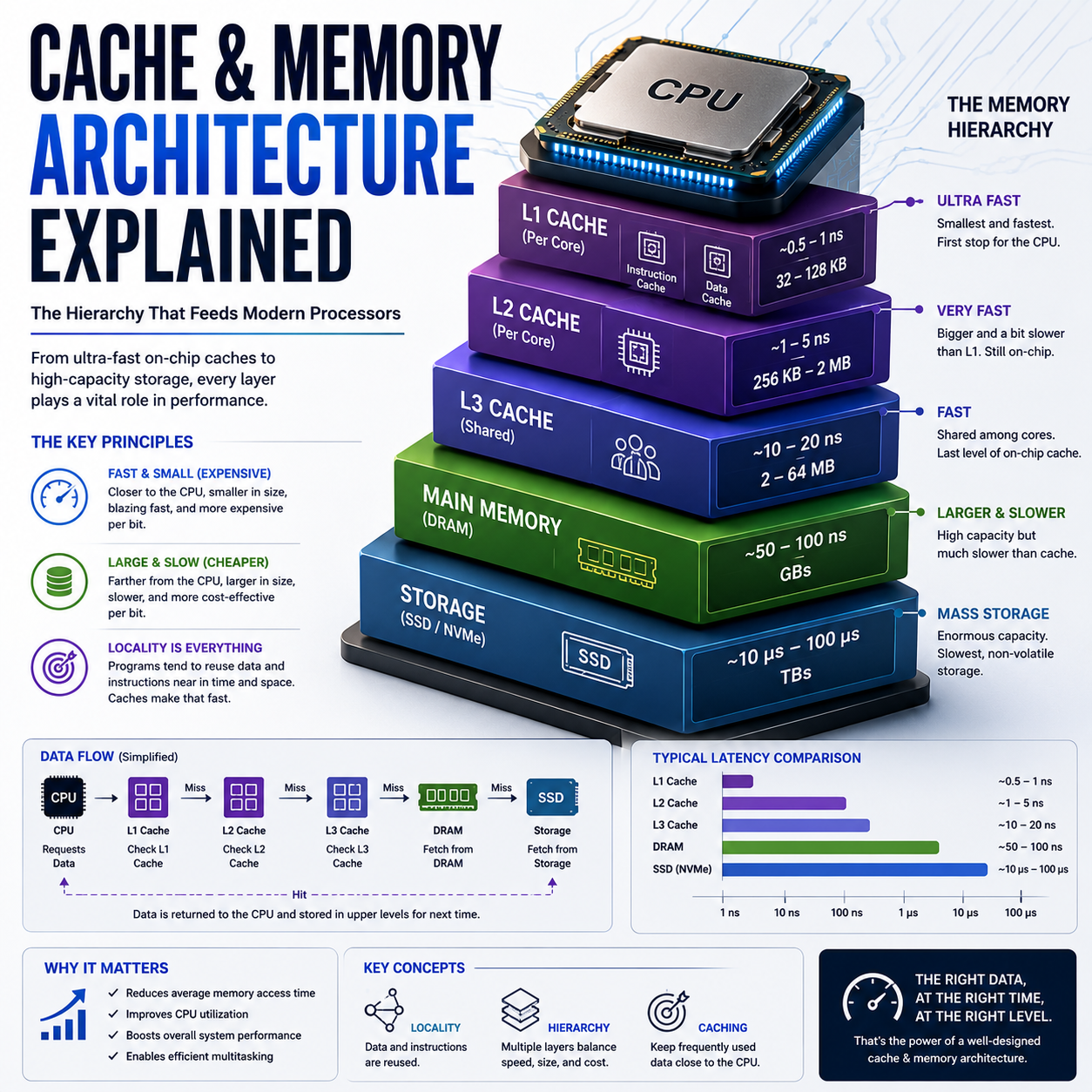
A large on-chip cache can reduce how frequently the GPU needs to access external memory.
The concept is:
GPU compute
↓
Large local cache
↓
External VRAM only when necessary
This can improve effective memory efficiency.
The RX 9070 XT, for example, combines 16GB GDDR6, a 256-bit interface and 64MB of Infinity Cache.
The important lesson is that memory bandwidth cannot be evaluated independently of cache architecture.
Two GPUs with identical external memory bandwidth can behave differently depending on cache effectiveness and workload.
13. FSR: AMD’s Answer to AI-Assisted Rendering
AMD’s FidelityFX Super Resolution, or FSR, is central to Radeon’s graphics strategy.
Its evolution illustrates an important philosophical difference between AMD and NVIDIA.
FSR began as a relatively lightweight image-scaling technology designed to support a broad range of hardware.
Over time, AMD has moved toward increasingly sophisticated temporal and machine-learning techniques.
AMD’s current FSR technology family includes:
- temporal upscaling
- frame generation
- ML-based upscaling
- ML-based frame generation
- ML-based ray regeneration
AMD now calls its current ML-powered upscaling technology FSR Upscaling, as part of its broader FSR “Redstone” technology family.
That evolution is strategically significant.
AMD is moving toward AI-assisted rendering without abandoning its broader software ecosystem.
14. FSR 4: AMD Embraces Machine Learning
The most important change is AMD’s move toward ML-based upscaling.
AMD introduced FSR 4 with RDNA 4 and describes it as a machine-learning-based algorithm designed to improve:
- temporal stability
- fine detail
- image quality
- ghosting behavior
The algorithm is trained using high-quality game data on AMD Instinct accelerators and uses RDNA 4’s hardware-accelerated matrix operations.
This marks an important philosophical shift.
AMD is no longer treating machine learning as something separate from its graphics pipeline.
It is using ML directly to construct a better final image.
That puts Radeon much closer to the broader industry transition toward neural rendering.
15. Radeon and the AI Graphics Transition
The modern Radeon architecture can now be understood through three major compute layers.
Conventional GPU
Rasterization + shaders
Ray-Tracing Hardware
Ray traversal / intersection acceleration
AI Hardware
Matrix operations + neural workloads
The result is increasingly similar to the overall direction of modern GPU design:
Compute + Ray Tracing + AI
But AMD’s implementation is not identical to NVIDIA’s.
That distinction matters.
16. Radeon vs GeForce: Different Paths to the Same Future
It is tempting to reduce the competition to:
AMD vs NVIDIA
But the more useful comparison is architectural.
NVIDIA
CUDA + RT Cores + Tensor Cores + DLSS + RTX ecosystem
AMD
Compute Units + Ray Accelerators + AI Accelerators + FSR + Radeon software ecosystem
Both companies are moving toward:
Rasterization + Ray Tracing + AI
But they arrived there through different architectural and software strategies.
NVIDIA established RTX around dedicated ray tracing and AI hardware earlier.
AMD initially emphasized broad hardware compatibility and software flexibility, then increasingly added dedicated AI capabilities.
RDNA 4 shows AMD closing that architectural gap in specific areas.
17. Rasterization Still Matters
One danger in the current AI discussion is assuming traditional graphics no longer matter.
They do.
A game still needs:
- geometry
- shaders
- textures
- rasterization
- physics
- animation
- lighting calculations
AI does not eliminate those workloads.
Instead, AI can reduce the amount of information that needs to be calculated directly.
That creates the same fundamental transition occurring across the GPU industry:
AI is becoming an accelerator for graphics rather than a replacement for graphics.
This is one of the most important ideas readers should understand.
18. Ray Tracing Is Still a Major Radeon Challenge
AMD has made significant progress with ray tracing.
RDNA 4 introduces third-generation ray-tracing accelerators, and AMD says the architecture provides up to twice the ray-tracing throughput per generation compared with RDNA 3.
But ray tracing remains a workload where architecture, software and game-engine optimization interact heavily.
The relevant question is not simply:
How many Ray Accelerators does a GPU have?
It is:
How much useful ray-traced performance does the entire platform deliver per watt and per dollar?
That requires real-world testing.
19. VRAM: Radeon Has a Strategic Advantage
Memory capacity is increasingly important for modern graphics.
The RX 9070 XT and RX 9070 both provide 16GB of GDDR6.
That capacity can be valuable for:
- 4K gaming
- high-resolution textures
- ray tracing
- content creation
- local AI workloads
AMD is also explicitly positioning Radeon around local AI, highlighting large VRAM capacity as an advantage for running larger AI models.
This is strategically important.
As AI workloads increasingly move onto consumer PCs, VRAM becomes both a graphics resource and an AI memory resource.
That changes how GPU memory should be evaluated.
20. Radeon Is Becoming a Local AI Platform
This is one of the most interesting developments in AMD’s current strategy.
Radeon can now be positioned for:
Gaming
Ray tracing
AI inference
Content creation
Local generative AI
AMD says RX 9000-series graphics can provide up to 1,557 TOPS of INT4 performance on the RX 9070 XT under its specified conditions.
But TOPS alone should not be treated as an application-performance metric.
Real AI performance depends on:
- model architecture
- precision
- sparsity
- software stack
- memory
- optimization
- framework support
This is another reason Digital Plaza should separate theoretical accelerator throughput from measured application performance.
21. Software Is Radeon’s Other Battlefield
Hardware is only half the story.
AMD’s Software: Adrenalin Edition provides the software layer for Radeon gaming and performance management.
AMD highlights functions including:
- driver updates
- performance monitoring
- Radeon Anti-Lag
- Radeon Boost
- HYPR-RX
- Fluid Motion Frames
- FreeSync
- image sharpening
- FSR
- Smart Access Memory
AMD’s current Radeon product pages position Adrenalin as the central interface for drivers, performance data and software features.
This is important because modern GPUs increasingly compete through software.
The GPU itself is only the foundation.
22. AMD’s Open-Technology Philosophy
One of AMD’s recurring strategic themes has been broader hardware compatibility.
That philosophy has influenced technologies such as FSR.
Historically, some AMD graphics technologies have been designed to operate across a wider range of GPUs rather than requiring a specific generation of AMD hardware.
That creates an important trade-off.
Advantage
Broader adoption.
Disadvantage
Potentially less opportunity to optimize around a narrowly defined hardware platform.
AMD’s recent move toward ML-based FSR changes that equation somewhat.
The more advanced the AI model becomes, the more important specialized hardware becomes.
FSR’s evolution therefore represents a balancing act between:
openness
and
hardware-specific optimization.
23. The Chiplet Question
RDNA 3 demonstrated AMD’s willingness to use chiplets in consumer GPUs.
But chiplets are not automatically superior.
A GPU is an exceptionally bandwidth-sensitive processor.
Communication between compute resources must be fast.
Data locality matters.
Cache coherence and memory access patterns matter.
The success of a chiplet GPU therefore depends on whether the system-level architecture can make multiple pieces of silicon behave like a coherent high-performance processor.
AMD’s CPU experience gives it an unusual advantage here.
But GPUs impose different constraints.
That makes the Radeon chiplet story one of the most interesting architectural experiments in modern consumer computing.
24. How Radeon Performance Should Be Measured
A serious Radeon review should divide performance into distinct layers.
Rasterization
Traditional game rendering.
Ray Tracing
Hardware-accelerated ray-traced workloads.
Path Tracing
Extremely demanding lighting workloads.
FSR Upscaling
AI or temporal reconstruction performance.
Frame Generation
Generated-frame performance.
Native Resolution
Pure rendering performance without upscaling.
AI
Real-world AI inference and content-generation workloads.
VRAM
Capacity and memory-pressure behavior.
Efficiency
Performance per watt.
This prevents one metric from becoming a misleading representation of the entire GPU.
25. What Radeon Means for Gamers
For gamers, Radeon remains fundamentally about performance, image quality and value.
But the definition of those terms is changing.
A modern Radeon GPU must increasingly deliver:
- strong raster performance
- competitive ray tracing
- high image quality
- effective upscaling
- frame generation
- low latency
- efficient power use
The RX 9000 generation shows AMD attempting to combine those elements with stronger AI capabilities and improved ray tracing.
The competitive question is therefore no longer simply whether Radeon can render a game quickly.
It is whether Radeon can provide a complete modern graphics experience.
26. What Radeon Means for Creators
Radeon GPUs can also serve workloads outside traditional gaming:
- video editing
- streaming
- 3D rendering
- image processing
- AI
- encoding
- simulation
The Enhanced Media Engine and Radeon display technologies in RDNA 4 expand the platform’s capabilities for modern content workflows. AMD says RX 9000 also introduces a redesigned Radiance Display Engine and Enhanced Media Engine.
That makes Radeon increasingly relevant as a general-purpose graphics and media accelerator.
27. What Radeon Means for AI
AMD’s AI strategy deserves special attention.
The company is effectively building two complementary AI paths.
Radeon
Consumer and workstation local AI.
Instinct
Data-center and large-scale AI acceleration.
That creates a continuum:
PC AI → Workstation AI → Data-center AI
Radeon therefore becomes part of AMD’s larger AI strategy rather than an isolated gaming product.
This is particularly important because local AI is becoming a growing category.
28. What We Don’t Know
Several important questions remain open.
Can Radeon close the software ecosystem gap?
Hardware progress is easier to measure than software maturity.
How competitive will ML-based FSR become?
Image quality and game support will determine its real value.
Can AMD sustain ray-tracing gains?
RDNA 4 represents a major improvement, but continued progress is necessary.
Will chiplets return in future high-end gaming GPUs?
The long-term role of chiplets remains strategically interesting.
Can Radeon become a major consumer AI platform?
Hardware capability exists, but software and developer adoption will be decisive.
How will AMD balance openness and optimization?
The more AI-specific Radeon becomes, the greater the potential tension between broad compatibility and specialized hardware acceleration.
29. Editorial Analysis
Radeon is at an important architectural crossroads.
For years, AMD’s strongest GPU story was relatively straightforward:
Strong rasterization performance, competitive pricing and efficient hardware.
The industry has changed.
Ray tracing has become a mainstream graphics capability.
AI has become part of the rendering pipeline.
Upscaling has become a standard performance technology.
Frame generation has changed how frame rate is interpreted.
And local AI is creating new demand for GPU compute and memory.
AMD therefore has to compete on more dimensions than it did during the early RDNA era.
RDNA 4 shows that AMD understands this shift.
The architecture adds stronger ray-tracing hardware and significantly more capable AI accelerators.
FSR is also moving toward ML-powered rendering.
The result is a Radeon platform that looks increasingly similar to the broader direction of the GPU industry:
Graphics + Ray Tracing + AI
But AMD’s opportunity is not to simply reproduce NVIDIA’s strategy.
Its opportunity is to create a different balance.
AMD can compete through:
- GPU efficiency
- VRAM capacity
- price/performance
- broader hardware support
- open technologies
- CPU/GPU platform integration
- AI acceleration
- gaming consoles
- PC ecosystem
That combination could be more powerful than simply attempting to match NVIDIA feature-for-feature.
30. Radeon vs GeForce: The Real Competition
The future competition can be summarized as:
NVIDIA
RTX + CUDA + DLSS + Tensor + RT
AMD
Radeon + RDNA + FSR + AI Accelerators + Ray Accelerators
Both are converging toward AI-assisted graphics.
But they retain different strengths.
NVIDIA’s advantage is its exceptionally mature AI and software ecosystem.
AMD’s opportunity lies in combining GPU hardware, Ryzen integration, Radeon graphics, broader platform reach and aggressive performance/value positioning.
The next phase of competition will determine whether AMD can turn its improving hardware architecture into an equally compelling complete platform.
31. Three Possible Futures for Radeon
Scenario 1 : Performance and Value
AMD continues to prioritize strong rasterization and competitive pricing while gradually improving ray tracing and AI.
Most conservative path.
Scenario 2 : Balanced Graphics + AI
Radeon becomes equally focused on:
Rasterization + Ray Tracing + AI
FSR becomes increasingly important, while AI accelerators become a standard part of the GPU architecture.
Most plausible path.
Scenario 3 : Neural Radeon
AI becomes deeply integrated into the rendering pipeline.
Radeon GPUs increasingly use machine learning for:
- reconstruction
- ray regeneration
- lighting
- materials
- animation
- frame generation
In this scenario, AMD’s AI architecture becomes as strategically important as its traditional compute architecture.
32. What to Watch Next
Digital Plaza should track:
- RDNA 4 ray-tracing performance
- FSR ML image quality
- FSR frame generation
- AI accelerator utilization
- Radeon local AI performance
- VRAM capacity
- Power efficiency
- Future chiplet designs
- Game-engine adoption
- AMD’s software ecosystem
- Radeon vs GeForce pricing
- Next-generation RDNA architecture
Digital Plaza Verdict
Radeon Is No Longer Just the Alternative GPU
AMD Radeon has reached an important point in its evolution.
The transition from GCN to RDNA established a stronger gaming architecture.
RDNA 2 brought hardware ray tracing.
RDNA 3 demonstrated AMD’s willingness to rethink GPU construction through chiplets.
RDNA 4 now pushes significantly harder into ray tracing and AI acceleration.
And FSR is evolving from traditional upscaling toward machine-learning-based rendering.
The result is a Radeon architecture that increasingly resembles the future of the GPU itself:
programmable compute + specialized ray tracing + specialized AI + large memory + intelligent software.
The challenge for AMD is no longer simply building a competitive GPU.
It is building a competitive graphics platform.
That means matching the entire experience:
hardware → drivers → game engines → AI → image quality → latency → developer adoption.
AMD has made substantial architectural progress.
The next question is whether Radeon can convert that progress into the kind of software and ecosystem advantage that has made NVIDIA’s RTX platform so difficult to displace.
That is the real Radeon story.
And it is why the future of AMD graphics will be determined not only by how many frames a Radeon GPU can render, but by how intelligently it can create the final visual experience.