Meta Description:
Explore Samsung’s 32-inch M8 UHD 4K AI Smart Monitor, combining 4K resolution, AI features, smart TV functionality, productivity tools and a connected entertainment experience.
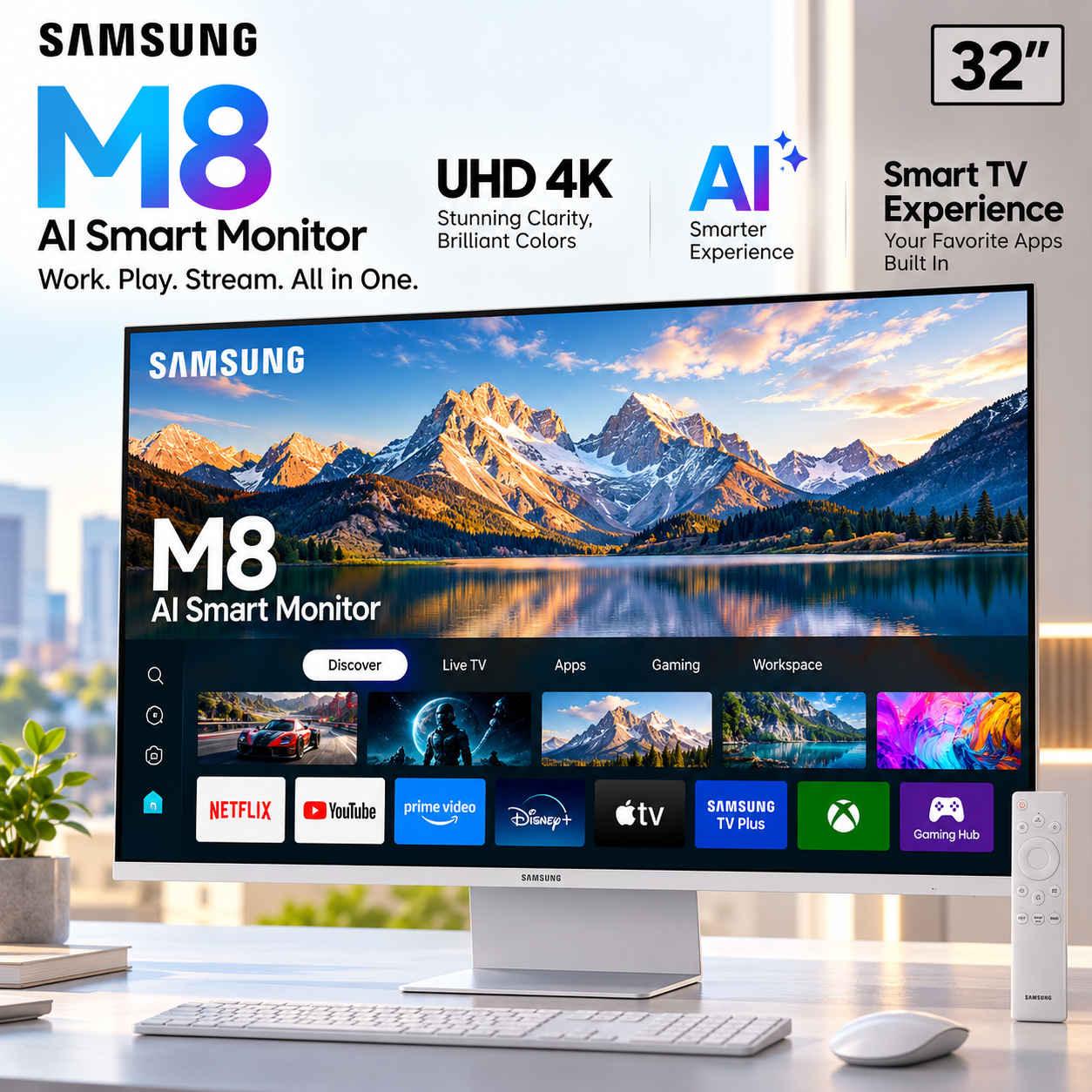
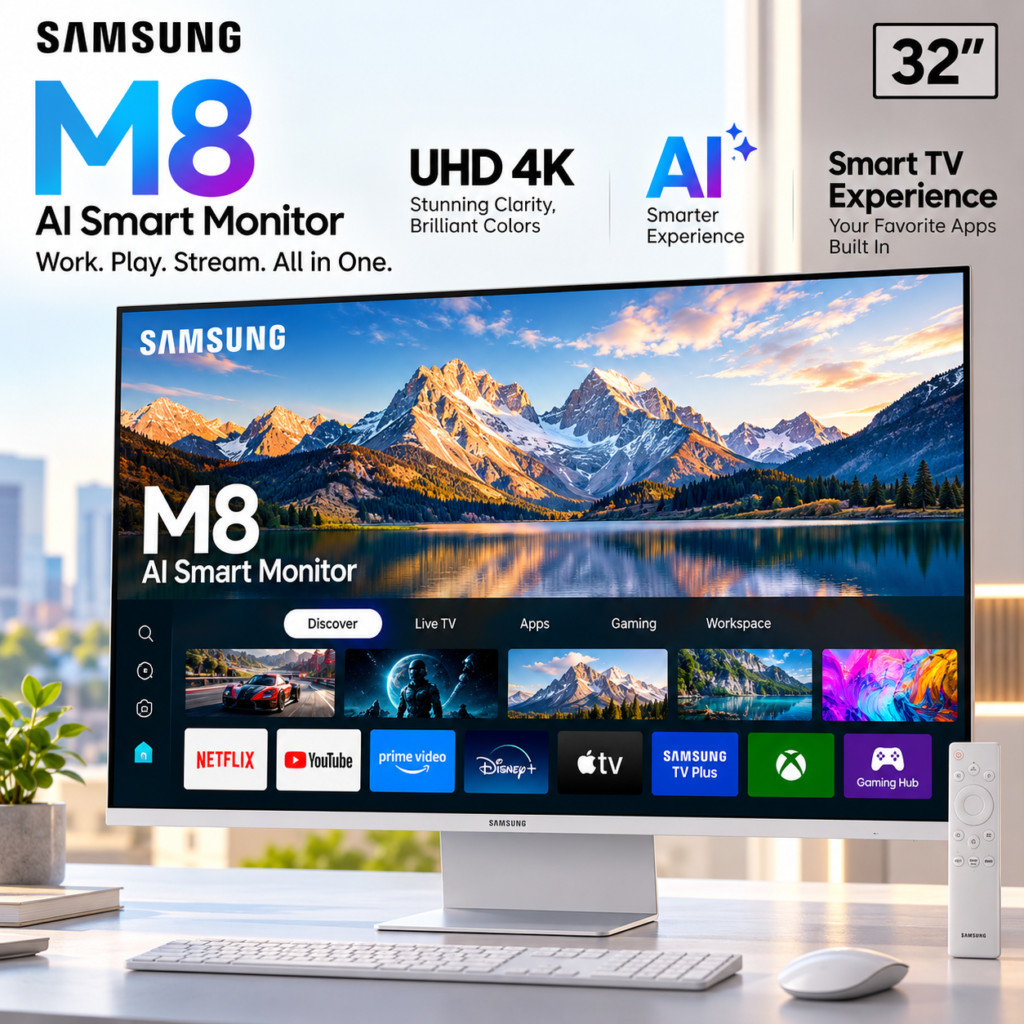
Samsung’s 32-inch M8 UHD 4K AI Smart Monitor combines 4K display technology, AI-powered features, smart TV functionality and PC productivity in a connected all-in-one display.
The Samsung 80 cm (32-inch) M8 UHD 4K AI Smart Monitor represents an important shift in how a modern display can be used. Rather than functioning solely as an external screen for a PC, the M8 combines UHD 4K resolution, smart-TV functionality, AI-enabled features, connected services and traditional monitor capabilities in a single device.
That makes the M8 fundamentally different from a conventional 32-inch 4K monitor.
A traditional monitor generally follows a simple architecture:
PC → Display cable → Monitor
The M8 expands that model:
PC + Streaming + Smart TV + Apps + AI + Connected Devices → One Display
The result is an all-in-one display designed for users who want a large, high-resolution workspace during the day and a television-like entertainment platform when the workday ends.
1. At a Glance
| Technology | Samsung M8 |
|---|---|
| Screen size | 32-inch / 80 cm |
| Resolution | UHD 4K |
| Resolution | 3,840 × 2,160 |
| Aspect ratio | 16:9 |
| Display category | Smart Monitor |
| Smart platform | Samsung Smart TV experience |
| AI | AI-enabled features, model/region dependent |
| Connectivity | Wi-Fi, Bluetooth and wired interfaces |
| Use cases | PC, productivity, entertainment, streaming |
| Form factor | Desktop monitor |
| Primary concept | Monitor + Smart TV + connected workspace |
Exact specifications can vary by M8 generation, model number and market, so the specific SKU should always be verified before publication or purchase.
2. What Is a Smart Monitor?
A conventional monitor is primarily an output device.
It receives a video signal from another device and displays it.
A smart monitor is different because it contains its own computing environment.
The basic architecture becomes:
Display Panel
↓
Display Processor
↓
Operating System / Smart Platform
↓
Apps + Streaming + Connectivity + Smart Features
That means the monitor can perform certain functions without a connected PC.
This is the fundamental idea behind Samsung’s Smart Monitor family.
The M8 takes that concept further by combining the monitor with a Smart TV-style experience.
3. Why the 32-inch Size Matters
At 32 inches, the M8 occupies an interesting position between conventional desktop monitors and televisions.
A 24-inch monitor is generally optimized for close-range desktop work.
A 27-inch display provides more workspace.
A 32-inch 4K monitor provides substantially more physical screen area while maintaining high pixel density.
The M8’s:
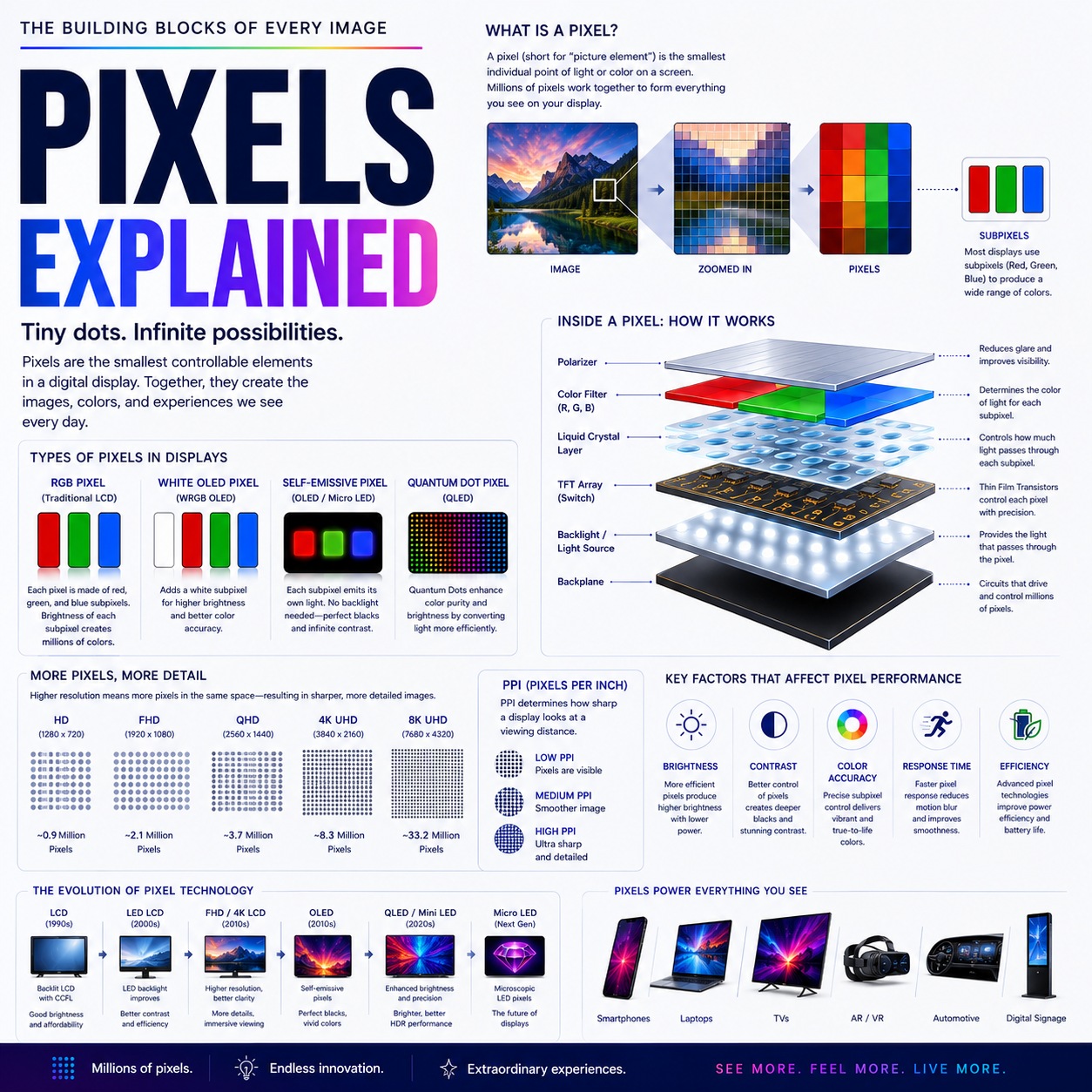
3,840 × 2,160 pixels
produces approximately:
8.29 million pixels
across the display.
That is four times the pixel count of a conventional:
1,920 × 1,080 Full HD
display.
The result is a large desktop canvas with enough resolution to display fine text, detailed images and high-resolution video.
4. UHD 4K: More Than Just More Pixels
4K is often treated as a simple resolution upgrade.
Technically, however, the additional pixels change how applications can be arranged.
A 32-inch 4K display can simultaneously accommodate:
Browser + Document
or:
Spreadsheet + Email + Browser
or:
Video Timeline + Preview Window + Assets
or:
Code Editor + Documentation + Terminal
The advantage is particularly noticeable when working with large documents, spreadsheets, photographs, video timelines and other information-dense interfaces.
The M8 therefore functions as a high-density workspace, not simply a larger screen.
5. Pixel Density and Desktop Sharpness
A 32-inch 3,840 × 2,160 display provides approximately:
138 pixels per inch
That is considerably denser than a 32-inch 1080p monitor.
Higher pixel density can improve:
- Text sharpness
- UI detail
- Image clarity
- Fine graphical elements
- 4K video presentation
However, operating-system scaling becomes important.
At native 100% scaling, interface elements can appear relatively small.
Many users may therefore prefer:
125% or 150% scaling
depending on viewing distance and eyesight.
This is not a weakness of 4K. It is a consequence of having substantially more pixels available within the same physical screen size.
6. The M8 as a Desktop Display
When connected to a PC or laptop, the M8 behaves like a conventional monitor.
That makes it suitable for:
Office Productivity
- Word processing
- Spreadsheets
- Presentations
- Web research
Creative Work
- Photography
- Graphic design
- Video editing
- Content creation
Development
- Programming
- IDEs
- Documentation
- Browser testing
- Terminal workflows
The key advantage is that users do not have to give up the Smart Monitor functionality when using it as a PC display.
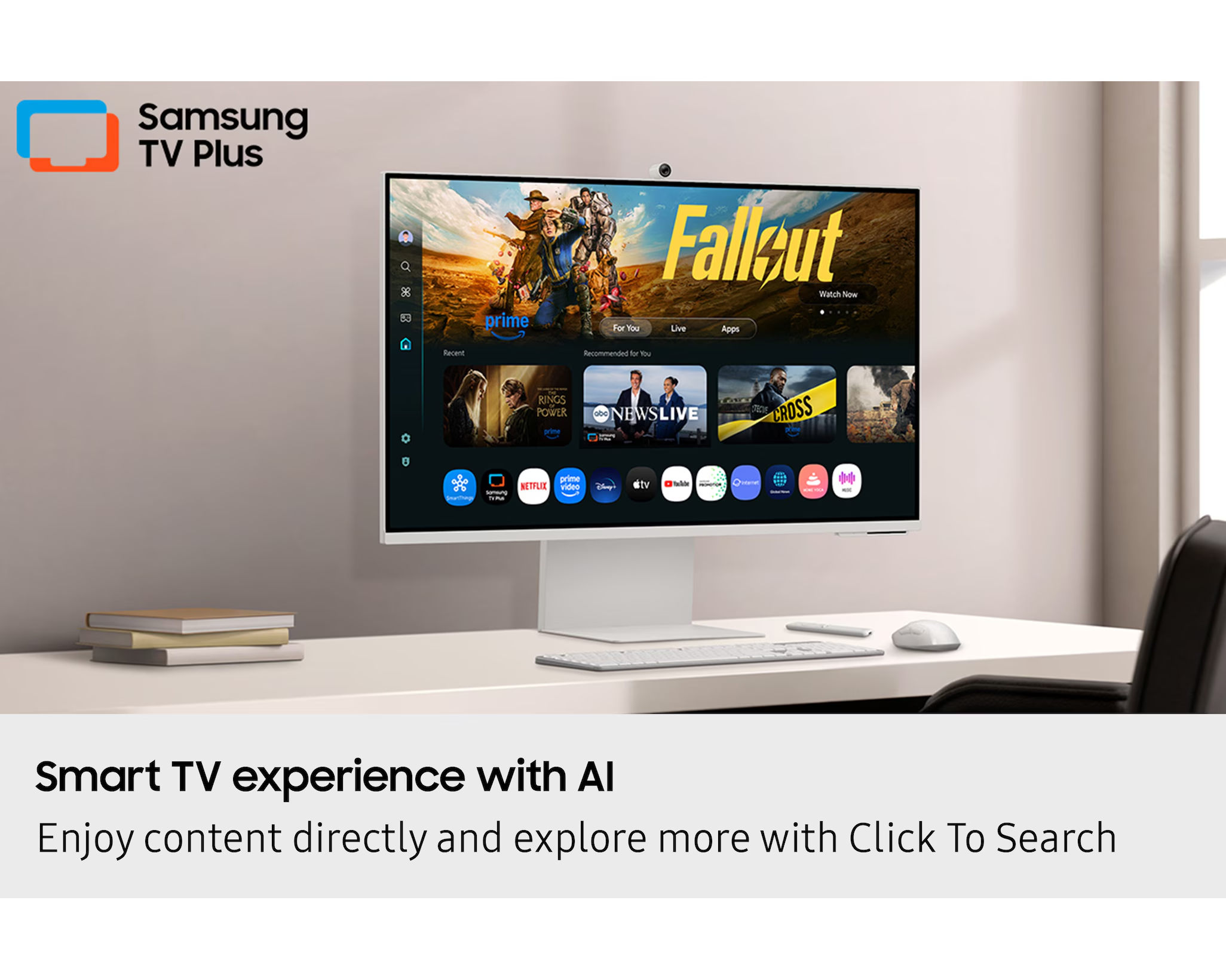
7. The Smart TV Experience
This is where the M8 becomes fundamentally different from a conventional 4K monitor.
Samsung’s Smart Monitor platform allows the display to operate independently for supported entertainment services and connected functions.
Instead of:
PC → Netflix
the architecture can become:
M8 → Smart platform → Streaming service
This means the PC does not have to remain switched on simply to watch entertainment.
The monitor effectively combines:
Desktop display + streaming device + television-style interface
in one unit.
Availability of specific apps and services varies by country, region and software version.
8. Monitor + TV: The Convergence
Historically, consumers generally needed two devices:
Computer Monitor
and
Television
The M8 belongs to a newer category where those two products increasingly overlap.
The same screen can be used for:
09:00 — Work
13:00 — Research
18:00 — Gaming
20:00 — Streaming
This is particularly attractive for:
- Bedrooms
- Apartments
- Dormitories
- Home offices
- Small living spaces
- Minimalist workstations
Instead of buying a monitor and a television separately, the user can build around one display
9. AI Changes the Smart Monitor Concept
The addition of AI is one of the most significant developments in newer M8 generations.
However, it is important to distinguish between several types of AI functionality.
AI Image Processing
The monitor may use intelligent processing to analyze incoming content and optimize aspects of the displayed image.
AI Upscaling
Lower-resolution content can potentially be processed to appear sharper or more detailed.
AI Recognition
Connected smart functions can use AI to identify or interpret content in supported scenarios.
AI Interaction
Some Samsung smart-monitor configurations integrate AI-assisted interaction and connected ecosystem functions.
The exact AI capabilities depend heavily on the specific M8 generation, model and region.
Therefore, an article should not treat “AI” as a single feature.
AI in a modern display can refer to:
Content analysis + image processing + smart interaction + connected services
10. AI Upscaling and Image Processing
One of the most interesting potential applications of AI in a 4K smart monitor is content processing.
Not all content is native 4K.
A streaming service might provide:
- 1080p
- 1440p
- 720p
while older video content can be even lower resolution.
An intelligent image-processing pipeline can analyze the incoming image and attempt to reconstruct missing detail.
Conceptually:
Low-resolution input
↓
Image analysis
↓
Edge/detail detection
↓
Texture reconstruction
↓
Noise processing
↓
4K output
This is not equivalent to receiving native 4K information.
AI upscaling is fundamentally an estimation process.
The processor is attempting to produce a visually convincing higher-resolution image from incomplete source data.
11. AI and the Connected Ecosystem
Samsung’s broader ecosystem is another important part of the M8 concept.
A smart monitor can act as a central screen within a connected environment involving:
- Smartphones
- Laptops
- Tablets
- Smart-home devices
- Bluetooth accessories
- Samsung ecosystem products
This changes the monitor’s role from:
Peripheral
to:
Connected computing endpoint
The distinction is subtle but important.
A traditional monitor is mostly dependent on its source device.
A smart monitor has its own software environment and network connectivity.
12. Connectivity Architecture
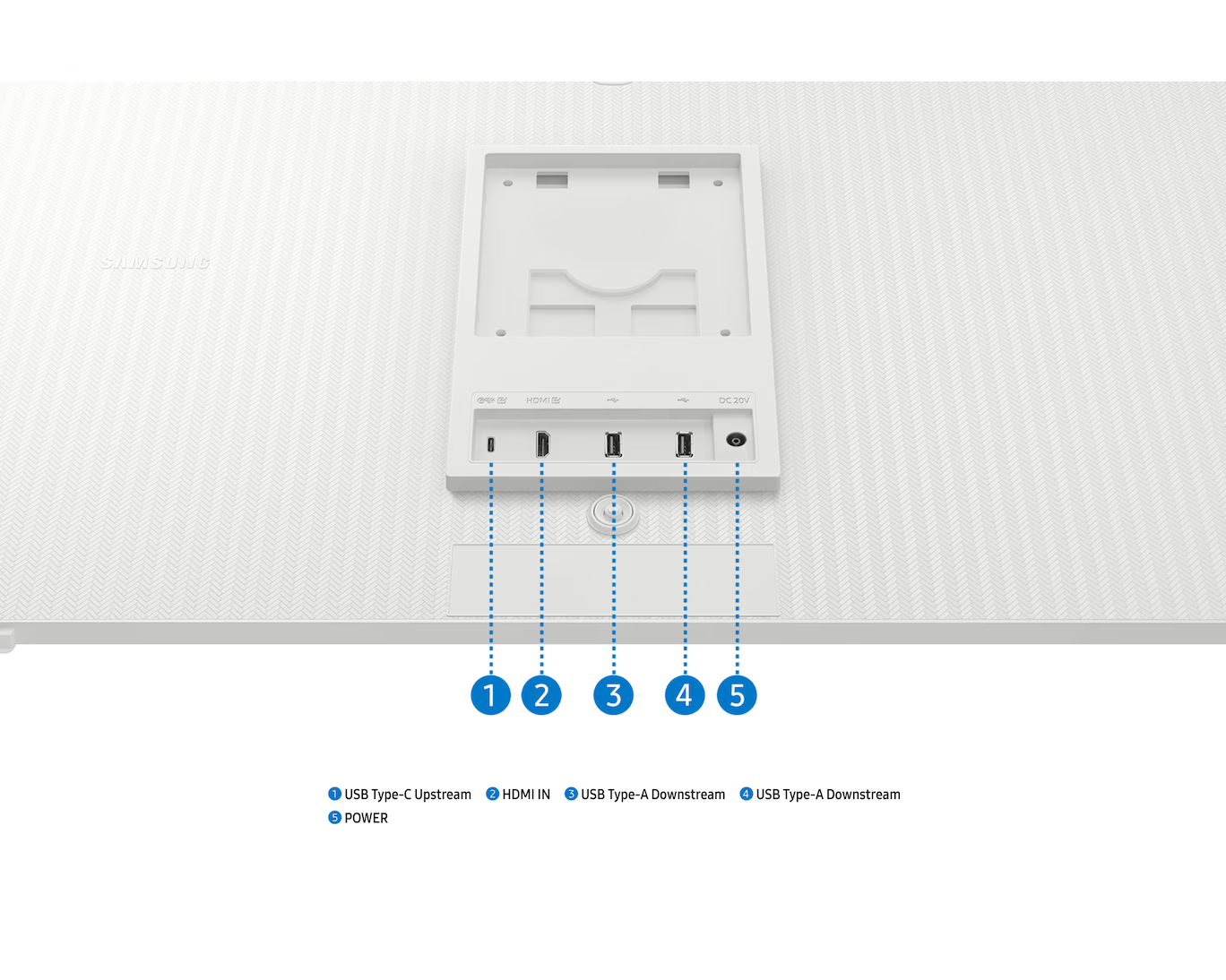
The M8 is designed to connect to multiple device types.
Depending on the exact generation, users may have access to combinations of:
- HDMI
- USB
- USB-C
- Display connectivity
- Wi-Fi
- Bluetooth
The USB-C functionality is particularly important for modern laptops.
A compatible USB-C connection can potentially consolidate:
Video + Data + Power
into a single cable.
That can transform the desktop experience.
Instead of:
Laptop → power cable
Laptop → display cable
Laptop → USB hub
users can potentially reduce the workstation to:
Laptop → One USB-C cable → M8
The exact power-delivery and USB capabilities must be checked against the specific model.
13. Wireless Connectivity
A smart monitor’s network connection is essential because the display itself can access online services.
Wi-Fi allows the smart platform to connect to:
- Streaming services
- Software services
- Cloud-connected functions
- Smart-home ecosystems
- Firmware updates
Bluetooth expands the peripheral ecosystem.
For example:
M8 + Bluetooth keyboard + Bluetooth mouse
can create a more television-like or lightweight computing setup.
14. Productivity Without a PC
One of the most interesting concepts in Smart Monitor technology is PC-less productivity.
Depending on supported features and services, users can access cloud-based workflows without relying entirely on a local desktop computer.
The architecture becomes:
Monitor
↓
Internet
↓
Cloud services
↓
Applications / Documents
This can be useful for users whose computing needs revolve around:
- Web applications
- Cloud documents
- Remote access
- Browser-based workflows
- Streaming
- The M8 therefore occupies a space between a conventional monitor and a lightweight all-in-one computer.
15. Remote and Cloud Computing
A smart monitor can also become an endpoint for remote computing.
Conceptually:
M8
↓
Network
↓
Remote PC / Cloud service
↓
Desktop environment
This allows the large 4K display to serve as the visual interface while processing occurs elsewhere.
For businesses and professionals, this architecture is increasingly relevant as computing moves toward cloud and hybrid environments.
16. The 16:9 Advantage
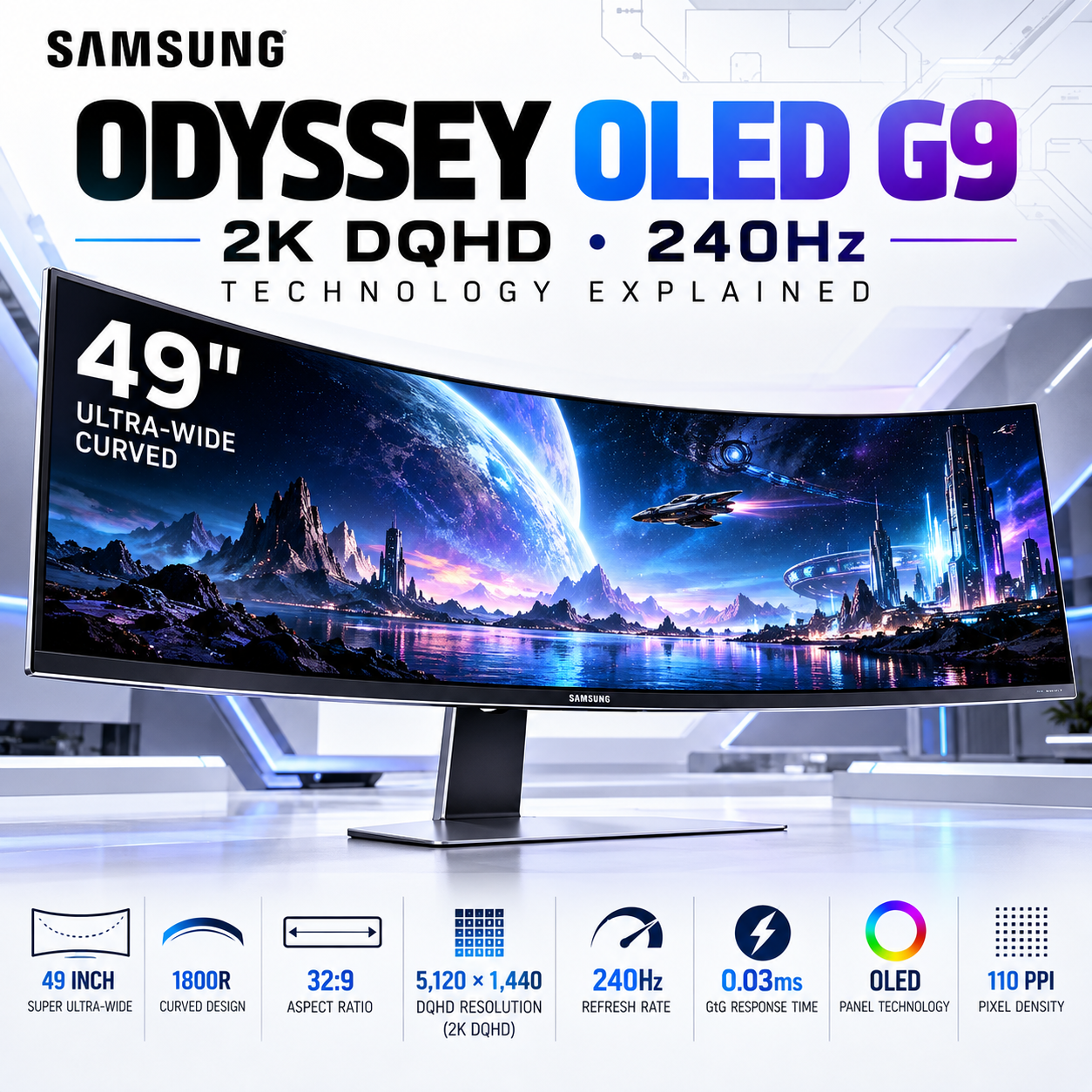
Unlike the 49-inch Odyssey OLED G9, the M8 uses the familiar:
16:9 aspect ratio
This matters because 16:9 is supported almost universally.
Games, movies, streaming services, websites and office applications are all designed around conventional widescreen formats.
That means the M8 doesn’t have the compatibility considerations associated with 32:9 ultrawide displays.
The result is a more universally compatible screen.
17. 4K for Content Creation
A 32-inch 4K screen is particularly useful for creators.
For photography, 4K provides a detailed canvas for:
- Image editing
- Color correction
- Cropping
- Retouching
- Asset management
For video editing, 4K allows the editor to see a high-resolution preview while maintaining workspace for:
Timeline + preview + editing controls
The actual suitability for professional color work depends on the exact panel characteristics, calibration, color gamut and workflow requirements.
A Smart Monitor should not automatically be considered a professional reference monitor simply because it is 4K.
18. Gaming
The M8 can also function as a gaming display.
Its 4K resolution provides high image detail, particularly for:
- Adventure games
- RPGs
- Strategy games
- Console gaming
- Cinematic titles
However, the M8’s design priorities differ from those of Samsung’s Odyssey gaming monitors.
The Odyssey OLED G9 prioritizes:
240Hz + OLED + 32:9 + gaming responsiveness
The M8 prioritizes:
4K + Smart TV + productivity + connected features
That distinction is important.
The M8 is essentially a multi-purpose smart display, rather than a specialist competitive gaming monitor.
19. Entertainment Architecture
The M8’s television functionality changes the way it can be integrated into a room.
A conventional monitor often requires:
PC + monitor + speakers + streaming device
The M8 can consolidate several of these functions.
This can reduce:
- Hardware
- Cables
- Desk clutter
- Number of devices
It also means the display can remain useful when the PC is turned off.
20. The Role of Speakers and Audio
Smart monitors need a different audio strategy from traditional displays.
Because the M8 can operate independently for entertainment, integrated audio becomes more important.
The display can function as the center of an entertainment system while supporting external audio devices where appropriate.
Users can therefore build:
M8 + Bluetooth audio
or
M8 + external sound system
depending on their requirements.
21. Design Philosophy
The M8 family has traditionally emphasized a relatively minimalist design.
That makes sense because the product is intended to live in multiple environments:
Office
Bedroom
Living room
Study
Creative workstation
The monitor therefore has to look less like a specialist gaming device and more like a piece of consumer electronics.
This is an important distinction from the aggressive styling of many gaming monitors.
22. The M8 vs a Conventional 32-inch 4K Monitor
| Capability | Conventional 32″ 4K Monitor | Samsung M8 |
|---|---|---|
| 4K resolution | Yes | Yes |
| PC connectivity | Yes | Yes |
| Smart TV experience | Usually no | Yes |
| Built-in smart platform | Usually no | Yes |
| Streaming without PC | Usually no | Yes |
| AI features | Usually limited | Supported features vary |
| Wi-Fi | Usually no | Yes |
| Bluetooth | Usually no | Yes |
| Productivity | Yes | Yes |
| Entertainment | External devices often needed | Integrated |
| Multi-purpose use | Moderate | High |
The distinction is therefore not simply picture quality.
It is functionality.
23. M8 vs Samsung Odyssey OLED G9
The two products represent almost opposite display philosophies.
| Technology | M8 32″ | Odyssey OLED G9 49″ |
|---|---|---|
| Primary role | Smart productivity | High-end gaming |
| Resolution | 3,840 × 2,160 | 5,120 × 1,440 |
| Aspect ratio | 16:9 | 32:9 |
| Display technology | UHD smart display | OLED gaming display |
| Smart TV experience | Yes | Model dependent |
| AI | Yes, model dependent | Model dependent |
| Refresh-rate focus | General-purpose | High-refresh gaming |
| Productivity | Strong | Very strong |
| Gaming | General | Specialist |
| Entertainment | Strong | Strong |
| Physical size | 32″ | 49″ |
This comparison demonstrates why screen specifications alone cannot describe a modern monitor.
The M8 and G9 solve different problems.
24. The M8 as a Convergence Device
The deeper technological significance of the M8 is convergence.
Several historically separate product categories are merging:
Monitor
Television
Streaming Device
Thin Client
Smart-Home Interface
AI-enabled Display
The M8 sits at the intersection of these technologies.
That is arguably more important than any individual specification.
25. The Future of Smart Monitors
The direction of the market suggests that displays will increasingly become independent computing endpoints.
Future smart monitors can potentially incorporate:
- More advanced AI processors
- Better on-device AI
- Cloud AI services
- Intelligent image enhancement
- Voice interaction
- Personalized interfaces
- Smart-home control
- More powerful cloud computing
- Better wireless connectivity
- Advanced device integration
The display could eventually become less dependent on a traditional PC.
The architecture could become:
User
↓
AI-enabled display
↓
Cloud + local compute + connected devices
That is a fundamentally different model from the conventional monitor.
26. What the 32-inch M8 Gets Right Conceptually
The strongest idea behind the M8 is simplicity.
Instead of asking the user to assemble:
Monitor + TV + streaming stick + speakers + wireless connectivity + smart ecosystem
the M8 attempts to consolidate much of that experience into one device.
For a modern home office, this can be extremely practical.
During working hours:
4K monitor
After work:
Smart TV
For cloud workflows:
Connected computing endpoint
For smart-home interaction:
Smart display
That versatility is the central proposition.
27. Limitations to Consider
The M8’s versatility does not mean it replaces every specialist display.
A professional colorist may want a dedicated reference display.
A competitive gamer may want a high-refresh OLED gaming monitor.
A workstation user may prefer a 49-inch ultrawide.
A home-theater enthusiast may prefer a much larger television.
The M8 instead targets the space between these categories.
Its strength is breadth of functionality
28. Final Analysis
The Samsung 80 cm (32-inch) M8 UHD 4K AI Smart Monitor represents the evolution of the monitor from a passive PC peripheral into a connected computing and entertainment platform.
Its 3,840 × 2,160 UHD resolution provides a high-density 32-inch workspace, while its Smart Monitor architecture allows the screen to operate beyond the traditional PC-display model. AI-enabled functionality adds another layer, potentially covering intelligent image processing, smart interaction and connected experiences depending on the exact generation and region.
The most important aspect of the M8, however, is not simply 4K or AI.
It is the convergence of technologies:
4K Display
Smart TV Experience
AI
Internet Connectivity
PC Productivity
Entertainment
Connected Devices
That combination transforms the M8 from a conventional computer monitor into something closer to a digital hub for the modern desktop and living space.
Where specialist displays such as Samsung’s Odyssey OLED G9 are designed to maximize immersion and gaming performance, the M8 takes a different approach: one screen designed to perform several roles without requiring the user to switch between separate devices.
And that is ultimately the technological story of the Samsung M8: the future of displays may not be defined simply by how many pixels a screen can show, but by how much computing, intelligence and connectivity can be built around those pixels.
Samsung 32-inch M8: Full Specifications
1. Basic Information
| Specification | Details |
|---|---|
| Brand | Samsung |
| Product | Smart Monitor M8 |
| Model | M80F |
| Model Number | LS32FM801UWXXL |
| Product Category | Smart Monitor |
| Screen Size | 80 cm (32 inches) |
| Launch Date | July 7, 2025 |
| Country of Origin | Vietnam |
| Color | Warm White |
| Operating System | Tizen™ |
Samsung’s current India page identifies this specific M8 as the 80 cm (32-inch) M8 UHD 4K AI Smart Monitor with Smart TV experience.
2. Display Specifications
| Specification | Details |
|---|---|
| Screen Size | 32 inches / 80 cm |
| Panel Type | VA |
| Display Shape | Flat |
| Aspect Ratio | 16:9 |
| Resolution | 3,840 × 2,160 |
| Resolution Type | UHD 4K |
| Pixel Density | Approx. 138 PPI |
| Refresh Rate | 60Hz |
| Response Time | 4ms (GTG) |
| Typical Brightness | 400 cd/m² |
| Minimum Brightness | 300 cd/m² |
| Static Contrast Ratio | 3,000:1 |
| Viewing Angle | 178° / 178° |
| Colour Support | Max 1 billion colors |
| sRGB Coverage | 99% (CIE1931) |
| HDR | HDR10 |
| HDR10+ | Certified |
| Factory Tuning | Yes |
| Adaptive Picture | Yes |
| Eye Saver Mode | Yes |
| Flicker Free | Yes |
| Image Size | Yes |
Samsung specifies a VA panel, 3,840 × 2,160 resolution, 60Hz refresh rate, 4ms GTG response time, 400 cd/m² typical brightness, 3,000:1 static contrast and up to 1 billion colors for this model.
3. Smart Monitor / Smart TV Platform
| Feature | Details |
|---|---|
| Smart Platform | Samsung Smart TV experience |
| Operating System | Tizen™ |
| Smart Monitor | Yes |
| Smart TV Apps | Yes |
| Samsung TV Plus | Yes |
| Universal Guide | Yes |
| Streaming Services | Supported |
| Bixby | Yes |
| Far-Field Voice Interaction | Yes |
| Alexa Built-in | Yes |
| SmartThings Hub | Yes |
| Remote Access | Yes |
| Multi View | Up to 2 videos |
| Smart Calibration | Basic |
| Knox Vault | Yes |
Samsung notes that smart services and app availability can vary by country and region, and network-based smart features require an internet connection and Samsung Account.
4. AI Features
The current M8 belongs to Samsung’s AI-enabled Smart Monitor generation.
| AI / Intelligent Feature | Availability |
|---|---|
| AI Smart Monitor functionality | Yes |
| AI-enabled display processing | Supported |
| AI-related Smart features | Model/region dependent |
| 4K AI Upscaling | M8 family feature; verify exact mode/SKU |
| Intelligent picture features | Yes |
| Adaptive Picture | Yes |
Samsung’s 2025 Smart Monitor lineup identifies the M8 as supporting 4K AI Upscaling, alongside Smart TV apps and Copilot integration.
Important editorial distinction: don’t list every AI feature from Samsung’s M9 or older M8 generations as though it necessarily belongs to this exact LS32FM801UWXXL SKU.
5. Gaming Features
| Feature | Details |
|---|---|
| Maximum Refresh Rate | 60Hz |
| Response Time | 4ms GTG |
| Virtual AIM Point | Yes |
| Game Bar | Game Bar 2.0 |
| Ultrawide Game View | Yes |
| Adaptive Picture | Yes |
| HDR | HDR10 / HDR10+ |
| HDMI-CEC | Yes |
| Auto Source Switch | Auto Source Switch+ |
| Windows Certification | Windows 11 |
The M8 is therefore a general-purpose 4K Smart Monitor, rather than a high-refresh competitive gaming monitor like Samsung’s Odyssey OLED G9. Samsung specifically lists Game Bar 2.0, Virtual AIM Point and Ultrawide Game View among the M8’s gaming-related features.
6. Connectivity
| Connection | Specification |
|---|---|
| HDMI | 1 × |
| HDMI Version | HDMI 2.0 |
| HDCP — HDMI | 2.2 |
| USB Hub | 2 × |
| USB Hub Version | USB 2.0 |
| USB-C | 1 × |
| USB-C Power Delivery | Up to 65W |
| HDCP — USB-C | 2.2 |
| Wi-Fi | Wi-Fi 5 |
| Bluetooth | Bluetooth 5.2 |
| Wireless Display | Yes |
| HDMI-CEC | Yes |
| Auto Source Switch | Auto Source Switch+ |
The 65W USB-C power delivery is particularly important for laptop users because a compatible laptop can potentially use a single USB-C connection for display, data and charging.
7. Wireless & Multi-Device Features
| Feature | Details |
|---|---|
| Wi-Fi | Wi-Fi 5 |
| Bluetooth | 5.2 |
| Wireless Display | Yes |
| Mobile-to-Screen | Yes |
| Screen Mirroring | Yes |
| Sound Mirroring | Yes |
| Wireless On | Yes |
| Tap View | Yes |
| Multi View | Up to 2 videos |
| SmartThings | Built-in |
| Remote Access | Yes |
These features allow the M8 to function beyond a traditional wired monitor and integrate with supported Samsung/mobile devices.
8. Audio
| Specification | Details |
|---|---|
| Built-in Speaker | Yes |
| Speaker Output | 10W |
| Audio Technology | Adaptive Sound Pro |
| Smart Audio Features | Supported |
The current Samsung India specification lists 10W speaker output and Adaptive Sound Pro.
9. Physical Design
| Specification | Details |
|---|---|
| Front Color | Warm White |
| Rear Color | Warm White |
| Stand Color | Warm White |
| Design | Slim |
| Screen | Flat |
| Stand Type | Height Adjustable Stand |
| Height Adjustment | 120 ± 5 mm |
| Tilt | -2° ±2° to 15° ±2° |
| Pivot | -92° ±2° to 92° ±2° |
| VESA Mount | 100 × 100 mm |
The M8’s stand provides height adjustment, tilt and pivot, giving it considerably more ergonomic flexibility than a basic fixed-stand monitor.
10. Dimensions
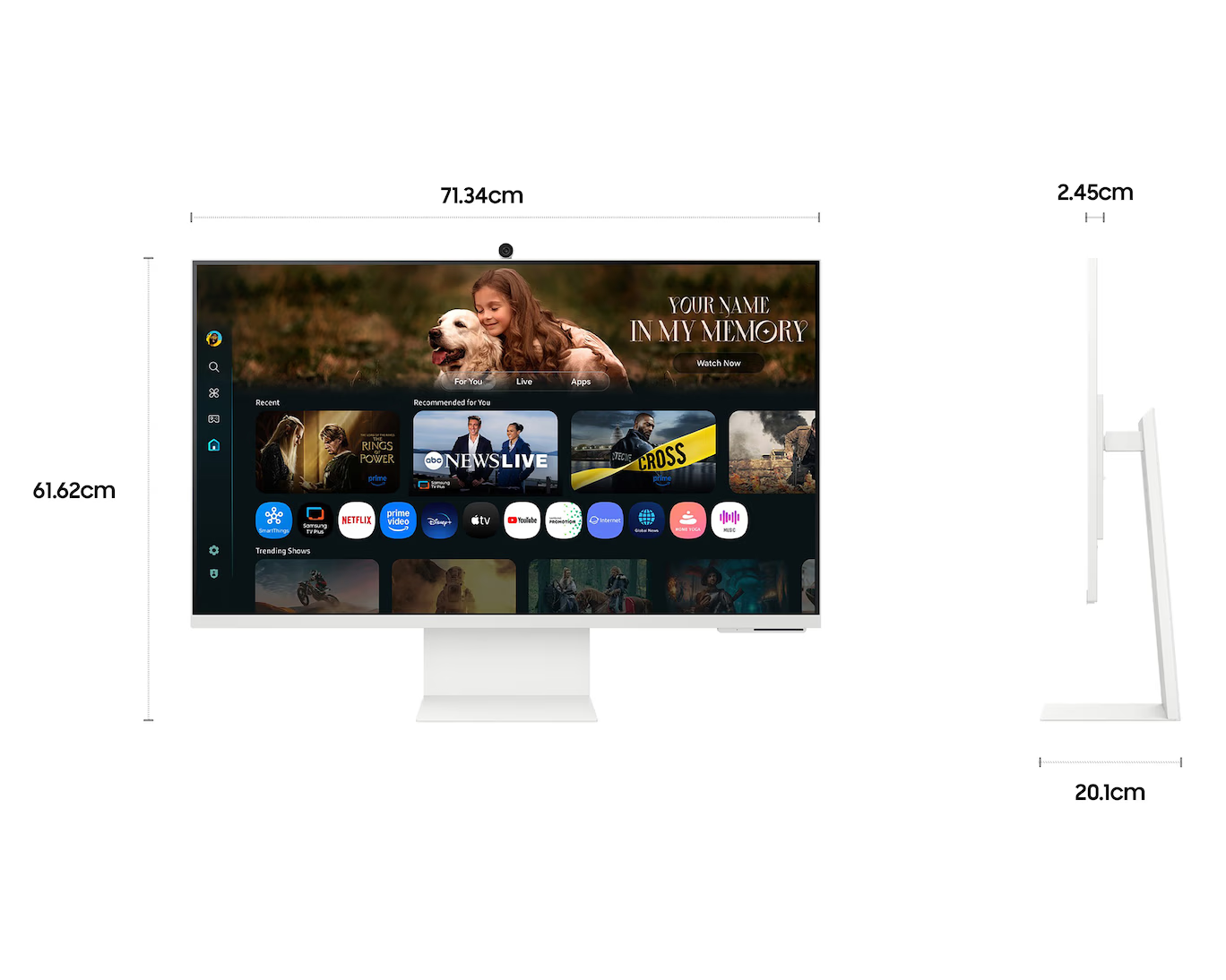
With Stand
713.4 × 616.2 × 200.1 mm
or approximately:
71.34 × 61.62 × 20.01 cm
Without Stand
713.4 × 423.8 × 24.5 mm
or approximately:
71.34 × 42.38 × 2.45 cm
Packaging
909.0 × 122.0 × 483.0 mm
or approximately:
90.9 × 12.2 × 48.3 cm
Samsung provides these dimensions for the current India SKU.
11. Weight
| Configuration | Weight |
|---|---|
| Monitor + Stand | 7.0 kg |
| Monitor without Stand | 4.0 kg |
| Package | 10.5 kg |
12. Power
| Specification | Details |
|---|---|
| Power Supply | AC 100–240V |
| Power Supply Type | External Adapter |
| Maximum Power Consumption | 140W |
13. Operating Environment
| Specification | Details |
|---|---|
| Operating Temperature | 10°C–40°C |
| Operating Humidity | 10%–80% |
| Humidity Condition | Non-condensing |
14. Security & Smart Protection
| Feature | Details |
|---|---|
| Knox Vault | Yes |
| Samsung SmartThings | Yes |
| Smart Platform Security | Supported |
| Remote Access | Yes |
| Samsung Account | Required for full smart functionality |
Samsung specifically lists Knox Vault among the M8’s general smart features.
15. Productivity Features
| Feature | Details |
|---|---|
| PC Productivity | Yes |
| Remote Access | Yes |
| Wireless Display | Yes |
| Multi View | Up to 2 videos |
| Mobile-to-Screen | Yes |
| Screen Mirroring | Yes |
| Smart TV Apps | Yes |
| SmartThings | Yes |
| USB-C Laptop Connectivity | Yes |
| USB-C Charging | Up to 65W |
16. Compatibility
| Platform / Technology | Support |
|---|---|
| Windows 11 | Certified |
| USB-C Devices | Supported |
| Samsung Mobile Devices | Supported features |
| Wireless Display | Yes |
| HDMI Devices | Yes |
| Bluetooth Devices | Yes |
| Smart TV Services | Yes |
| SmartThings Ecosystem | Yes |
Actual compatibility can vary according to the connected device, operating system and application.
17. Core Specification Summary
| Category | Samsung M8 M80F |
|---|---|
| Model | LS32FM801UWXXL |
| Size | 32-inch / 80 cm |
| Panel | VA |
| Resolution | 3,840 × 2,160 4K UHD |
| Aspect Ratio | 16:9 |
| Refresh Rate | 60Hz |
| Response Time | 4ms GTG |
| Brightness | 400 cd/m² typical |
| Contrast | 3,000:1 |
| HDR | HDR10 / HDR10+ Certified |
| Color | Up to 1B colors |
| sRGB | 99% |
| OS | Tizen |
| Smart TV | Yes |
| AI | Yes / model-specific features |
| Wi-Fi | Wi-Fi 5 |
| Bluetooth | 5.2 |
| USB-C | 1 ×, up to 65W |
| HDMI | 1 × HDMI 2.0 |
| USB Hub | 2 × USB 2.0 |
| Speakers | 10W |
| VESA | 100 × 100 mm |
| Weight | 7.0 kg with stand |
| Color | Warm White |